Water Wise Landscaping in Utah: Plan, Plants and Rebates
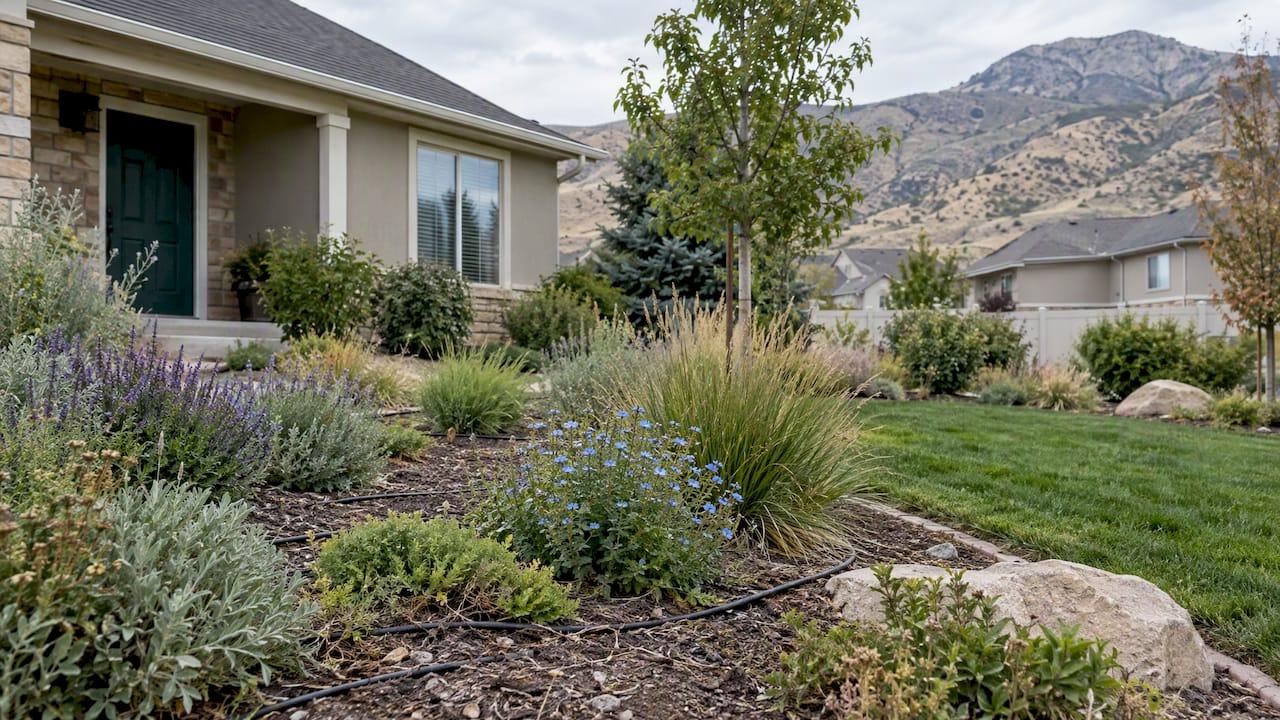
A water wise yard in Utah is one where the plants, soil, and irrigation are matched to a high-desert climate, so the landscape stays green and attractive on far less water. The order of work matters more than the plant list. Plan the layout and irrigation zones first, check the state rebate rules before you remove any grass, then plant and install drip. Do it in the wrong order and you can lose the incentive or kill the plants you just bought.
This guide covers what the state programs require, how to design the yard, which plants work, and how to scope the project so quotes are comparable.
TL;DR
- Utah’s statewide Landscape Incentive Program pays up to $3 per square foot of living, maintained lawn you replace. Confirm your city’s current rate and eligibility before you start.
- Do not remove or kill the lawn until your application is approved and the pre-conversion site visit is done. Doing it early makes you ineligible.
- Group plants by water need (hydrozoning) and put them on a separate low-volume drip zone.
- Water wise does not mean rock and cactus. Utah’s plant lists include trees, shrubs, perennials, and native grasses.
- Measure the project on a map first. Exact square footage drives your rebate, your plant count, and your quotes.
Table of Contents
- Why Utah yards are the place to save water
- Check the Landscape Incentive Program before you touch the lawn
- Design the yard before you buy plants
- Plants that work in Utah
- Irrigation: the part that makes or breaks it
- Where Utah homeowners go wrong
- Perspective: measure first, then everything else follows
- Step by step: a Utah lawn conversion
- Get a site-specific estimate for the work
- What does a water wise yard cost in Utah?
- FAQ
- Sources
Why Utah yards are the place to save water
Outdoor watering is where Utah households have the most room to cut. The Utah Division of Water Resources reports that residential landscapes use roughly 60% of the municipal water delivered to households, and that improving irrigation efficiency can cut a typical household’s total water use by up to 40%. USU Extension puts urban landscape irrigation at 50 to 65% of annual municipal water use, much of it applied beyond what plants need.
That is why the state pays people to change their yards. A lawn that is replaced with the right plants and drip irrigation keeps saving water every year after the rebate check clears.

Check the Landscape Incentive Program before you touch the lawn
Utah launched the first statewide water-wise landscaping incentive program in the nation in 2023. As of 2026, the Utah Water Savers program page lists up to $3 per square foot for living lawn replaced with water-efficient landscaping. The program’s detailed guidelines page has shown a different per-square-foot figure and a funding cap per application, so read the current guidelines and your city’s eligibility before you budget around a number.
Funds are available only in locations that have adopted qualifying landscape ordinances, so start with the list of eligible cities.
The rules that trip people up
- Wait for approval. The program mandates a pre-conversion site inspection. If you remove or kill the grass before the technician verifies that it was living and maintained, you are ineligible, however good the new design is.
- Minimum size. The project area generally must be at least 200 square feet. Exceptions can apply to isolated areas such as park strips.
- Time limit. Projects must be completed within 365 days of approval.
- Plant cover. Official guidelines call for at least 50% canopy cover at maturity from water wise perennials or shrubs. A bed of rock or mulch does not qualify on its own.
- Drip irrigation. Installation rules require low-volume drip, and you cannot return the converted area to lawn once the incentive is paid.
- Weed barrier. Landscape fabric that does not let water and air through can cause problems. Verify permeability before you buy it.
- Timing of payment. Payments are mailed about 90 days after final inspection and complete paperwork, including a W-9.
These details can change, so treat the Utah Water Savers pages as the final word and keep your approval email until the check arrives.
Design the yard before you buy plants
A landscape design helps you decide where, when, and how you use water and should reflect the site’s existing conditions. In practice, that means walking the yard and noting a few things:
- Sun and shade. South and west exposures bake in July. East and north sides hold moisture longer.
- Slope and drainage. Water runs off hardpan and slopes quickly. Low spots stay wet.
- Soil. Many Utah soils are heavy clay or alkaline. Some, especially in southern Utah, are sandy or rocky. Know what you have before choosing plants.
- Use. Where do kids play, where do you walk, where do you want shade? Keep a small functional lawn only where people will actually use it.
- Hardscape. Patios, paths, and retaining walls shape where the water goes.
Hydrozoning: the foundation
USU Extension’s principles of water wise landscaping put hydrozoning at the center: group plants with similar water needs in the same area. Utah’s homeowner guidance says landscapes are healthiest when plants are organized by water need and sit on the same irrigation zone.
The common mistake is mixing a drought-tolerant shrub into a lawn zone. The shrub drowns, or the lawn gets starved to protect it. A simple three-zone plan works for most yards:
| Zone | What goes there | Watering approach |
|---|---|---|
| High use | Small lawn, vegetable beds, container plantings | Spray or rotor on its own valve, smart controller |
| Moderate | Perennials, ornamental grasses, young trees | Drip on a dedicated valve |
| Low | Established natives, xeric shrubs, far edges | Drip, minimal supplemental water once established |
Plants that work in Utah
A common misconception is that water wise means rock and cactus. USU’s water wise plant list for Utah landscapes includes ornamental trees, shrubs, perennials, and native grasses adapted to the arid high desert and its cold winters. As the Heber Valley guide in the search results also stresses, a water wise garden can be lush and attractive.

The state’s Waterwise Plant List application, announced in 2025, lets you enter your address to see plants suited to your USDA Plant Hardiness Zone. Use it as your shopping list. Utah spans a wide range of elevations, so a plant that thrives in St. George may freeze out in Park City.
If you want more ideas for color, texture, and structure, browse drought-tolerant plant ideas and then check each pick against your Utah hardiness zone and the state list before you buy.
Design tips that make it look intentional
- Plant in drifts of three to seven rather than single specimens.
- Mix evergreen structure with seasonal bloom and grasses for movement.
- Use mulch to cover bare soil between plants, and keep it away from stems.
- Leave room for mature size. The canopy requirement is measured at maturity, so a young yard will look sparse for a couple of seasons.
- Add hardscape such as paths, gravel seating areas, and boulders for form, not as a replacement for plants.
Irrigation: the part that makes or breaks it
On a rebate project, drip is not optional. It is also the best way to water new plants. Utah’s guidance recommends a dedicated, low-volume drip system on its own valve for the new plants, separate from any remaining lawn zone.
A few practical points:
- Convert, don’t just cap. Retrofit old spray heads to drip or cap them off properly, and make sure no spray reaches the new bed.
- Match emitters to plants. Trees need more emitters, spread outward as they grow. Perennials need fewer.
- Adjust by season. The Division of Water Resources warns that water wise landscaping is a living system, not set and forget. Even drought-tolerant plants need monitoring during the first seasons while roots establish, and controllers should be changed with the weather instead of running one summer schedule all year.
- Stop overspray. Water that lands on pavement is wasted, and USU notes that overspray causes substantial losses.
Where Utah homeowners go wrong
- Removing the grass first. The most expensive mistake, because it can erase the rebate.
- Rock everywhere. Gravel with a few shrubs fails the canopy requirement and runs hot in summer.
- One irrigation zone for everything. Plants die or water is wasted.
- Cheap fabric. Non-permeable barriers choke soil and can cause issues with the program.
- Guessing the area. Tape-measuring a curved yard is how people end up with the wrong plant count and a rebate application that does not match the final job.
Perspective: measure first, then everything else follows
We see the same pattern in outdoor projects of every kind. People ask for a price before they know the dimensions, then get a range so wide it tells them nothing. Water wise conversions are especially prone to this, because square footage sets the rebate, the plant count, the mulch volume, the drip line length, and the labor, all at once.
Our advice is to draw the yard before you call anyone. Outline the lawn you plan to convert, mark the paths, patios, and beds you want to keep, and note where a retaining wall or new concrete pad will change drainage. If the conversion includes hardscape, plan those pieces together, since drainage from a wall or slab affects which plants will survive nearby. Our guides on lawn alternatives for drought and planning a backyard layout on a map walk through that process.
Then write down the scope. A contractor can only quote what is on paper, and a vague scope is the main reason bids for the same yard come back thousands of dollars apart. What a landscaping scope of work should include is a good checklist: removal, soil prep, plants, irrigation, mulch, cleanup, and who handles the rebate paperwork.
Finally, treat the rebate as a bonus, not the plan. Design the yard you want to live with, then see how well it fits the program rules.
— Christian
Step by step: a Utah lawn conversion
- Check eligibility. Confirm your city is on the eligible list and read the current incentive terms.
- Measure and sketch. Get the exact square footage of living lawn, plus the areas you want to keep.
- Apply and wait. Submit your application and plan. Keep watering the lawn so it stays living and maintained.
- Pass the pre-conversion visit. Only after approval and the signed participation agreement do you remove grass.
- Prep and install. Remove sod, amend soil as needed, set irrigation zones, plant, mulch.
- Finish inside 365 days. Then request the final inspection and submit paperwork, including the W-9.
- Maintain. Adjust the controller each season, and watch new plants closely for the first couple of years.
Get a site-specific estimate for the work
Once your yard is measured, you can price the pieces. Our map-based estimators let you draw the exact area on aerial imagery, see locally adjusted planning ranges, and send contractors a scope packet with drawings, measurements, and photos. No account is required to start. If your conversion includes a new patio, walkway, or pad, try the Utah concrete estimator, or start a local project report for the whole yard. If a wall is part of the plan, our guide to retaining wall drainage explains what to map before you buy filter fabric.
What does a water wise yard cost in Utah?
Costs vary by yard size, access, soil, plant sizes, and how much hardscape you add, so we will not quote a single number. Break the budget into lines: sod removal and disposal, soil prep, plants, drip system, mulch or gravel, any hardscape, and labor. Then subtract the rebate you expect, bearing in mind that it is paid roughly 90 days after final inspection, so you front the cost. Mapping the area first gives each contractor the same measurements to price against.
FAQ
Can I get paid to remove my lawn in Utah?
Yes, if your city is eligible. The statewide Landscape Incentive Program lists up to $3 per square foot for living, maintained lawn replaced with water-efficient landscaping. You must apply and be approved before removing any grass.
How much of my yard has to be plants?
Program guidelines call for at least 50% canopy cover from water wise perennials or shrubs at maturity. Rock or mulch alone does not meet that requirement, and the rest of the area is typically mulched or covered with other approved materials.
Do I need drip irrigation?
For the incentive, yes: low-volume drip is required, ideally on its own valve. Even without a rebate, drip on a separate zone is the best way to avoid overwatering drought-tolerant plants that share a yard with lawn.
Do water wise plants need any water?
They do. New plants need regular watering and monitoring while roots establish, usually the first few seasons. After that, they need far less, but you should still adjust irrigation seasonally.
Sources
- Utah Water Savers: Landscape Incentive Program
- Division of Water Resources Landscape Incentive Program details
- Utah launches statewide water-wise landscaping incentive program
- Utah Homeowner Landscape Resources (PDF)
- Principles of Water Wise Landscaping, USU Extension
- How to Irrigate Efficiently, USU Extension
- Designing a Low Water Use Landscape, USU Extension
- Water wise plants for Utah landscapes, USU Extension
- Make every drop count: new waterwise tools for homeowners