What a Landscaping Scope of Work Should Actually Include
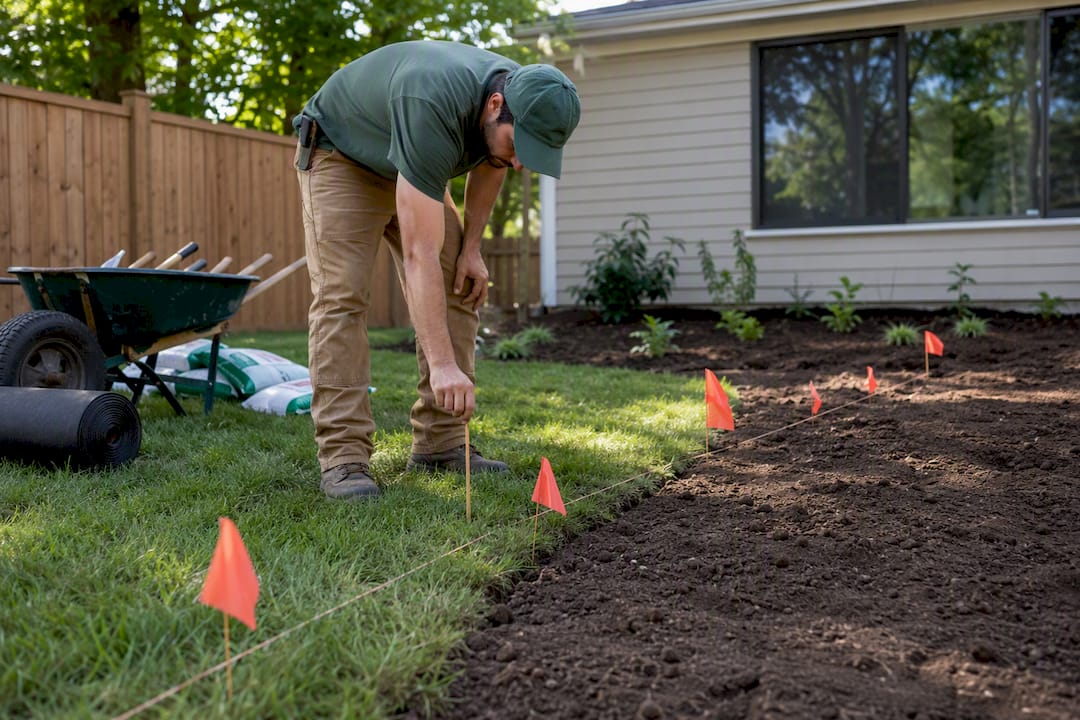
A landscaping scope of work is the line-item document that spells out exactly what gets built, what materials get used, and how you’ll know the job is done right. It’s the difference between a lower patio quote and a much higher one for the “same” project. Every solid landscaping scope of work covers project overview, plant schedule, hardscape specs, irrigation details, site prep, timeline, permits, exclusions, and warranty terms.
Before you sign anything, take one action: attach a dimensioned site plan or drawing to the proposal and require the contractor to return an itemized scope of landscaping services, not a lump-sum number. That single step forces specificity into every section below.
A complete landscaping scope of work template should include:
- Project overview with area breakdowns
- Plant schedule with botanical names and container sizes
- Hardscape material and assembly specifications
- Irrigation zones and equipment details
- Site prep, grading, and soil work
- Timeline with milestone triggers
- Permit and HOA responsibility assignments
- Written exclusions and change-order process
- Warranty terms and acceptance criteria
Key Takeaways
A landscaping scope of work reduces bid variance and disputes only when it replaces vague task names with measurable specifications for materials, dimensions, and acceptance standards.
| Point | Details |
|---|---|
| Define scope boundaries first | Break the project into named zones with square footage before listing any tasks. |
| Specify plant details fully | Include botanical name, container size, quantity, spacing, and a substitution policy for every plant line. |
| Measure hardscape assemblies | Record base depth in inches, material grade, and joint fill method to prevent settling disputes. |
| Assign permit and exclusion responsibility | State in writing who pulls permits and what work is explicitly not included. |
| Attach a dimensioned plan | Use a tool like Propertyimprovementestimator to export exact quantities and locations to attach to any scope document. |
Table of Contents
- Setting the Project Overview and Scope Boundaries
- What Belongs in a Landscaping Plant Schedule
- Hardscape Specs That Prevent Callback Disputes
- How to Scope Irrigation Zones and Underground Utilities
- Site Preparation, Grading, and Soil Work
- Building a Realistic Timeline With Milestones
- Permits, Warranties, and Acceptance Standards
- Exclusions and the Change-Order Process
- Copy This Scope Template and Audit Checklist
- Common Mistakes That Sink a Landscaping Scope
- How Precise Scopes Cut Bid Variance and Disputes
- Who Does What: Contractor, Subcontractor, and Client Roles
- Quality Control: Inspections, Milestones, and Documentation
- Safety Practices and Erosion Control on the Job Site
- Why Specificity Beats Trust in Every Landscaping Contract
- Turn Your Property Plan Into an SOW-Ready Package
- Sources
Setting the Project Overview and Scope Boundaries
The overview section is where most landscaping contract details fall apart before the project even starts. Vague language here (“landscape the backyard”) gives every downstream contractor room to interpret the job differently, and that’s exactly how three bids for one property come back $8,000 apart.
Write the overview so a stranger could walk the property and know precisely where work starts and stops. Break the project into named zones (front bed, side yard, rear patio) and assign approximate square footage to each. Reference the design plan by author and date, and state clearly whether the client or the landscape company owns the final design file.
A strong overview section includes:
- Project type and classification (new install, renovation, or maintenance conversion)
- Square footage or linear footage for each distinct work zone
- Named designer or plan reference, with revision date
- Objectives stated as outcomes (“establish full turf coverage by month three”), not vague intentions
- A sign-off field where both parties initial the final scope before work begins
That last point matters more than it looks. Once scope, price, and signatures appear together, the proposal often functions as a binding contract, according to Altitude Law’s landscape contracts guidance, which means the wording in your overview carries real legal weight if a dispute ever reaches a lawyer.
What Belongs in a Landscaping Plant Schedule
The plant schedule is one of the two sections most commonly at the center of landscaping disputes, alongside hardscape base specifications, according to a contractor scope of work template guide. The reason is simple: “medium shrubs” and “large trees” mean wildly different things to different suppliers, and price swings hard depending on what shows up on the truck.
A defensible plant schedule needs these fields for every species listed:
- Botanical name and cultivar (not just common name)
- Container size (1 gallon, 5 gallon, 15 gallon, or B&B with caliper size for trees)
- Quantity and on-center spacing
- Substitution policy, naming acceptable alternates if the specified cultivar is unavailable
- Delivery condition (root-bound rejection standard, healthy foliage requirement)
- Installation tolerance (depth relative to root flare, mulch ring diameter)
An example line item looks like this: “Ilex crenata ‘Sky Pencil’, 5-gallon container, quantity 12, spaced 30 inches on center, no substitutions without written approval.” That single line prevents a contractor from swapping in a cheaper dwarf variety and calling it equivalent.
Pro Tip: Ask for a photo of the actual nursery stock before installation day, especially for specimen trees or unusual cultivars. A five-minute phone photo saves a return trip when the delivered plant doesn’t match what you pictured.

Hardscape Specs That Prevent Callback Disputes
Vague hardscape language causes more litigation risk than almost any other section of a landscaping project outline. “Install patio” tells an estimator nothing about base depth, drainage, or how joints get filled, which means the bid that comes back could reflect a 4 inch gravel base or a corner-cutting 2 inch one.
Every hardscape line item should record:
- Material brand, grade, and color, plus finish (natural cleft, tumbled, sandblasted)
- Base assembly depth in inches (compacted aggregate, sand bedding layer, geotextile fabric if used)
- Edge restraint type (aluminum, plastic, concrete curb) and anchoring method
- Drainage slope expressed as a percentage or inches of fall per foot, away from structures
- Joint width and fill material (polymeric sand, mortar, open joint)
- Acceptance criteria for settling (maximum allowable deflection after one freeze-thaw cycle) and joint consistency
Specificity here is what separates an enforceable scope from a shrug-and-argue situation later. The Landscaping Audit Authority frames it as a five-component test: task name, method, material specification, equipment, and acceptance standard. If any hardscape line item is missing one of those five, push back before signing.
How to Scope Irrigation Zones and Underground Utilities
Irrigation is where a landscaping scope of work either shows real engineering thought or becomes a guess. Zone count, head type, and pipe sizing all drive both material cost and labor hours, so an estimator who gets vague zone descriptions has to price in a margin of uncertainty, and that margin comes out of your pocket.
Scope every irrigation zone with:
- Controller model and total number of zones it manages
- Head type per zone (rotor, spray, drip) matched to plant water needs
- GPM and precipitation rate notes so flow doesn’t overload the water supply
- Mainline and lateral pipe sizing (typically 1 inch mainline, 3/4 inch laterals, though this varies by property)
- Backflow prevention device type and required inspection
- A utility locate requirement (call 811 before digging) written directly into the scope
Labor for irrigation trenching and installation is priced against national wage benchmarks. The Bureau of Labor Statistics tracks grounds maintenance labor data that estimators use to build realistic per-hour pricing, which is worth knowing if a bid seems unusually low. If your project includes landscape lighting, fold that into the same scope document rather than treating it as a separate verbal add-on. Electrical runs and irrigation trenching often share the same trench line, and coordinating them upfront avoids paying to dig the same trench twice.
Site Preparation, Grading, and Soil Work
Before anything gets planted or poured, the SOW needs to define what happens to the ground itself. Skipping this section is how homeowners end up with drainage running toward the foundation instead of away from it.
Cover these specifics:
- Demolition scope, including estimated haul-off volume (cubic yards) for removed sod, old hardscape, or debris
- Stump and root removal notes, specifying depth of grinding and whether roots near structures require hand excavation
- Grading tolerances, stated as a minimum slope (commonly 2% or roughly a quarter inch per foot) away from the foundation
- Soil test inclusion, if any, and who pays for it
- Amendment specifications, including depth of tilled compost or topsoil and material source
If a soil test reveals compaction or drainage problems mid-project, the scope should state upfront who absorbs that correction cost. Leaving it unassigned is one of the fastest ways a $500 surprise becomes a $500 argument.
Building a Realistic Timeline With Milestones
A timeline that just lists a start date and an end date tells you nothing about how the work actually unfolds. Landscaping projects have real dependencies, and a scope that ignores them sets up delays that feel like broken promises even when they’re not.
- Sequence phases by dependency: irrigation installation before planting, hardscape base compaction before paver setting, grading before sod
- Build in lead-time buffers for specialty items. Container-grown trees are often available within days, but specialty pavers or smart irrigation controllers can carry multi-week order lead times
- Write weather and seasonal clauses directly into the timeline. Frozen ground halts excavation; sod installed in peak summer heat needs an adjusted watering schedule
- Define acceptance triggers for each milestone. “Irrigation complete” should mean the system has run a full test cycle with no leaks, not just that pipe is in the ground
Realistic timeline expectations also lean on labor availability. Seasonal demand spikes in spring push lead times out, a pattern grounded in the same labor market data that shapes crew scheduling industry-wide.
Permits, Warranties, and Acceptance Standards
Permit responsibility is one of the most commonly assumed, and most commonly wrong, assumptions in a landscaping contract. Retaining walls above a certain height, electrical work for lighting, and major grading changes typically require permits pulled by the contractor. Fence placement and HOA design approval, though, often fall to the homeowner unless the scope states otherwise.
Warranty and acceptance language belongs in writing:
- Plant warranty duration (commonly 30 to 90 days) and the specific conditions that void it, like inadequate watering by the homeowner
- Replacement terms: like-for-like species, size, and planting method
- Owner maintenance obligations during the warranty period, spelled out rather than assumed
- Final acceptance checklist covering cleanup, irrigation test run, and a walkthrough sign-off
- Payment holdback tied to that final walkthrough, not the last day of visible work
Checking a contractor’s Landscape Industry Certified status through NALP is a fast way to confirm they’re operating to recognized training standards before you rely on their warranty language.
Exclusions and the Change-Order Process
An exclusions section is a risk-management tool, not fine print. Spelling out what’s not included protects both sides from the classic “I thought that was part of it” argument.
Common items homeowners assume are included but rarely are: tree removal above a certain diameter, fence repair, existing irrigation system troubleshooting, and hauling away materials from unrelated projects. State site access assumptions too: where equipment stages, whether the contractor needs water and power access, and who clears the work area beforehand.
- Change orders require written approval before work proceeds, never a verbal go-ahead
- Pricing method should be stated in advance: time and materials, or pre-set unit rates for common additions
- Execution timeframe for approved changes should be capped, so a change order doesn’t stall the whole project
Copy This Scope Template and Audit Checklist
Use this as a modular skeleton. Copy the section headers into any proposal and fill in the specifics before signing:
- Project Overview (zones, square footage, plan reference)
- Site Prep and Grading (demolition, haul-off, slope tolerance)
- Plant Schedule (botanical names, sizes, quantities, substitution policy)
- Hardscape Specifications (materials, base depth, edge restraint)
- Irrigation and Utilities (zones, controller, backflow, pipe sizing)
- Timeline and Milestones (phases, lead times, weather clauses)
- Permits and HOA Approvals (responsibility assignment)
- Warranty and Acceptance Standards
- Exclusions and Change-Order Process
- Total Price and Payment Schedule
Run any contractor’s proposal against this landscaping work checklist before signing:
- Does every plant have a container size and quantity?
- Is paver or concrete base depth stated in inches?
- Are irrigation zones counted and head types named?
- Is permit responsibility assigned to a specific party?
- Is there a written substitution policy?
- Does a final acceptance walkthrough trigger the last payment?
- Are exclusions listed, not just assumed?
Attach dimensioned drawings and dated photos to the proposal, and name files consistently (Zone1_FrontBed.pdf) so nothing gets lost in email threads.
Common Mistakes That Sink a Landscaping Scope
Vague language costs money. “Install patio” should read “install 20x15 paver patio, 4 inch compacted base, polymeric sand joints.” “Plant shrubs” should specify container size and cultivar, since a 1 gallon and a 5 gallon shrub of the same species can differ by 300% in price.
Red flags in a proposal: no material brands named, no base depth listed, no substitution policy, and no written exclusions section at all.
How Precise Scopes Cut Bid Variance and Disputes
A structured scope functions like a technical specification. Contractors price to the spec, so the more measurable it is, the tighter the bid range comes back. Map-based, itemized plans that export exact quantities and locations directly to a scope document cut down on the back-and-forth clarification emails that usually stall a project before it starts.
- Draw project zones on a satellite map, export quantities, and attach the file to your written scope
- Reference NALP’s industry standards when defining maintenance versus enhancement versus construction categories
- Use BLS labor data as a sanity check against unusually low labor line items
Pro Tip: Include a plant photo and a marked-up map with every scope you send out. It cuts clarification back-and-forth dramatically because the estimator isn’t guessing at quantities.
Who Does What: Contractor, Subcontractor, and Client Roles
Every landscaping scope of work needs a roles section, and skipping it is how “I thought you were handling that” arguments start. The general contractor typically holds overall responsibility for sequencing, quality control across trades, and coordinating subcontractors like irrigation specialists or electricians for lighting work. Name each subcontractor by trade in the scope, even if the specific company isn’t finalized yet, so the client knows who’s accountable for what.
The client’s responsibilities deserve equal clarity. That usually includes granting site access during agreed hours, clearing personal items from work zones, providing water and power access unless otherwise arranged, and making timely decisions on any change orders. A scope that’s silent on client obligations puts all the risk on the contractor’s timeline, which tends to create friction the first time a decision gets delayed.
Subcontractor responsibility matters most where trades overlap. If an electrician runs conduit for landscape lighting before a mason sets pavers, the scope should state which trade is responsible for correcting a conflict if the conduit lands somewhere inconvenient. Write in a single point of contact, usually the general contractor’s project manager, so subcontractor issues don’t bounce between the client and multiple crews. This single detail eliminates most of the confusion that shows up on multi-trade landscape projects, where three or four specialists are on site across different weeks.
Finally, state who signs off on subcontractor work before the general contractor invoices for it. A landscaping project outline that lets subcontracted work pass without a documented check creates a gap where poor workmanship slips through unnoticed until it’s expensive to fix.
Quality Control: Inspections, Milestones, and Documentation
Quality control only works if it’s tied to specific, checkable moments, not a vague promise to “do good work.” Build inspection points into the timeline at each major milestone: after grading and before sod, after irrigation installation and before backfill, after hardscape base compaction and before paver setting, and at final walkthrough.
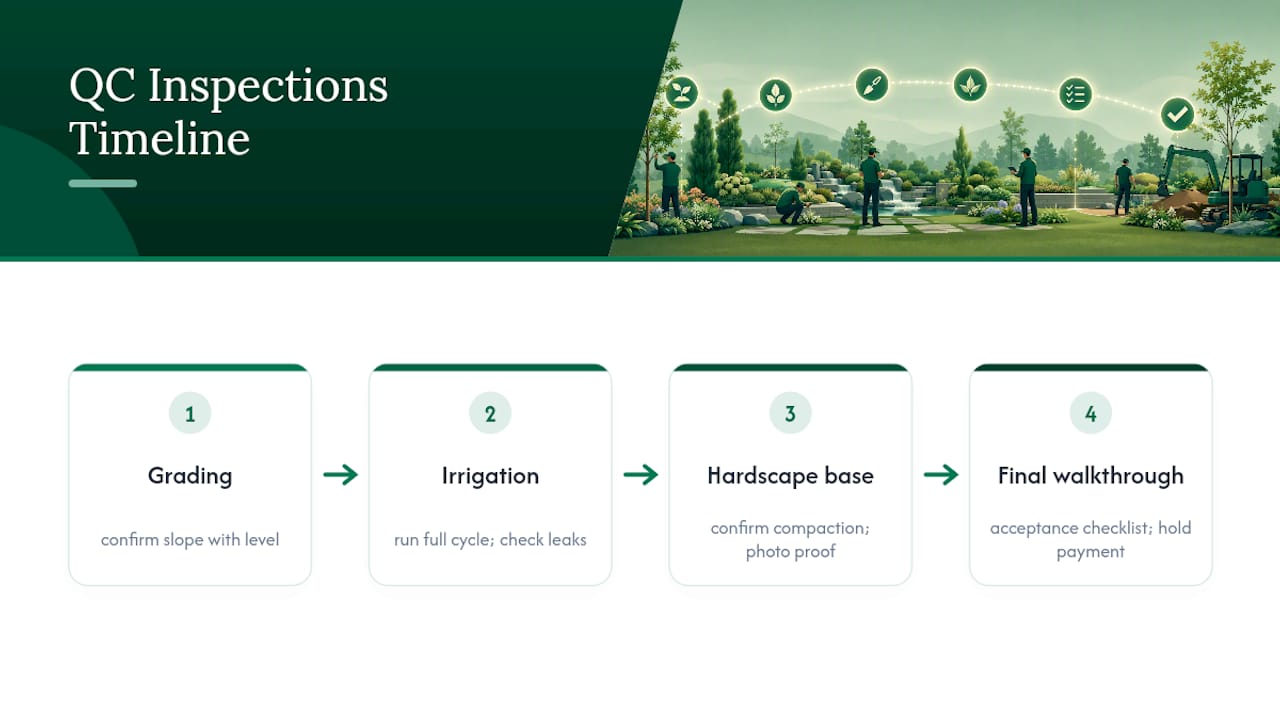
Each inspection needs a documented criterion, not just a visual check. Grading inspection should confirm slope with a level or laser, not a glance. Irrigation inspection should include running a full test cycle for each zone, checking for leaks, misaligned heads, and correct coverage overlap. Hardscape base inspection should confirm compaction depth against the number stated in the scope, ideally with a photo showing a tape measure against the excavated depth before base material goes in.
Documentation protects both sides. Photos at each milestone, timestamped and organized by zone, create a paper trail if a dispute arises later about what was actually done versus what was specified. Some contractors provide this automatically; if yours doesn’t, ask for it in writing as part of the scope, not as an afterthought once work is underway.
Final inspection should use the acceptance checklist built into the scope itself: irrigation test run complete, cleanup finished, plant material matches the schedule, hardscape shows no visible settling or cracking. Tie final payment to this walkthrough rather than to a calendar date, so there’s a financial incentive to get quality control right the first time instead of rushing to hit a deadline.
Safety Practices and Erosion Control on the Job Site
Site safety belongs in the scope of work, not just in a contractor’s internal policy manual. At minimum, the SOW should note fencing or barrier requirements around excavation areas, especially on properties with children or pets, and specify how equipment gets staged to avoid blocking emergency access to the home.
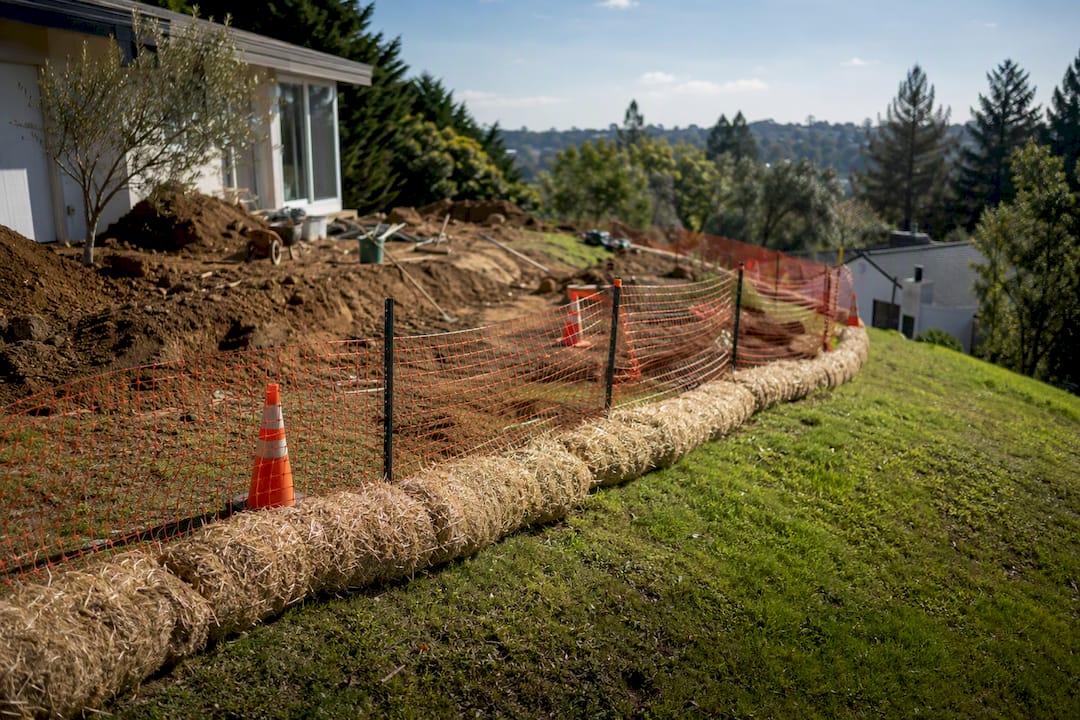
Erosion control matters most during grading and before sod or plantings establish root systems. Silt fencing along the downhill edge of a graded slope, coupled with straw wattles on steeper grades, prevents sediment from washing into storm drains or neighboring properties during the vulnerable window between excavation and planting. Local jurisdictions increasingly require erosion control measures as a condition of grading permits, so check with your city or county before work starts rather than after an inspector flags a violation.
Utility locate requirements tie directly into safety. Calling 811 before any excavation isn’t optional, and the scope should state explicitly that the contractor bears responsibility for scheduling that locate before digging begins. Tree removal near property lines or structures carries its own safety considerations worth scoping separately. Improper felling technique or root disturbance near a foundation can cause damage far more expensive than the removal itself, which is why guidance on common tree removal mistakes is worth reviewing before that portion of the project starts.
Runoff management during construction, particularly on properties near slopes or water features, should specify temporary drainage measures until permanent grading and planting stabilize the soil.
Why Specificity Beats Trust in Every Landscaping Contract
Homeowners often assume a good contractor relationship means they don’t need an exhaustive scope. That assumption backfires more often than it pays off. The contractors most worth trusting are usually the ones who welcome a detailed scope, because it protects their pricing as much as it protects your expectations.
The biggest blind spot I see in landscaping project outlines isn’t the plant schedule or the hardscape spec. It’s the assumption section: who provides site access, who’s responsible for utility marking delays, what happens if a change order stalls a phase. Negotiate those terms before the busy spring season hits, when crews are booked out and contractors have less patience for scope renegotiation mid-project.
— Christian
Turn Your Property Plan Into an SOW-Ready Package
Getting a contractor to price your project accurately starts with giving them accurate quantities, not a rough sketch and a phone call. Propertyimprovementestimator lets you draw fences, patios, retaining walls, and planting beds directly on a satellite map of your own property, generating dimensioned quantities you can attach straight to your scope document instead of guessing at square footage from memory.

The workflow is straightforward: draw your project zones on the map-based property estimator, export the plan with quantities attached, drop it into your written scope, and send it out for itemized quotes. If lighting or permit costs are part of the project, the outdoor lighting estimator breaks those numbers out separately so they don’t get buried inside a vague electrical line item. Start your property plan today and attach real dimensions to your next scope of work instead of a rough description.
Sources
- Bureau of Labor Statistics — Grounds maintenance workers
- Altitude Law — Landscape contracts newsletter
- Landscaping Audit Authority — Landscaping services scope of work definitions