Tennis Court Orientation: Which Way Should Your Court Face?
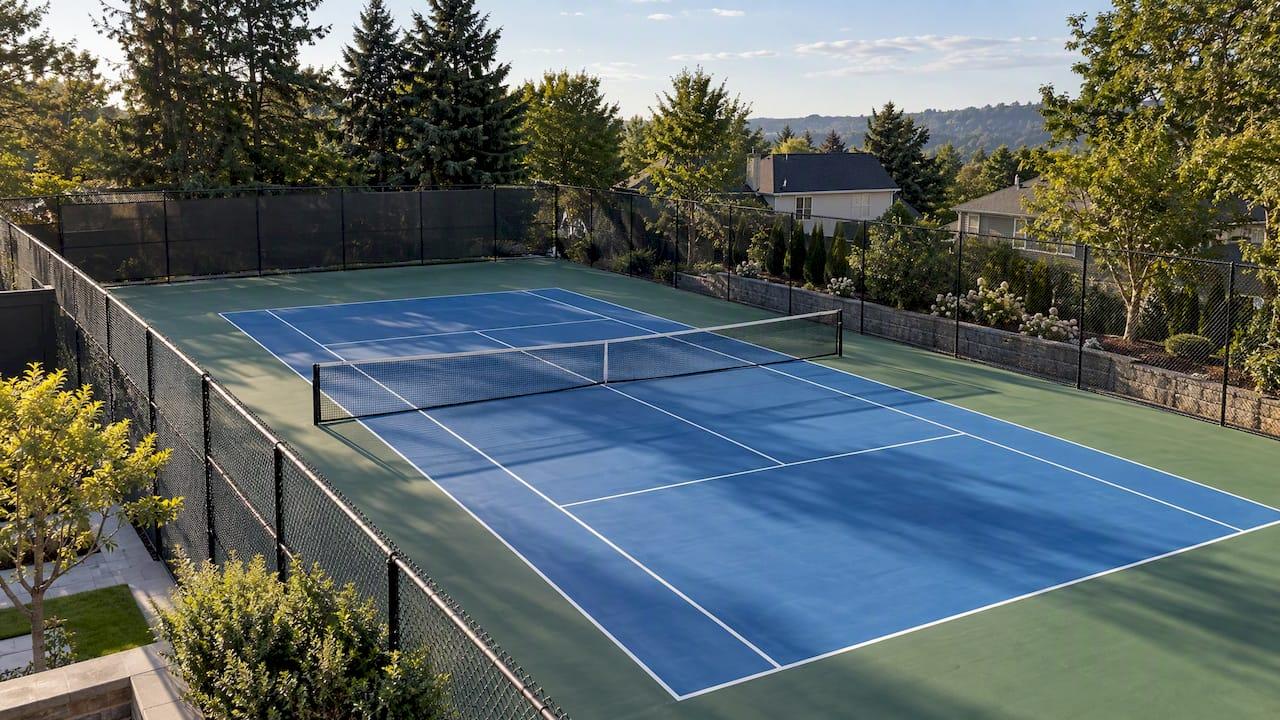
An outdoor tennis court should run north-south along its long axis, measured from true north rather than the compass needle. That layout keeps the low sun out of players’ eyes for most of the day. On a home lot you can often bend that rule a little, and sometimes you have to. This guide covers the standard, the exceptions, and how to check your own yard before anyone pours concrete.
TL;DR
- Run the long axis of the court north-south. It is the standard for tennis in the U.S. and in tournament rules, because it limits how long players stare into the sun.
- Measure from true north, not magnetic north. Look up your local declination before you stake anything.
- In the southern U.S., where people play year-round, a court turned 15 to 25 degrees off true north can protect afternoon play.
- If your lot forces east-west, the court is still playable, but you will schedule around sun glare.
- Sun angle is only one input. Slope, drainage, setbacks, trees and fencing decide whether the court fits at all.
Table of Contents
- Why north-south is the standard
- True north versus magnetic north
- How much can you deviate?
- Sun first, wind second
- Orientation for the Mountain West
- When your lot will not allow north-south
- Where orientation sits in the planning sequence
- Our perspective
- Draw your court before you request quotes
- FAQ
- Sources
Why north-south is the standard
Tennis is unusual because the ball goes high. A serve is tossed overhead, and lobs and overheads send players’ eyes straight up. The players also stand at opposite ends of the long axis, looking along it. If that axis points east-west, one player faces the rising sun and the other the setting sun, exactly when the sun sits low and bright.
The American Sports Builders Association’s tennis court construction guidelines say courts should generally be laid out with the long axis north-south, so players spend as little time as possible looking into the sun while serving or following the ball. Strictly speaking, the ideal is a court perpendicular to the sun’s azimuth. But the azimuth changes with time of day, season and latitude, so north-south works as the standard generalization for any location.

The professional rulebook says the same. The 2024 ATP rulebook states that courts should be laid out north-south, while allowing that geographic considerations may modify this to minimize serving into the sun.
That last phrase matters for a homeowner. The rule is a strong default, not a law of physics. It exists to solve a glare problem, and where the glare problem looks different, the layout can too.
True north versus magnetic north
This is the mistake that quietly ruins good plans. A phone compass or a handheld compass points to magnetic north. A court should be laid out on true north. The ASBA guidance is explicit that orientation is measured relative to true north and that magnetic north should be avoided, with local declination data used to adjust the layout.
Declination is the angle between the two, and it changes with location and over time. NOAA publishes a free magnetic declination calculator that returns the value for your address and date. A surveyor will also stake true north for you as part of a site layout.
A practical way to use it:
- Enter your ZIP code or coordinates in the NOAA calculator and note the declination, east or west.
- Apply it to any compass bearing you take in the yard, so your stakes follow true north.
- Cross-check with satellite imagery. Aerial photos are north-up, so a line drawn along a map’s vertical edge is true north.
That third step is the easiest for most homeowners. Draw the court as a rectangle on a satellite view, rotate it until its long side lines up with the top and bottom of the screen, and you have a true north-south court without touching a compass.
How much can you deviate?
There is no single permitted angle. The guidance ties acceptable deviation to seasonal, site-specific sun analysis. Two rules of thumb from Tennis Ontario’s court construction guide are useful:
- In the northern and middle parts of the U.S., north-south is generally the most desirable layout when play is balanced between morning and afternoon.
- In the southern U.S. with year-round play, turning the court 15 to 25 degrees off true north, toward a northwest-southeast line, can keep players on the north end from facing the low afternoon sun directly.
The logic of that second rule is about when people play. If your family plays after work, the western sun is the problem, and shifting the axis so it points away from the late-day sun helps. If you play mostly in the morning, the eastern sun matters more. Pick the hours you will actually use the court, then check the sun for those hours.
A quick comparison
| Layout | Glare risk | Best for | Watch out for |
|---|---|---|---|
| True north-south | Lowest overall | Most backyard and club courts | Needs a long, narrow clear space |
| 15 to 25 degrees off north (NW-SE) | Low in afternoon | Warm regions with year-round play | Check setbacks, since the footprint rotates |
| East-west | Highest at sunrise and sunset | Only when the lot leaves no choice | Plan play times around glare |
If the court must deviate from north-south, Tennis Ontario notes that players may need to adjust play times to avoid sun-glare hazards. Its sharper point is worth remembering: orienting a court a certain way “just because it fits” can leave it unusable at prime hours when a better option existed.
Sun first, wind second
People often ask about wind. Prevailing wind is a real site factor, but guidance treats it as secondary to the sun, partly because players switch ends and each side gets its share of tailwind and headwind. A windbreak of fencing or windscreen helps more than rotating the court to chase the breeze.
What does deserve attention alongside the sun:
- Shadows. Houses, garages, tall evergreens and neighboring buildings throw long shadows in winter. A half-shaded court grows moss and stays damp. The same guidance recommends minimizing shadows from surrounding structures.
- Sun tables. Sun azimuth-elevation tables let you see where the sun sits at each hour in each season for your latitude. Use them for the months you plan to play.
- Surrounding uses. Driveways, pedestrian routes, property lines and adjacent structures all shape where the court can go.
Orientation for the Mountain West
Our work is concentrated in Idaho and Utah, so here is how the rule plays out on lots like those in Boise County and St. George.
In the Treasure Valley and much of southwestern Idaho, winters are long and low-sun, and a lot of play happens in late spring through early fall. For most of those lots, a true north-south court is the right starting point. The exception is hillside property, where slope, not sun, usually dictates the axis.
In St. George, play stretches across most of the year and afternoons are bright. That puts the southern-region advice in play: if your plan has you on court in the late afternoon, test a court turned somewhat west of north-south on your site drawing and see how the baseline players’ view changes. Do the check with real sun data for your latitude rather than copying a number from this article, since your lot’s shape and your own schedule drive the answer.
In both areas, canyon walls, ridgelines and mature trees can block low sun in ways a generic rule ignores. A site walk at the hour you plan to play beats any rule.

When your lot will not allow north-south
Most backyards are not laid out for a 60-by-120-foot rectangle, the common size for a recreational singles and doubles court with run-off. For the dimensions you need to fit, see our guide to tennis court dimensions and striping. Once you know the footprint, you will probably hit one of these situations.
The only flat area runs east-west
Before accepting east-west, ask whether grading changes things. Moving the court costs less than living with a court you cannot use at 5 p.m. A few degrees of rotation off pure east-west does not fix the glare, so consider whether a larger rotation, with some retaining or fill, is realistic. Our notes on the sport court base, slope and drainage explain what grading a court needs, since that cost often decides the orientation.
Trees or the house shade one end
Shade is easier to solve than glare in some cases. Tree removal or limbing may be less work than rotating the whole court. Shift the court away from the structure, or accept a partly shaded end and use it for the side you play on in the heat of summer.
Setbacks and property lines
Local zoning and setback rules can overrule the best sun angle. Check your city or county requirements and any HOA rules before you commit to a layout. The planning inputs in the construction guidelines include topography, zoning, property lines and adjacent structures, which is why orientation is just one item on the list.
You want a multi-use court
Many homeowners want pickleball lines on the same slab, or a basketball hoop at one end. Pickleball courts are smaller, so the orientation logic carries over: keep the long axis north-south. Hoops at the ends of a tennis court should not interfere with the run-off; see our pickleball court placement guide for how the lines and posts share a tennis or basketball surface.
Where orientation sits in the planning sequence
Orientation is a decision you make early, because it controls everything after it: fence lines, light poles, drainage direction and the access path to the gate.
- Confirm the footprint. Court plus run-off, plus fence offset.
- Find true north on your lot with satellite imagery and the NOAA declination value.
- Test the sun for the months and hours you will play.
- Check slope and drainage. Courts need a gentle, uniform slope for water to leave the surface.
- Check rules. Zoning, setbacks, HOA, and any lighting restrictions.
- Set the fence and lighting plan, then get quotes.
Our overview of tennis court dimensions and surfacing options covers the surface choices that follow, and the backyard sports court design ideas show how other layouts have been resolved on typical lots.
Our perspective
We hear one complaint again and again from homeowners who planned a court: the estimate they were given assumed a perfect, flat, empty rectangle, and their yard is none of those things. Orientation is a good example. A contractor quoting from a phone call cannot know that your best flat ground runs east-west, or that a fence line will have to move when the court rotates 20 degrees.
That is why we built the platform around drawing the project on the actual property. When you place the court on aerial imagery, rotate it to true north-south, and see how much of the yard it takes, you learn in minutes what a site visit would show you in a week. Then the quote request carries the drawing, the measurements and the options, so the contractor is pricing your lot and not a generic one.
Our advice is simple. Start with north-south. Deviate only for a reason you can name: afternoon play in a warm climate, a slope, a setback. And draw both options before deciding, because the cheaper layout and the better layout are not always the same one.
— Christian
Draw your court before you request quotes
If you are weighing two orientations, the fastest comparison is to draw each on your own property. Our Tennis Court Estimator lets you place the court on satellite imagery, rotate it, and see a site-specific planning estimate based on its dimensions and local cost data, with no account required. If you want to see how costs move with new construction, resurfacing, fencing and lighting, the tennis court cost calculator breaks those pieces out.

When the layout looks right, you can send the drawing and measurements to local contractors as one request, so the bids reflect the same plan. For a broader look at the process, read our guide for planning a sport court with a site-specific estimate.
FAQ
What is the best orientation for a tennis court?
North-south along the long axis, measured from true north. This keeps the sun out of players’ eyes for most of the day. In warm southern regions with year-round play, a court turned 15 to 25 degrees toward northwest-southeast can be better for afternoon use.
Does it matter if a tennis court faces east-west?
It matters mostly at sunrise and sunset, when the low sun lines up with the long axis and one end of the court is in glare. The court is still usable at midday, and you can schedule around the problem. If you have any choice, avoid it for a court you want to use after work.
Should I use a compass to lay out the court?
Not on its own. A compass points to magnetic north, which differs from true north by the local declination. Look up the value for your address with the NOAA calculator, or have a surveyor stake the line, then check it against a north-up satellite image.
Is wind or sun more important when choosing orientation?
Sun is the primary concern. Players change ends, so wind averages out over a match, and windscreens on the fence handle most of the rest. Wind is worth noting, but it rarely justifies a layout that puts the sun in players’ eyes.
Sources
- USTC&TBA and ASBA, Tennis Court Construction Guidelines
- ATP Rulebook 2024, Chapter VI: Facilities and On-Site Conditions
- Tennis Ontario, Court Construction
- NOAA NCEI, Magnetic Declination Calculator