Vinyl vs Wood Fence: Costs, Upkeep, and What to Pick
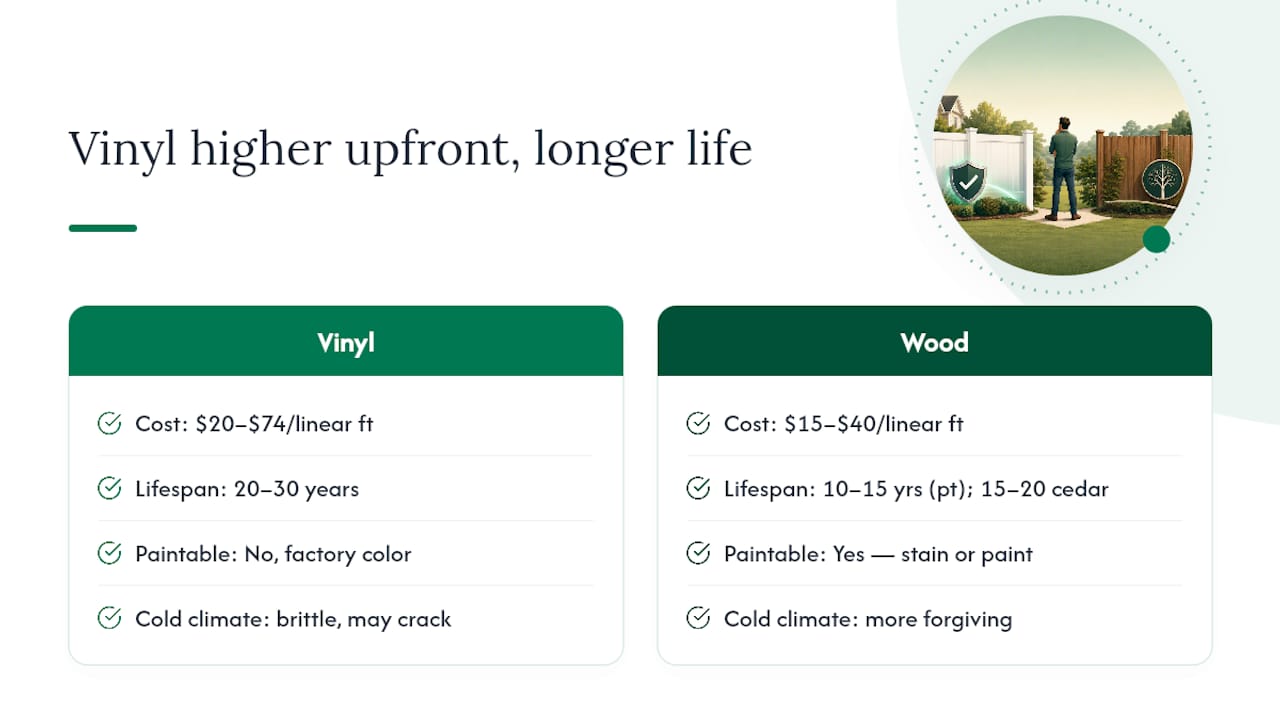
Choose vinyl if you want a fence that lasts 20 to 30 years with almost no scheduled upkeep. Choose wood if you want the lowest upfront price and a natural look you can refinish whenever you want. Vinyl typically installs for $20 to $74 per linear foot, while wood runs $15 to $40 per linear foot installed. A 100-foot vinyl fence often lands between $2,000 and $7,400 installed, while a comparable wood fence usually falls between $1,500 and $4,000.
- Vinyl: 20 to 30 year lifespan, minimal maintenance, higher upfront cost
- Wood: 10 to 20 years depending on species, needs staining every 2 to 3 years, lower upfront cost
- Cost overlap zone: mid-grade vinyl and premium cedar often land in the same $25 to $35 per foot range
Quick numbers: Vinyl lifespan 20 to 30 years. Pressure-treated wood lifespan 10 to 15 years. Cedar lifespan 15 to 20 years with regular care.
Key Takeaways
Vinyl fencing costs more upfront but requires far less maintenance and typically outlasts wood by 10 or more years.
| Point | Details |
|---|---|
| Lifespan gap | Vinyl lasts 20 to 30 years; pressure-treated wood lasts 10 to 15 years, cedar 15 to 20 years. |
| Upfront cost | Wood runs $15 to $40 per foot installed; vinyl runs $20 to $74 per foot installed. |
| Maintenance load | Wood needs staining or sealing every 2 to 3 years; vinyl needs only occasional rinsing. |
| Climate fit | Vinyl handles heat, humidity, and salt air better; wood tolerates hard freezes more reliably. |
| Plan before you buy | Use Propertyimprovementestimator to draw your exact fence line and request quotes based on real dimensions instead of a national average. |
Table of Contents
- Vinyl vs Wood Fence at a Glance
- How long do vinyl and wood fences actually last?
- What maintenance and repairs really look like
- Comparing vinyl vs wood fence cost
- Which one looks better in your yard?
- Which climate favors vinyl vs wood?
- What installation day actually involves
- Which material is better for the environment?
- How to choose between vinyl and wood for your yard
- Getting an accurate installed quote for your fence
- Plan Your Fence and Get Local Quotes
- Frequently Asked Questions
- Sources
Vinyl vs Wood Fence at a Glance
The short version: wood wins on day-one price and customization, vinyl wins on total time and money spent over the life of the fence. Here’s how the two stack up across the factors that actually change a homeowner’s decision.
| Factor | Vinyl | Wood |
|---|---|---|
| Upfront cost per foot | $20–$74 | $15–$40 |
| Lifetime cost (25 years) | Often lower once maintenance is counted | Higher due to recurring staining/sealing |
| Lifespan/warranty | 20–30 years, often with manufacturer warranty | 10–20 years depending on species |
| Maintenance | Occasional rinse | Stain/seal every 2–3 years |
| Repairability | Often whole-panel replacement | Single-board swaps |
| Customization | Factory colors only | Fully paintable/stainable |
| Climate fit | Strong in heat, humidity, salt air | Better in extreme cold |
| Recyclability | Limited, non-biodegradable | Renewable, but treated wood needs special disposal |
- Vinyl’s biggest selling point is time: you’re not repainting it every other summer.
- Wood’s biggest selling point is money up front and the freedom to change the color whenever you redecorate the yard.
How long do vinyl and wood fences actually last?
Vinyl fencing typically holds up 20 to 30 years, while pressure-treated wood tends to last 10 to 15 years and cedar 15 to 20 years with consistent upkeep. Those numbers assume decent installation. A fence with shallow post footings will fail early no matter what it’s made of.
Failure modes differ sharply by material:
- Wood fails through rot at the post line, insect damage, warping, and splintering from UV exposure.
- Vinyl fails through brittleness and cracking in extreme cold, and through panel replacement rather than spot repair when damage does happen.
- Both materials suffer when posts aren’t set in concrete footings deep enough to resist frost heave.
Manufacturers often back vinyl products with 20 to 25 year limited warranties against cracking, warping, and fading, something wood fencing rarely offers since it’s a raw material rather than an engineered product. That warranty gap alone pushes some buyers toward vinyl even when the upfront number stings a little more.
What maintenance and repairs really look like
Wood asks for a recurring calendar commitment. Vinyl asks for almost nothing beyond an occasional rinse.
Wood maintenance schedule:
- Power wash the fence annually to clear mildew and dirt buildup.
- Sand rough or splintering boards every 2 to 3 years.
- Re-stain or reseal every 2 to 3 years, sooner in wet climates.
- Inspect posts yearly for rot at the soil line.
Vinyl maintenance schedule:
- Rinse with a garden hose or mild soap once or twice a year.
- Check gate hardware and hinges annually for loosening.
- Inspect for cracks after hard freezes or storm impacts.
Repair costs diverge too. A rotted wood board can be pulled and replaced individually for the cost of one plank. Damaged vinyl panels, especially in panelized systems, often require replacing the entire section rather than a single piece.
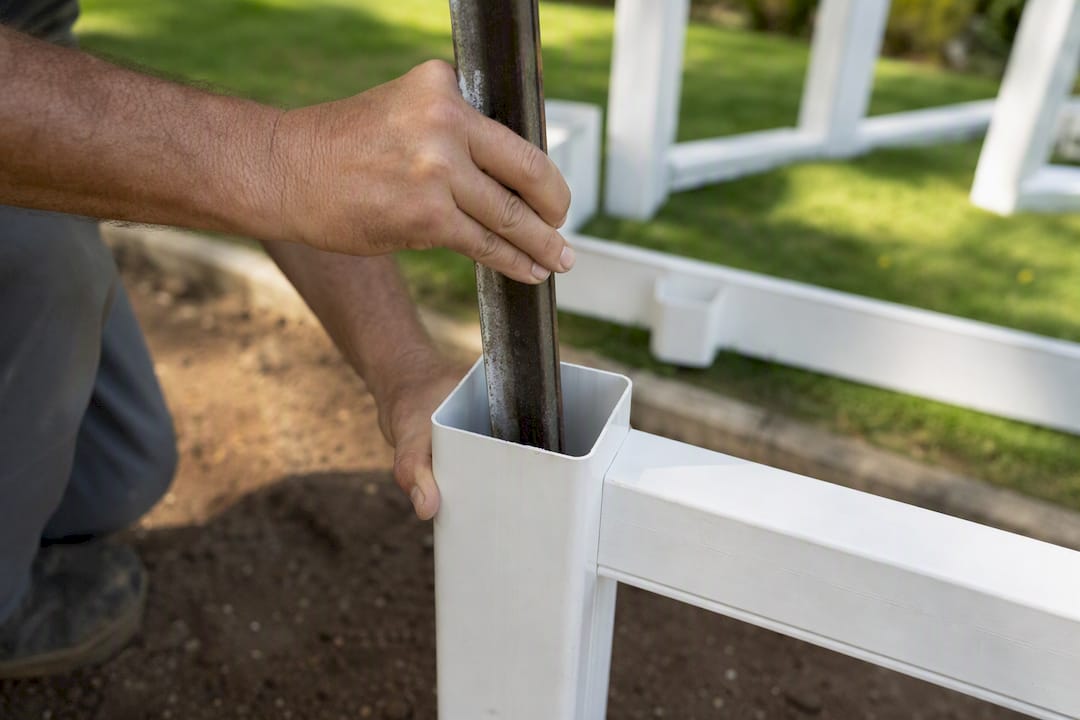
Pro Tip: Ask your installer about metal-reinforced vinyl posts at gates and corners. That’s where wind load and daily use concentrate stress, and a $20 insert now can prevent a $300 panel replacement later.
Comparing vinyl vs wood fence cost
Money is usually the deciding factor, so let’s put real numbers next to each other. Vinyl installed costs run roughly $20 to $74 per linear foot depending on panel style and region, while wood typically installs for $15 to $30 per linear foot. Premium vinyl and premium cedar frequently overlap in the $30 to $45 range. This surprises a lot of homeowners expecting a clean price gap.
| Scenario (100 ft fence) | Vinyl total | Wood total |
|---|---|---|
| Budget | $2,000 | $1,500 |
| Mid-range | $2,000 to $7,400 | $1,500 to $4,000 |
| Premium | $7,400 | $4,000 |
Wood’s real cost shows up after installation. Staining and sealing every 2 to 3 years adds up over decades, and over a 25-year span, vinyl often ends up cheaper overall once you count wood’s maintenance cycles and earlier replacement. If you plan to stay in your home long-term, vinyl’s break-even point usually arrives somewhere around year 10 to 15.
Pro Tip: Run your own numbers instead of relying on national averages. Local labor rates and panel styles swing the per-foot cost more than most buying guides admit.
Which one looks better in your yard?
Wood has grain, warmth, and the kind of imperfect character that vinyl still can’t fully fake, even though modern solid cellular vinyl now mimics wood grain convincingly compared to the plasticky panels of decades past. The real trade-off isn’t day-one looks. It’s flexibility later.
- Wood can be stained a different color or painted entirely whenever your taste changes.
- Vinyl’s color is baked in at the factory and essentially permanent, so pick carefully.
- Vinyl holds its finish without fading or peeling, which some buyers actually prefer over wood’s need for upkeep to look good.
- Resale perception tends to favor whichever material looks well-maintained. A pristine white vinyl fence and a freshly stained cedar fence both read as “cared for” to buyers.
Which climate favors vinyl vs wood?
Weather narrows the decision fast. Vinyl generally outperforms wood in hot, humid, and coastal conditions since it resists rot and salt corrosion that eat away at wood posts over time. Wood tends to be more forgiving in areas with hard freezes, where vinyl can turn brittle and crack on impact.
- Hot, sunny climates: vinyl resists UV fading better than most wood species.
- Cold, freezing climates: wood flexes without cracking; vinyl needs deeper frost-line footings and sometimes metal post reinforcement.
- Wet, humid regions: vinyl avoids the rot risk wood faces without regular sealing.
- Coastal, salt-air zones: vinyl resists corrosion; wood needs marine-grade fasteners and more frequent sealing.
- Sloped or shifting soil: both materials need deeper, wider footings, but wood posts are easier to reset individually if the ground moves.
What installation day actually involves
A typical fence install follows the same basic sequence regardless of material:
- Mark property lines and check local permit or HOA requirements.
- Dig post holes and set posts in concrete footings below the frost line.
- Attach panels, rails, or individual boards.
- Hang and align gates with reinforced hardware.
Wood installation is more DIY-friendly since boards are lightweight and forgiving of small measurement errors. Vinyl panels are pre-assembled and go up faster, but they demand precise post spacing since panels don’t flex to fit gaps. Most homeowners hire a professional for vinyl and consider DIY more seriously for wood.
Which material is better for the environment?
Wood is renewable, but pressure-treated lumber contains chemical preservatives that complicate disposal and can’t go in standard yard waste. Vinyl is petroleum-based and doesn’t biodegrade, though some manufacturers now run take-back or recycling programs for PVC scrap. Neither material is a clean environmental win. If sustainability matters most to you, look specifically for FSC-certified wood or vinyl products with documented recycled content, and check regional material guidance before you commit.
How to choose between vinyl and wood for your yard
Match the material to how you actually live, not how you feel on installation day.
- If you want to spend zero weekends on fence upkeep, pick vinyl.
- If your budget is tight right now and you’re comfortable with periodic staining, pick wood.
- If you’re selling within 3 to 5 years, wood’s lower upfront cost usually makes more financial sense.
- If you’re staying 10+ years, vinyl’s lower lifetime cost tends to win.
- A weekend homeowner who wants free Saturdays: vinyl.
- A short-term owner planning to sell soon: wood, for the lower entry cost.
- A homeowner in a coastal or freeze-thaw climate: match material to climate first, budget second.
Run your specific yard through the fence material cost calculator before deciding. Generic per-foot ranges are a starting point, not your actual quote.
Getting an accurate installed quote for your fence
National price ranges only get you so far. Draw your property’s actual fence line, choose vinyl or wood options, and request quotes based on real dimensions instead of a rough guess.
- Measure and draw your exact fence line on a site map.
- Select material, height, and gate options.
- Request quotes from local contractors using that specific scope.
Pro Tip: Contractors bid faster and more accurately when they receive exact measurements upfront instead of a vague phone description.
A homeowner’s honest trade-off
Every fence decision comes down to trading time, money, or looks. There’s no version where you get all three maxed out, so figure out which one you’re least willing to sacrifice before you call a contractor.
Plan Your Fence and Get Local Quotes
Propertyimprovementestimator turns your yard into an actual site plan instead of a rough phone estimate. Draw your exact fence line on your property map, and the platform factors in your dimensions and local costs instead of handing you a generic national average.

That precision matters most once you’re ready to compare bids. Contractors quoting off a detailed drawing with measurements and material choices respond faster and with tighter numbers than contractors working from a verbal description. You’ll also see how vinyl and wood options change your total cost before you commit to either one. When you’re ready to compare real numbers for your yard, request local fence quotes built from your exact plan.
Frequently Asked Questions
Is vinyl or wood fencing cheaper overall? Wood costs less upfront, typically $15 to $40 per linear foot versus vinyl’s $20 to $74. Over 25 years, vinyl often costs less total once you factor in wood’s recurring staining and earlier replacement.
How long does a vinyl fence actually last compared to wood? Vinyl typically lasts 20 to 30 years. Pressure-treated wood lasts 10 to 15 years, and cedar can reach 15 to 20 years with consistent maintenance.
Can you paint or stain a vinyl fence like wood? No. Vinyl color is set at the factory and isn’t designed to be repainted. Wood can be stained or repainted as many times as you want, which is a real advantage if your style preferences change.
Which fence material holds up better in cold climates? Wood tends to be more forgiving in freezing temperatures. Vinyl can become brittle and crack in extreme cold, especially at gate posts and corners without reinforcement.
Does a vinyl or wood fence add more resale value? Both add comparable curb appeal when well-maintained. A weathered, unstained wood fence often hurts resale perception more than an aging vinyl fence, since vinyl holds its finish without visible upkeep.
Sources
- Wood vs. Vinyl Fences: Which Makes More Sense for Your Yard - Bob Vila
- Vinyl vs. Wood Fencing: Pros, Cons, and How They Compare
- Wood Fence vs Vinyl Fence: Pros and Cons - Eastside Fence
- Vinyl Fence Cost 2026: $45-$74 Per Foot Installed