Tennis Court Dimensions: Size, Lines, Net and Backyard Space
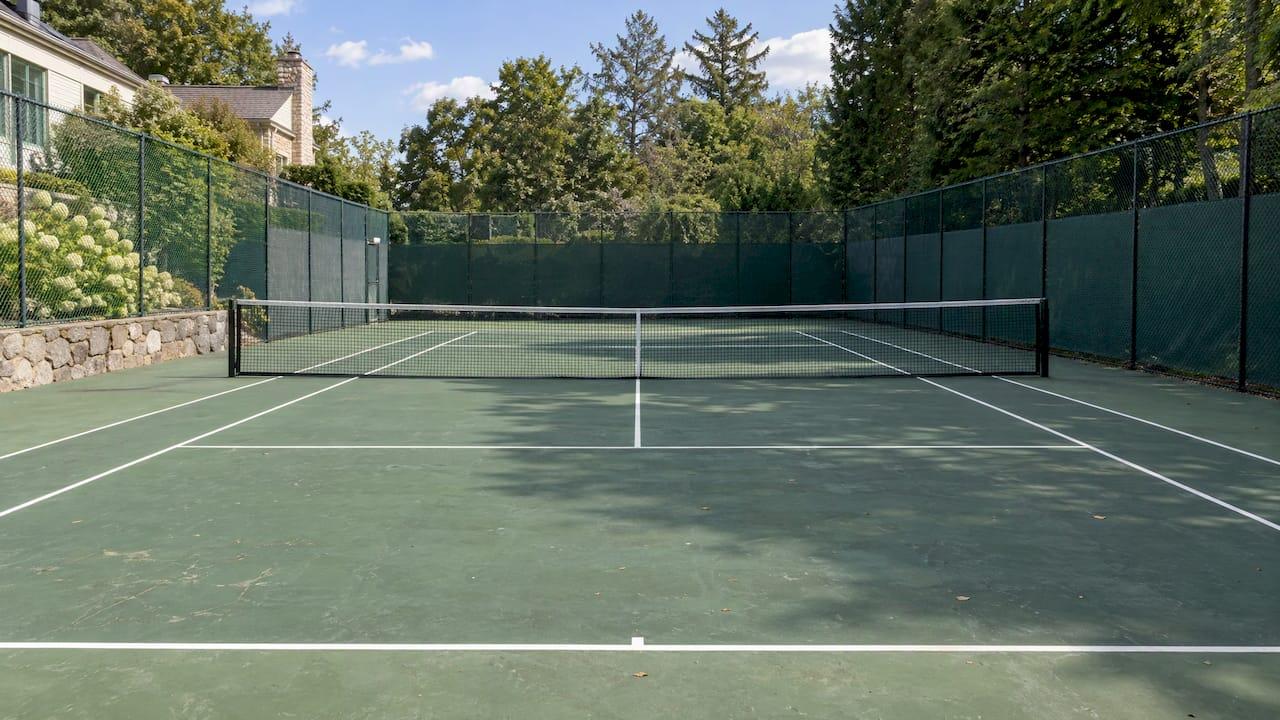
A regulation tennis court is 78 feet long, 27 feet wide for singles and 36 feet wide for doubles. That is the marked court only. If you are planning one at home, the space you need to clear is larger: about 60 feet by 120 feet once you add run-off behind the baselines and beside the sidelines. This guide gives you every measurement, then shows how to turn them into a footprint on your own lot.
TL;DR
- The marked court is 78 ft long, 27 ft wide for singles and 36 ft wide for doubles. The same court serves both formats.
- Service lines sit 21 ft from the net. The net is 3.5 ft high at the posts and 3 ft at the center.
- Plan a 60 ft by 120 ft overall area for one full-size court. 56 ft by 114 ft is the tight minimum.
- Doubles alleys add 4.5 ft on each side of the singles court. That is the whole difference between 27 ft and 36 ft.
- Before you commit, draw the full footprint on a map of your property and check it against setbacks, slope and trees.
Table of Contents
- Standard tennis court size for singles and doubles
- Tennis court layout dimensions, line by line
- How much space you need around the court
- Backyard tennis court size: a worked example
- Smaller courts for kids and tight lots
- What the dimensions mean for your budget
- Our perspective
- Plan your court on your own property
- Checklist before you break ground
- FAQ
- Sources
Standard tennis court size for singles and doubles
There is one court, with two sets of sidelines. The length is the same in both formats. Under the 2026 ITF Rules of Tennis, the court is 78 ft (23.77 m) long, 27 ft (8.23 m) wide for singles and 36 ft (10.97 m) wide for doubles. The USTA’s 2026 Friend at Court reproduces the same figures for play in the United States.
| Measurement | Feet | Metric |
|---|---|---|
| Court length | 78 ft | 23.77 m |
| Singles width | 27 ft | 8.23 m |
| Doubles width | 36 ft | 10.97 m |
| Service line to net | 21 ft | 6.40 m |
| Doubles alley (each side) | 4.5 ft | 1.37 m |
| Net height at posts | 3.5 ft | 1.07 m |
| Net height at center | 3 ft | 0.914 m |
Do the math on area and the numbers stay modest. A 78 by 36 ft doubles court covers 2,808 square feet of marked surface. That is roughly the size of a large two-car garage plus a driveway, which is why homeowners often underestimate the real footprint. The marked court is the smallest part of the project.
Singles versus doubles court size
The doubles court is 9 ft wider than the singles court. That extra width is two alleys, each 4.5 ft wide. The ITF glossary defines the alley as the strip between each singles sideline and the doubles sideline.
In practice:
- Singles play uses the inner sidelines. Balls landing in the alley are out.
- Doubles play uses the outer sidelines. Balls landing in the alley are in, though the serve still has to land in the correct service box.
- Both formats use the same baselines, service lines and center service line.
For a home court, build the doubles width. You can always play singles on it, and the cost of the extra 9 ft of pavement is small next to the work of excavation, base and fencing.
Tennis court layout dimensions, line by line
Knowing the outer size is enough to rough out a site. Knowing the interior layout matters when you stripe the surface or hire someone to do it.
Service boxes and the center line
The service lines run parallel to the net, 21 ft (6.40 m) from it. A center service line divides the area between the net and the service lines into two equal service courts. Each service box therefore measures 21 ft deep and 13.5 ft wide on a singles court (half of 27 ft).

The space between each service line and its baseline is 18 ft (78 divided by two is 39, minus 21). Players call it the backcourt, and it is where most rallies live.
Line widths
Line widths are set by the same rules. According to the ITF Rules of Tennis:
- The center service line and the center mark are 2 in (5 cm) wide.
- The center mark is 4 in (10 cm) long and sits at the middle of each baseline.
- Other lines are between 1 and 2 in (2.5 to 5 cm) wide.
- Baselines may be up to 4 in (10 cm) wide.
Line measurements are taken to the outside edge of the line for the court boundaries, so the width of each line sits inside the court size, not on top of it. If you are marking out a court yourself, snap your tape to the outer edges.
The net and net posts
The net is 3.5 ft (1.07 m) high at the posts and 3 ft (0.914 m) at the center, held down by a center strap. Per the 2026 rules, the net-post centers sit 3 ft (0.914 m) outside each doubles sideline. A singles net uses the same 3 ft offset outside the singles sidelines. If you use a doubles net for singles, you support it with singles sticks at that offset.
That 3 ft offset has a practical consequence. Your post footings sit outside the 36 ft width, so the hardware needs a little more room than the lines do. Include it in your layout.
How much space you need around the court
The lines are not the limit. Players run well past the baseline to chase lobs and well past the sidelines for wide serves. That clearance is part of the court.
U.S. court-planning guidance from the ITF’s court size document recommends:
- 21 ft behind each baseline
- 12 ft beside each sideline
Add that to the marked court and you get the standard overall playing area: 78 + 21 + 21 = 120 ft long, and 36 + 12 + 12 = 60 ft wide. The same figure appears in court construction guidance, which recommends a 60 by 120 ft area for one full-size court rather than building to the 78 by 36 ft marked court.
That is 7,200 square feet, about two and a half times the marked surface. Fencing, backstops and any fixed obstruction such as a wall, tree or shed should sit outside that rectangle.
The minimum when space is tight
When the lot does not allow 60 by 120 ft, 56 ft by 114 ft is the minimum for an individual court that allows play with reasonable comfort. That works out to 6,384 square feet. You give up a few feet on each side, and the court plays fine for recreation. Players who hit hard or play competitive doubles will notice the shorter run-off.
Multiple courts and shared fences
If you plan two courts side by side, the clearances between them are shared, and the layout changes. Treat that as a separate planning exercise, and note that the tight-lot numbers above apply to one individual court.
Backyard tennis court size: a worked example
Here is how the numbers play out on a real lot. Suppose you own a flat rectangular area behind the house that measures 100 ft by 70 ft.
- Full size: You need 120 ft by 60 ft. The 100 ft length is 20 ft short. The court does not fit at full recommended clearance.
- Minimum size: You need 114 ft by 56 ft. Still 14 ft short on length.
- Conclusion: This lot needs either more length, or a different kind of court.
Now suppose the clear area is 125 ft by 65 ft. Both fit. The full 120 by 60 ft footprint leaves 5 ft in each direction for the fence line and a gate. That is a comfortable fit, but you still need to check setbacks, drainage and utilities before anything gets built.
Two practical questions come up at this stage:
- Does the ground slope? Courts need to be close to level, so a sloped lot means grading, and perhaps a retaining wall. Our retaining wall estimator is built for that part of the plan.
- Which way does the court run? The USTA’s standard for 10-and-under courts prefers a north-south orientation, which keeps low sun out of players’ eyes along the long axis. We cover it in more detail in our tennis court orientation guide.
Smaller courts for kids and tight lots
A full court is not the only option for a yard. The USTA’s 60-foot court standard, used for 10-and-under tennis, defines the court as 21 ft wide for singles and 27 ft wide for doubles. It calls for minimum overrun of 10 ft at the sides and 14 ft at the baselines. The minimum pavement area for one 60 ft doubles court is 84 ft by 47 ft.
That is 3,948 square feet of pavement, about 55 percent of the 7,200 square feet a full-size court uses. For a family with younger players, it is a realistic fit on many suburban lots. It also converts more easily into other uses later.

Sharing the surface with pickleball
Many homeowners ask whether the same slab can handle both sports. A pickleball court is much smaller than a tennis court, so lines for one can be painted over the other. We walk through the layouts in our guides on pickleball court placement on a tennis court and sport court dimensions. If you want a dedicated pickleball footprint, see our pickleball court dimensions for homeowners.
What the dimensions mean for your budget
Every measurement above feeds a quantity. Surface area drives pavement and surfacing. Perimeter drives fencing. Run-off drives how much ground you clear and grade. Net-post offset drives footings.
That is why a generic square-foot price is not much use here. Two lots with the same court can have different costs because of slope, access for equipment, soil and local labor rates. A site-specific plan starts with the actual shape you draw.
For the next step, our guides on tennis court dimensions and striping steps and dimensions and surfacing options cover the finish work. If you are thinking about the lighting and fencing around the court, those are separate line items you can plan on the same map.
Our perspective
Most people start a tennis court project with the wrong number. They remember 78 by 36 and picture a slab that size. Then they learn they need about 60 by 120 once run-off is counted, and the plan changes.
We built the platform around that moment. Instead of guessing, you draw the court on satellite imagery of your own property and see whether the full footprint fits. You can slide it, rotate it, shrink it to the tighter layout, and watch the estimate respond to the dimensions you drew.
Our approach is designed to give contractors a clear picture of the scope: the drawing, the measurements, the options you chose, and photos. That means fewer back-and-forth calls and quotes that reflect your actual lot, not an average one.
If you are even thinking about a court, draw it before you do anything else. It takes a few minutes, and it turns a loose idea into something you can price.
Christian
Plan your court on your own property
If you want to see how a court sits on your lot, our Tennis Court Estimator lets you draw it on a satellite map. You can also try our tennis court cost calculator for new builds, resurfacing, fencing and lighting. Our platform is designed to give you a locally adjusted price range from your dimensions, with no account required.

When the layout looks right, you can send the drawing and measurements to local contractors as one quote request. Start from our main planning page, or get a local project report for your site.
Checklist before you break ground
Use this list once your court fits on paper:
- Confirm the footprint. 60 by 120 ft recommended, 56 by 114 ft minimum.
- Check fixed obstructions. Keep walls, trees and sheds at least 12 ft from each sideline and clear of the area behind the baselines, as the ITF guidance recommends.
- Check orientation. Favor a north-south long axis where the lot allows.
- Walk the grade. Note any slope across the footprint.
- Call local authorities. Ask your city or county about setbacks, fence height limits, lighting rules and permits. These differ widely, whether you are in Boise, St. George or anywhere else.
- Mark it on the ground. Stakes and string at the full footprint will show you how much yard the court really takes.
- Collect quotes with a drawing. Contractors price better when they can see what you mean.
FAQ
What is the size of a doubles tennis court?
A doubles court is 78 ft long and 36 ft wide, per the ITF Rules of Tennis. That is 2,808 square feet of marked surface. The two 4.5 ft alleys on either side are in play for doubles and out for singles.
How much space do you need for a tennis court at home?
Plan about 60 ft by 120 ft for one full-size court, which includes 21 ft behind each baseline and 12 ft beside each sideline. When the lot is tight, 56 ft by 114 ft is the minimum for comfortable recreational play. Fencing and fixed obstructions should sit outside the area you choose.
How far should a tennis court be from a fence or wall?
Recommended clearance is 21 ft from each baseline to the backstop and 12 ft from each sideline to a fixed obstruction, according to the ITF court size guidance. Use those figures as your target, then confirm local rules for fence placement with your city or county.
How high is a tennis net?
The net is 3.5 ft (1.07 m) at the posts and 3 ft (0.914 m) at the center. The posts stand 3 ft outside the doubles sidelines, so your footings need a little room beyond the 36 ft width.
Can I build a smaller tennis court for kids?
Yes. The USTA’s 60-foot court standard for 10-and-under play uses a court 21 ft wide for singles and 27 ft wide for doubles. It needs a minimum pavement area of 84 ft by 47 ft for one doubles court, which suits many smaller lots.
Sources
- ITF Rules of Tennis 2026
- USTA Friend at Court 2026
- ITF Tennis Glossary: Terms and Definitions
- ITF Court Size
- Court Construction guidance (Tennis Ontario)
- USTA 10 and Under Tennis: 60 Foot Court Standards