Swale Design for a Backyard: Size, Slope, Route and Check Dams
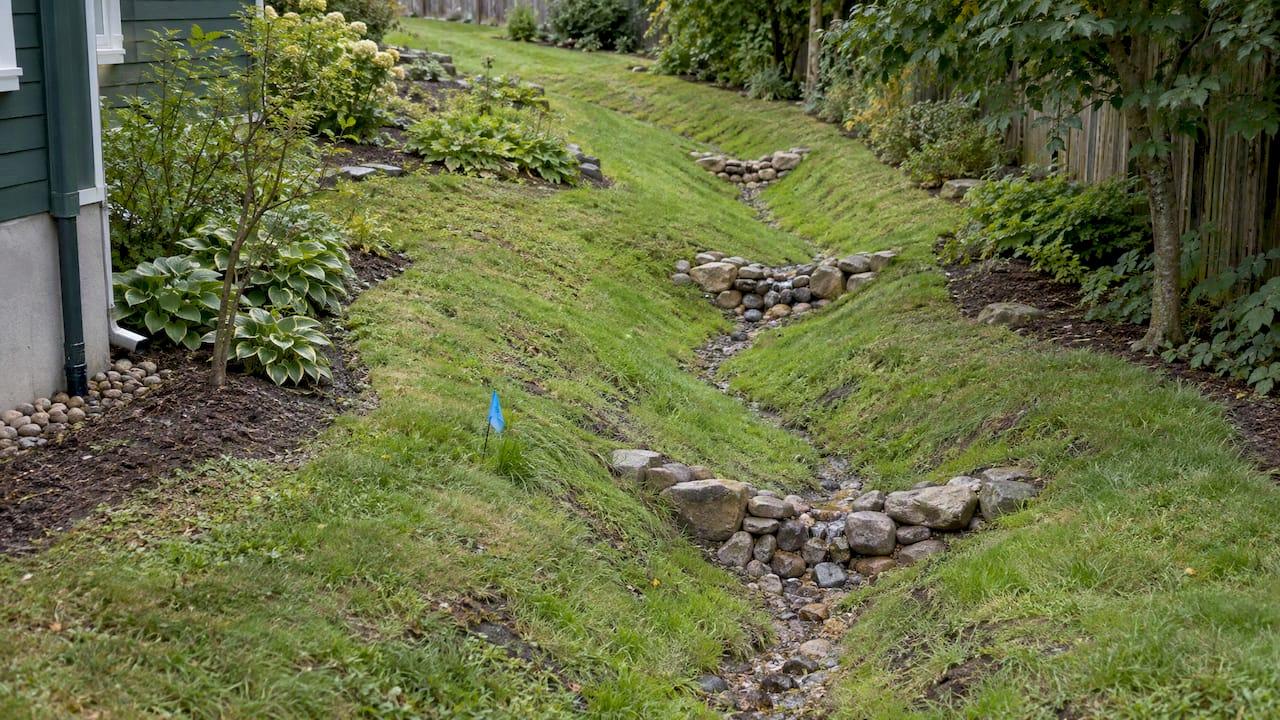
A good backyard swale is a shallow, gently sloped, planted channel that catches runoff, slows it down and lets it soak into the ground. Most home swales are about 8 to 16 inches deep and 2 to 4 feet wide. They sit at least 10 feet from the foundation and end in a spot where water can safely sink in. This guide covers how to choose the route, size the channel, add check dams and plant it. It also covers when to get a contractor involved.
TL;DR
- A swale is a shallow channel, usually with a berm on the downhill side, that collects runoff and lets it infiltrate slowly. It is not a trench that dumps water somewhere else.
- Typical size is 8 to 16 inches deep and 2 to 4 feet wide, with gentle side slopes of roughly 25 to 30%.
- Keep it 10 feet from foundations, 50 feet from septic systems and 100 feet from private wells, and end it in a rain garden or similar infiltration area on your own property.
- Check dams matter on steeper runs. Keep them no higher than half the bank height and anchor them into the banks.
- Measure your slope and map the route before you dig. That is where most swale mistakes start.
Table of Contents
- What a backyard swale does
- Where to put the swale
- Size and slope: the numbers that matter
- Check dams in swales
- How to build a backyard swale
- Maintenance and limits
- Perspective: plan the swale on the map first
- Plan the layout and get matched quotes
- FAQ
- Sources
What a backyard swale does
A landscape swale is a shallow, vegetated channel that collects stormwater, slows it and lets it soak in, so it does not leave your yard as fast surface runoff. According to Massachusetts’ homeowner guidance on vegetated swales, a swale captures flow from hard surfaces, reduces its speed, and so cuts erosion, filters pollutants and helps limit local flooding.
Two designs get called swales, and mixing them up causes trouble:
- Infiltration swales follow the contour of the land and hold water so it sinks in. They are common in permaculture and dry climates.
- Conveyance swales slope gently along a planned route and carry water to an outlet while slowing it. These suit most suburban lots with a drainage problem.
Decide which job you need before you choose a layout. If a downspout or driveway sends water toward the house, you probably need conveyance with infiltration at the end. If you simply want to keep rain on a dry hillside, a level, on-contour swale is closer to the right tool.
Where to put the swale
Start with where water already goes. The best location is a flow path that naturally concentrates stormwater, such as the line below a driveway edge or a roof downspout. The Massachusetts guidance gives setbacks that are worth treating as a baseline for any yard: at least 10 feet from foundations, 50 feet from septic systems and 100 feet from private wells.
Walk the yard during a real rain and note three things:
- Where water leaves the roof, patio or driveway.
- Where it pools or runs fastest.
- Where it could safely end up.
That third point decides the design. Send the outlet to a dedicated infiltration area, such as a rain garden, and keep all components on your own property. Do not discharge onto a neighbor’s lot or into public infrastructure.
Handle the roof first
A swale is much easier to size when the roof is not dumping a concentrated stream next to the foundation. Gutters and downspouts that carry water well past the wall make a big difference, and these yard tests for roof runoff show how to check where your downspouts are sending water before you decide where a swale should start.
Places to avoid
Swales are a poor fit in some spots. K-State Extension advises against placing them above or near septic systems, directly above bedrock or bedpan, in low flat areas, or where the water table is high. Massachusetts guidance adds that tight lots with no room for overflow or required setbacks, and poorly draining soils, may call for soil amendments or a different location.
If your yard borders a protected wetland or similar resource area, check with your local authority first. In Massachusetts that means the local Conservation Commission. In Idaho and Utah, call your city or county planning or public works office and ask whether grading or drainage changes need a permit. Rules differ by town, so do not assume.
Size and slope: the numbers that matter
Here is what the published guidance supports for a typical backyard channel.
| Design element | Typical value | Source |
|---|---|---|
| Channel depth | 8 to 16 inches | K-State Extension |
| Channel width | 2 to 4 feet | K-State Extension |
| Side slopes | About 25 to 30%, no steeper than 25 to 33% | Massachusetts guidance |
| Flow velocity in a water quality storm | No more than 1 foot per second | Minnesota Pollution Control Agency |
| Cross-section shape | Trapezoid | New Hampshire DES |
K-State notes that depth and width depend on the land’s slope and your area’s average rainfall. A yard in the wetter parts of the country needs more capacity than a dry Idaho or Utah lot. The velocity limit is the reason swales are shallow and wide rather than narrow and deep: slow water drops sediment and soaks in, while fast water scours the channel.
Measuring your slope
You cannot size a swale without knowing the fall along its route. A simple level, string and stakes will do. Our walkthrough on how to calculate yard slope over a 10-foot run shows the method. Take several readings along the planned path, not just one, because yards rarely fall evenly.
Draw the route before you dig
A meandering route slows water more than a straight line. Sketch it on an aerial view, measure the length, and note the distance to the house, any septic field and the property line. Our broader yard drainage plan guide covers how to map the problem areas and budget the work.
Check dams in swales
Check dams are low barriers, usually logs or stone, set across the channel to slow water and promote infiltration. They earn their place on steeper runs, where water would otherwise pick up speed.
The Massachusetts fact sheet gives the key construction rules:
- Keep each dam no higher than half the swale’s bank height.
- Embed it in the soil.
- Extend it up the bank slopes so water cannot go around the ends or undercut it.
How far apart to space them
A common design rule is that the spacing should not exceed the horizontal distance from the toe of the upstream dam to the same elevation on the downstream dam. In plain terms, each dam should sit so the water backed up behind it reaches back to the foot of the dam above. On a steeper slope the dams are closer together. If the slope varies along the swale, the spacing should vary with it.

That means a rough rule of thumb is not enough. You need a measured profile of the swale’s length and fall first.
Keep them maintainable
Check dams collect sediment, which is part of their job. Once material fills the space behind a dam up to the spillway level, the dam has done its work and needs cleaning out. Silt build-up is the same issue that larger retention features face, and this overview of retention pond muck and maintenance is a useful comparison for judging when sediment has become a problem.
How to build a backyard swale
The New Hampshire DES guidance outlines the build in a simple order:
- Mark the route with stakes and string.
- Excavate the channel, shaping it as a trapezoid and avoiding soil compaction.
- Stabilize the inlet so incoming water does not erode it.
- Plant dense, native vegetation.
- Mulch the planted areas.
Two practical points. First, do not drive equipment back and forth across the bottom. Compacted soil sheds water instead of absorbing it. Second, build the inlet and any check dams before the first big storm, because bare soil erodes fastest at the start.
What to plant
Choose hardy ground covers and grasses that form a dense, uniform cover and survive both flood and drought. A swale is wet after storms and dry in between, so plants have to tolerate both. New Hampshire DES advises watering consistently through the first two growing seasons while the roots establish.

In the arid West, where Idaho and Utah yards sit, pick native or well-adapted plants that handle the dry stretches. Our guide to water-wise landscaping in Utah covers plant choices and rebates, and the piece on drought lawn alternatives is useful for the areas around the swale.
Maintenance and limits
A swale is low-maintenance, not no-maintenance. Inspect it each season and after large storms for erosion, sediment build-up and stressed plants. Remove sediment and replace vegetation as needed. Clear leaves and debris from the inlet and outlet so water keeps moving.
Know the limits at the design stage and you can plan around them:
- A high water table or not enough room for overflow and setbacks makes a swale a poor choice.
- Heavy clay or other slow-draining soil may need amending, or the swale may need to go somewhere else.
- A steep site needs check dams, or a different approach such as terracing.
If the problem is a retaining wall or a grade change rather than open lawn, drainage becomes a structural matter. See our guides on retaining wall drainage and filter fabric and building a retaining wall on a slope.
Perspective: plan the swale on the map first
Most swale problems we see in project requests are not digging problems. They are measuring problems. The route was guessed, the slope was assumed, and the outlet was left for later.
That is why we built our platform around drawing on the property itself. When you outline the route on aerial imagery, you see the real distance to the house, the driveway, a septic area or the lot line before anyone picks up a shovel. You can move the line, compare options and keep the dimensions in one place.
Our approach is designed so that a contractor receives the measurements, drawings, options and photos instead of a vague description. A swale next to a new patio, fence line or retaining wall depends on all of those pieces fitting together, and a site-specific scope makes bids easier to compare.
Christian
Plan the layout and get matched quotes
If your swale ties in with other work, such as a fence line, a concrete pad or a deck footprint, draw it all on one map. With our Local project report, you outline the project on a satellite view and get a site-specific planning estimate based on your dimensions and local cost data, with no account required. You can then send a detailed quote request to contractors.

If you are planning a larger outdoor project nearby, you can start from our Concrete Estimator for pads and walkways, or from the home page to choose the project type that fits.
FAQ
What is a landscape swale?
A landscape swale is a shallow, vegetated channel that collects runoff, slows it and lets it soak into the soil. It usually has gently sloped sides and often a berm on the downhill edge. It reduces erosion and helps keep water away from structures.
How big are swales?
Backyard swales are commonly 8 to 16 inches deep and 2 to 4 feet wide, depending on slope and rainfall. Side slopes should be gentle, about 25 to 30%. Length depends on your lot and where the water needs to end up.
What are the downsides of swales?
They need space, setbacks from foundations and septic systems, and a spot for overflow. They also don’t suit high water tables or poorly draining soils without changes, and they need seasonal cleanup of sediment and debris. Good siting and a planted, stable channel avoid most of these problems.
When do I need check dams?
Add them when the swale runs down a noticeable slope and water speeds up along the way. Keep each one under half the bank height and anchor it into the soil and up both banks. Space them from a measured profile of the swale, not by eye.
Sources
- Stormwater Solutions for Homeowners Fact Sheet: Vegetated Swales (Mass.gov)
- What are Swales? (K-State Research and Extension)
- Vegetated Swale (New Hampshire DES)
- MS4 fact sheet: Vegetated Swales and Buffer Strips (Minnesota Pollution Control Agency)
- Check dams (LID SWM Planning and Design Guide)