Sport Court Surfacing Types: How to Choose for Your Yard
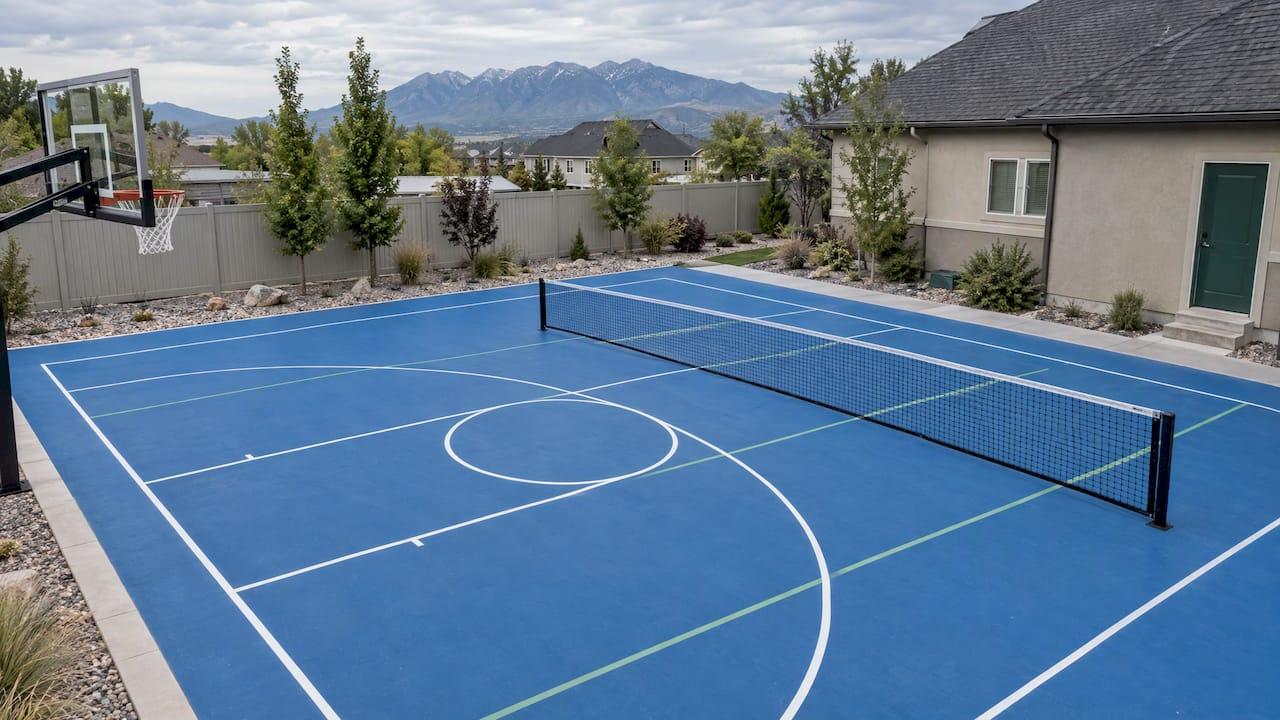
For most backyard courts, the choice comes down to three surfaces: acrylic over a concrete or asphalt slab, cushioned acrylic, or modular tiles. Acrylic on a sound concrete base is the standard for permanent tennis and pickleball courts. Cushioned systems and tiles trade a higher price for comfort or flexibility. Clay, grass and sand-filled turf are soft-court options with daily care. The surface you pick sets the price, the feel of play and the upkeep. The size and shape of your court, drawn on your own lot, set how much of it you will pay for. Before you ask a contractor for a number, it helps to map the court on your property so every bid covers the same area.
TL;DR
- Most permanent backyard courts are acrylic-coated concrete or asphalt. It is the lowest-cost hard surface and the default for tennis and pickleball.
- Cushioned acrylic and modular tiles are easier on joints. Published installed ranges run from about $3.50 to $14 per square foot depending on the system.
- Clay, grass and sand-filled turf play slower and need regular care. They suit owners who want that feel.
- The base under the surface (slab thickness, stone, one-way slope) governs how long the court lasts.
- Your court’s exact footprint drives the estimate, so measure it before you collect quotes.
Table of Contents
- The three families of court surfaces
- Hard courts: acrylic over asphalt or concrete
- Cushioned acrylic: the same court with a softer layer
- Modular tiles: interlocking polypropylene over a hard base
- Soft courts: clay, grass and sand-filled turf
- Surface types compared
- Matching the surface to your sport
- Do you need concrete underneath?
- What drives the cost of a surface
- Lifespan and maintenance in practice
- Our perspective
- Plan your court on your own property
- FAQ
- Sources
The three families of court surfaces
A court surface is a stack: the ground, a stone base, a slab or tile bed, and a playing layer on top. When people ask about types, they usually mean that top layer, but the industry sorts surfaces by how the whole stack handles water and impact.
The classification published by the Illinois Asphalt Pavement Association, citing the US Tennis Court & Track Builders Association, splits outdoor courts into three groups:
- Porous construction: water drains through the surface. Fast dry, clay, natural grass, sand-filled synthetic turf over a porous base, porous asphalt, porous concrete and modular systems sit here.
- Non-porous, non-cushioned: reinforced or post-tensioned concrete, hot plant mix asphalt and asphalt penetration macadam.
- Non-porous, cushioned: polymer-bound systems, textiles, sand-filled turf over a non-porous base and portable surfaces.
That adds up to 14 recognized types. For a homeowner, they collapse into a shorter list: hard courts, cushioned hard courts, modular tiles and soft courts. Each is covered below.
Hard courts: acrylic over asphalt or concrete
A hard court is asphalt or concrete, usually covered with an acrylic coating that protects the slab and shapes how the ball plays. According to the same association page, hard courts give a fast game with a low-angle bounce. The amount, type and size of sand in the color coating can change the speed, and slower, textured finishes are available. A properly installed hard court is durable and relatively low maintenance.

This is the most common choice for a reason. Published comparisons put installed cost for acrylic over asphalt at about $4 to $8 per square foot and acrylic over concrete at $5 to $11, for a 1,800 square foot court. Those figures exclude site preparation, which the same guide puts at $2,000 to $8,000.
The two bases differ in a few ways:
- Asphalt: lower first cost, but more prone to cracking where winters freeze and thaw. Cracks need filling before each recoat.
- Concrete: a reinforced slab typically costs more up front and tends to last longer. Post-tensioned concrete (steel cables tensioned inside the slab to hold cracking down) sits at the top of the price range, at roughly $6 to $12 per square foot in the same guide.
The acrylic layer itself is a wear item. The same guide says it generally needs reapplying every 5 to 8 years, and that a resurface of a single court runs $2,000 to $6,000. Plan for that recoat from day one.
Cushioned acrylic: the same court with a softer layer
A cushioned court adds a resilient layer between the slab and the color coat. The association page describes these courts as having excellent playing characteristics and an all-weather, year-round surface, though they cost considerably more than a plain hard court.
The published installed range is about $7 to $14 per square foot, or $12,600 to $25,200 on that 1,800 square foot example. Another cost breakdown puts a cushioned pickleball court at $15,000 to $26,000 against $7,000 to $12,000 for standard acrylic. The pitch is joint relief: knees, hips and backs notice the difference after an hour of play, which matters if the court is for family members of several ages.
Repairs on a cushioned system are more involved than on plain acrylic, so ask contractors how they handle damaged areas before you pick one.
Modular tiles: interlocking polypropylene over a hard base
Modular courts snap together from plastic tiles laid over a flat, hard base. They suit several situations:
- You already have a sound concrete or asphalt pad and want a better playing surface without pouring a new one.
- Several sports will share the court.
- You want to replace a damaged section without recoating the whole court.
- You may relocate the court someday.
Published installed costs run roughly $3.50 to $6 per square foot in one guide, and a 2026 acrylic-versus-tiles comparison gives $4 to $8 per square foot for tiles against $2 to $3 for acrylic coating alone. Tiles are priced higher per square foot than a coating, but the comparison lists a 10 to 15 year or longer life versus 5 to 8 years between acrylic recoats.
Tiles still need a flat, well-drained base underneath. They are a surface, not a substitute for the slab work.

Soft courts: clay, grass and sand-filled turf
Soft courts are clay, fast dry, natural grass and sand-filled synthetic turf. The association page notes they are easy on feet, back and legs and give a cool, glare-free surface. Except for grass and turf, they play slowly. They also need daily care, clay and fast dry courts need annual repair or resurfacing, and in colder climates they usually close for winter.
Idaho and Utah owners should weigh that last point. A court that cannot be used through a long cold season is a real cost, whatever its feel. Soft courts fit owners who want the traditional game and will commit to the routine. Synthetic turf is a lower-care option for pickleball and similar sports.
Surface types compared
| Surface | Installed cost (published range) | Typical life or recoat cycle | Feel |
|---|---|---|---|
| Asphalt + acrylic | $4–$8/sq ft | 15–20 years; recoat every 5–8 years | Fast, firm |
| Concrete + acrylic | $5–$11/sq ft | 25–30+ years; recoat every 5–8 years | Fast, firm |
| Post-tension concrete + coating | $6–$12/sq ft | 30+ years | Fast, firm, fewer cracks |
| Cushioned acrylic | $7–$14/sq ft | 20–25 years | Firm with give |
| Modular tiles | $3.50–$6/sq ft | 10–15 years | Cushioned, multi-sport |
The figures come from a 2026 surface comparison for an 1,800 square foot court, and site preparation is extra. Treat them as national ranges for orientation. Local labor, soil, access and slope move them.
Matching the surface to your sport
Pickleball. USA Pickleball does not require one surface material, but its guidelines call for a consistent ball bounce: a 34-inch rebound from a 78-inch drop. That guide notes acrylic-coated concrete is the default at most sanctioned events. Cushioned systems and tiles are popular for home courts because pickleball’s small court and light paddles do well on a surface that softens ball response.
Tennis. Acrylic hard courts are the familiar choice, with sand in the color coat adjusting pace. Clay and grass are for owners who want slower play and the extra upkeep.
Basketball. Basketball needs a firm surface with consistent bounce. A multi-sport flooring guide explains that shared surfaces use mid-range firmness, so basketball is a little less responsive and pickleball a little faster than on dedicated courts. The practical advice is to optimize for the sport you play most.
If you want a court that shares lines for several sports, check the footprint before you check the surface. Our sport court dimensions guide covers pickleball, tennis and futsal sizes, and the tennis court dimensions and surfacing options page goes deeper on tennis.
Do you need concrete underneath?
For a hard court, yes: the surface is only as good as what it sits on. Court builders consistently describe a reinforced slab about 4 inches thick poured over compacted stone, sloped in a single direction. One builder FAQ gives a slope of 0.83% to 1% and 4 to 6 inches of stone beneath asphalt or concrete, with a vapor barrier under concrete. The one-way slope is about 1 inch of fall per 10 feet, so water runs off instead of pooling on the coating.
Tiles need the same flat, draining base. Soft courts use a crushed-stone base with their own drainage design. Soil matters too: sloped sites or expansive clay soils can add retaining walls, engineered drainage or soil stabilization, which one cost breakdown says can add tens of thousands of dollars. Read our sport court base guide for slab, gravel, slope and drainage before you compare surface bids.
What drives the cost of a surface
The surface price per square foot is only one line. A real quote adds:
- Court footprint. A regulation pickleball court is much smaller than a tennis court, and a multi-sport pad is larger again. Every square foot multiplies each rate above.
- Site work. Clearing, grading, excavation and stone. A lot with slope or poor drainage costs more than a flat one.
- Base type. New slab, existing slab or new asphalt.
- Extras. Fencing, lighting, nets and posts. A published pickleball range for a quality 30 by 60 foot court including base, surface, fencing and posts is $18,000 to $50,000.
- Local labor and material prices. These differ across Idaho, Utah and the rest of the country.
The point is that surface options can look close in price per square foot and far apart in total once the footprint, base and extras are counted. That is why two bids for “a sport court” often cannot be compared. Our sport court quotes checklist lists the scope items to match across bids: base, surface, fence and lighting.
Lifespan and maintenance in practice
The base outlasts the surface. Acrylic wears out in years, while a well-built slab lasts decades. A few habits protect your investment:
- Sweep debris regularly and wash the surface about once a year.
- Fill small cracks early. A lifecycle guide notes that cracks wider than 1/8 inch should be filled with an acrylic-based sealant, because a small crack grows after a freeze-thaw winter.
- Budget for a recoat every 5 to 8 years on acrylic, with line repainting along with it.
- Keep tree debris and standing water off the surface, since they shorten coating life.
Tiles need less recoating work, but replace damaged tiles and keep the base clear. Soft courts need the most routine work.
Our perspective
Most homeowners start by asking which surface is best. We think the better first question is what you are surfacing, and where.
A court is a shape on a specific piece of ground. Its length, width, slope and distance from the house change the slab, the drainage, the fence and the lighting. A generic price per square foot cannot see any of that. When you draw the court on an aerial map of your own lot, the measurements stop being guesses, and you can see how much room you have for a pickleball court, a tennis court or a multi-sport pad before you pay for anything.
That is how we built the platform. You lay out the court, adjust it, and get a planning estimate based on your dimensions and local cost data. Contractors then receive the drawing, the measurements, your options and photos, so they quote the same job you have in mind. We think that makes for better conversations and fewer surprises, whichever surface you choose.
Christian
Plan your court on your own property
Our Sport Court Estimator lets you draw a court on satellite imagery of your property, see price ranges adjusted to your location, and send a complete scope to local contractors. No account is required to start, and homeowners do not pay to use it.
If tennis is your sport, the tennis court cost calculator covers new builds, resurfacing, fencing and lighting. Our local project report gathers the details of your project in one place.
FAQ
What is the most common sport court surface?
Acrylic over asphalt or concrete is the most common hard-court surface. The acrylic layer protects the slab and sets the pace of the ball. Concrete bases generally last longer than asphalt, and either one needs a fresh acrylic coat every 5 to 8 years.
How many court surfaces are there in tennis?
The US Tennis Court & Track Builders Association classification, as described by the Illinois Asphalt Pavement Association, lists 14 surface types. Seven are porous, three are non-porous and non-cushioned, and four are non-porous and cushioned. Most homeowners choose among hard acrylic, cushioned acrylic, modular tiles and clay or turf.
Which surface is best for pickleball at home?
Acrylic-coated concrete is the default for sanctioned pickleball, and USA Pickleball requires consistent ball bounce rather than one material, per this surface guide. For a home court, cushioned acrylic or modular tiles add joint comfort. Match the choice to who will play and how often.
Do I need concrete under a sport court?
For acrylic hard courts, a reinforced concrete or asphalt slab over compacted stone is the standard base, sloped about 1% in one direction for drainage. Modular tiles go over an existing hard, flat surface. Our base guide explains the layers.
How much does a sport court surface cost?
Published national ranges run from about $3.50 to $14 per square foot installed, depending on the system, with site preparation on top. Your total depends on the footprint, slope, base and extras. Drawing the court on your lot gives a more useful number than a national average.
Sources
- Illinois Asphalt Pavement Association: Tennis Courts
- Pickleball court surfaces compared: cost and durability
- Acrylic coating vs. modular tiles for pickleball
- Sport court cost breakdown by type, size and surface
- Pickleball court surface types
- Multi-sport court flooring options
- Pickleball court cost and site work FAQ
- Pickleball court flooring guide
- Sports court surface lifecycle guide