RV Parking Pad Size: Width, Length and Driveway Dimensions
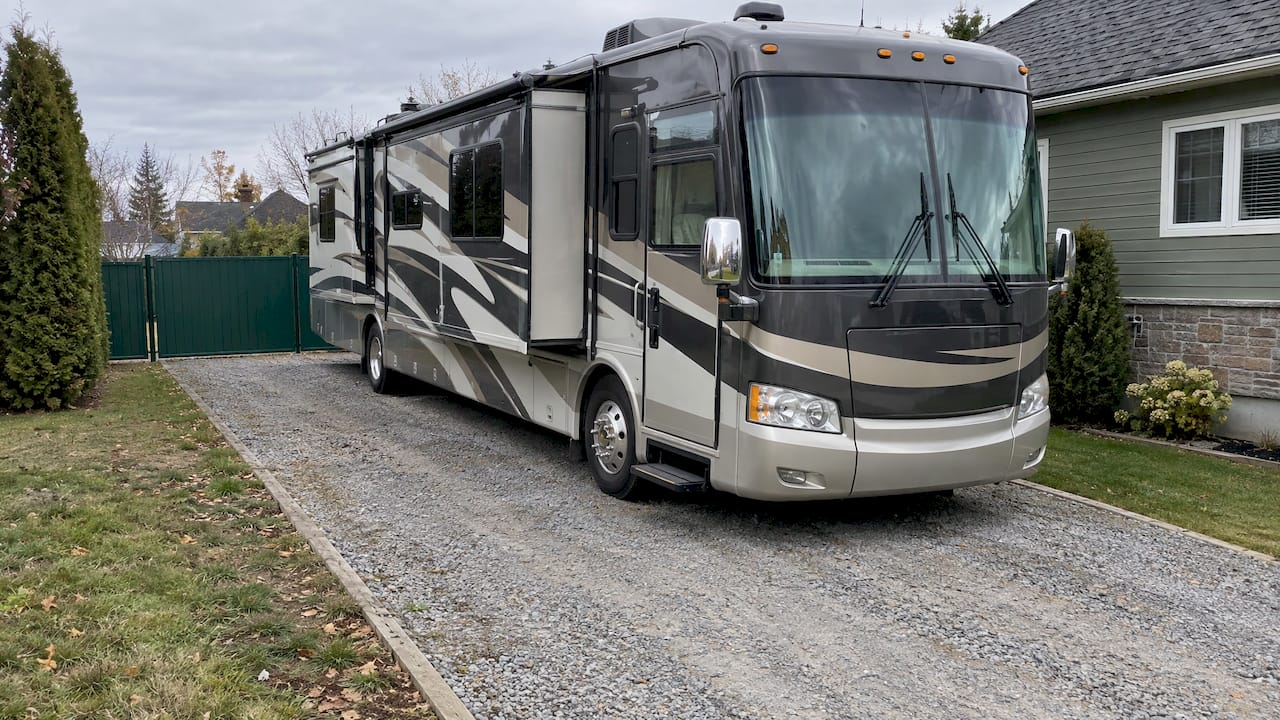
For most home RV pads, plan on a pad at least 2 feet wider and 4 feet longer than your rig, and add about 4 feet of width if you want to run the slide-outs. In practice that means roughly 12 to 16 feet wide and 30 to 45 feet long for a Class A motorhome or fifth wheel, and a little less for a travel trailer. Below you will find the numbers by RV type, what changes them, how the driveway leading to the pad should be sized, and what the base and the budget look like.
TL;DR
- Rule of thumb: pad length and width should exceed the RV by 4 feet and 2 feet, and more if the slide-outs will be open.
- A good starting point for a Class A or fifth wheel is 12 to 16 feet wide and 30 to 45 feet long, with clear space around the rig.
- The driveway that feeds the pad commonly runs 12 to 16 feet wide, and your city may set its own minimum.
- Gravel needs at least 4 inches of compacted base for a standard RV and 6 inches for heavy rigs; budget by square foot once you have the footprint.
- Draw the pad on a satellite map before you call anyone, so the dimensions you quote are the ones you will actually build.
Table of Contents
- Start with your RV’s real dimensions
- RV parking pad dimensions by rig type
- How much wider and longer than the RV?
- Slide-outs, awnings and the tow vehicle
- RV driveway width and length
- Local rules to check before you draw anything
- Surface and base: gravel or concrete
- What an RV pad costs
- Perspective
- Plan your pad on a map before you request quotes
- A quick planning checklist
- FAQ
- Sources
Start with your RV’s real dimensions
A pad is sized from the rig, not from a generic number. Typical widths run 8 to 10 feet for Class A motorhomes, 7 to 8.5 feet for Class C and 7 to 8 feet for travel trailers. Lengths for Class A coaches run 25 to 45 feet, and Class B vans run 16 to 22 feet, according to the same source.
Those are brochure figures. Pull out the spec sheet for your exact model and write down four numbers:
- Overall length, including bumper, ladder, spare tire carrier and hitch.
- Overall width with slide-outs retracted.
- Width with every slide-out and the awning extended.
- Overall height, including air conditioners and roof vents.
Then decide whether the tow vehicle will sit on the pad too. A fifth wheel that is still hitched can exceed 60 feet in combined length, which changes the pad plan completely compared with a trailer parked alone.
RV parking pad dimensions by rig type
The table combines the rule of thumb (rig plus 2 feet of width and 4 feet of length) with the ranges published for larger rigs. Treat the results as starting points, then adjust for your own measurements.
| Rig | Typical body width | Typical length | Suggested pad width | Suggested pad length |
|---|---|---|---|---|
| Class B van | about 7 to 8 ft | 16 to 22 ft | 10 to 12 ft | 22 to 28 ft |
| Small travel trailer | 7 to 8 ft | 16 to 26 ft | 10 to 12 ft | 24 to 32 ft |
| Class C motorhome | 7 to 8.5 ft | 20 to 33 ft | 12 ft | 30 to 40 ft |
| Large travel trailer or fifth wheel (parked alone) | 8 to 8.5 ft | 30 to 40 ft | 12 to 14 ft | 35 to 45 ft |
| Class A motorhome | 8 to 10 ft | 25 to 45 ft | 12 to 16 ft | 30 to 45 ft |
The Class B, small trailer and Class C rows are our own arithmetic from the rig sizes above and the 2-foot and 4-foot margins. The Class A row follows the published 12 to 16 foot by 30 to 45 foot starting range.
Another source points out that pads at campgrounds and parking areas are at least 10 feet wide, and at least 30 feet long for average RVs or 45 feet for larger ones. That is a reasonable floor for a side-yard pad, though a home pad you will walk around, level and maintain deserves more room.

How much wider and longer than the RV?
The guidance converges on a simple formula. An ideal pad is at least 4 feet longer and 2 feet wider than the RV’s maximum length and width. The absolute minimum is the rig plus 2 feet on each side, which that same source warns will probably feel cramped.
Why the extra room matters:
- Leveling blocks and jack pads. You need somewhere to put them without them hanging off the edge.
- Door swings. The entry door, bay doors and any basement storage doors all need clearance.
- Walking around the rig. A common DIY error is building too small, leaving no room for blocks, jack pads, awnings, door swings or working around the rig.
- Tire placement. A pad edge is its weakest point, and leaving at least 3 feet of clear space per side keeps the tires off that edge, per the same guidance.
If you can afford only one extra, spend it on width. Length mistakes are easy to live with because you can pull forward or back. A pad that is too narrow cannot be fixed without breaking out the edges.
Slide-outs, awnings and the tow vehicle
Slide-outs are where most pad plans go wrong. Most RVs measure 8 to 8.5 feet wide with slide-outs retracted, but deployed slide-outs extend 2 to 3 feet per side. Plan to add at least 4 feet to the pad width for fully extended slide-outs.
In real life that works out as follows. A 8.5-foot rig with slides out on both sides can reach about 13.5 to 14.5 feet of body width. A 14-foot pad would put the slide floors almost over the edge. Slide-outs do not need to sit over the pad surface itself, so grass or gravel beside the pad can work, but you must keep that side of the property clear of fences, shrubs, downspouts and utility boxes.
For length, decide before you pour where the tow vehicle will go:
- Beside the pad or in the driveway: size the pad for the RV only.
- On the pad, hitched: add the full length of the truck, and leave a few feet for the hitch and for walking between the vehicles.
- Backed in with a trailer: leave extra approach length so you can straighten the rig before you reach the pad.
RV driveway width and length
The driveway is a separate dimension from the pad, and it is often the real bottleneck. One buyer’s guide gives a standard RV driveway width of 12 to 16 feet and length of 40 to 60 feet, with clearance of 13 to 14 feet. Minimum widths start at 12 feet for single-lane access, while 14 to 16 feet is recommended for larger RVs or two-way traffic.
Three things to check beyond width:
- Slope. A grade of at least 1 to 2 percent helps direct water away from the parking area, and larger RVs need gentler approach angles so the underside does not scrape.
- Turning radius. A 35-foot coach does not turn like a pickup. Our guide on how to measure your driveway turning radius walks through the process with a tape and some chalk.
- Overhead clearance. Tree limbs, eaves and utility lines matter as much as pavement width. Roof air conditioners add inches you may forget.
If you are widening or lengthening an existing driveway to reach the pad, look at what a driveway extension really costs before you commit, and read about driveway width standards and permit minimums, since the width you can build is often limited by your city.
Local rules to check before you draw anything
Local codes can override every number above. Cities regularly regulate where an RV can park on a residential lot. As one example, Escondido, California allows RV parking in rear yards with a minimum 3-foot separation from walls containing windows and doors, screening from neighboring properties by a 5-foot solid wall, fence or vision-obscuring landscaping, and no encroachment into the public right-of-way without a permit.
Your city or county will have its own version. Before you pay for excavation, call the planning or building department and ask:
- Is RV parking allowed in the front, side or rear yard?
- What are the setbacks from property lines and from the house?
- Is screening required, and how tall?
- Does a new pad or driveway apron need a permit, and does the curb cut have a maximum width?
- Are there HOA rules on top of the city’s?
Also confirm where your lot lines and utilities run. Call 811 before you dig anywhere in the US.
Surface and base: gravel or concrete
The footprint sets the size, but the base sets how long the pad lasts. Heavy rigs concentrate load on four or six small contact patches, and soft soil is the usual cause of ruts and cracks.
Gravel pads
For gravel, plan on at least 4 inches of compacted gravel for a standard RV and 6 inches for heavier Class A motorhomes or large fifth wheels. On soft or heavy clay soil, 6 to 8 inches of compacted material is recommended by the same calculator. Gravel is forgiving, drains well and is cheaper per square foot, but it needs periodic regrading, and edges need restraint so the stone stays in place.
Concrete pads
One installer reports that a standard 4-inch reinforced slab handles RVs up to 30,000 pounds, with installation involving excavating 8 to 10 inches of topsoil, compacting a 4 to 6 inch gravel base, setting forms with rebar and pouring a 4000 PSI mix. Base preparation matters as much as thickness: a thin slab over a perfectly prepared base can outlast a thicker one poured over soft fill. If your rig is heavy, ask your contractor about thicker edges and a thicker slab, and confirm your rig’s loaded weight from its weight placard.
For a practical walk-through of how a compacted base is built and checked, this guide to patio base preparation covers the same steps that apply under a heavy pad. For concrete budgeting, our concrete pad cost guide shows how thickness and area drive the total, and the asphalt vs concrete comparison helps if you are weighing a paved surface.
What an RV pad costs
Once you have the dimensions, cost is mostly square footage. For gravel, one cost report gives materials at $2.50 to $6.50 per square foot and labor at $1.50 to $4.00 per square foot. That puts a 12 by 40 foot pad at roughly $2,400 to $8,000, and a 12 by 60 foot layout at $3,200 to $10,500.
Here is why the footprint matters so much. Adding 2 feet of width to a 40-foot pad adds 80 square feet. At the materials-plus-labor range above, that is a noticeable jump, but it is far cheaper than redoing the pad later. Other factors that move the price:
- Soil type, which decides whether you need 4 inches of base or 8.
- Excavation depth and where the spoil goes.
- Access for trucks and compactors.
- Drainage work, edging and any new driveway apron.
- Local labor and material prices, which differ across Idaho, Utah and the rest of the country.
These are published ranges, not quotes for your lot. Your own number depends on your dimensions and your local market.
Perspective
Most of the RV pad questions we see come down to one thing: homeowners estimate with a generic number, then discover the real site is different. The pad that looked like 12 by 40 feet on paper runs into a fence line, a sloped side yard, or a downspout once it is on the ground.
That is why we built our planning tools around the property itself. Drawing the pad on aerial imagery lets you see the slide-out side, the approach path and the distance to the house before anyone brings equipment. The dimensions you draw become the dimensions in the estimate, and the same drawing, measurements and photos go to the contractor, so everyone is bidding on the same footprint.
Our advice: size for the rig with its slides open, size the driveway for the turn, and settle the layout before you ask for prices. A clear scope gets clearer bids.
Christian
Plan your pad on a map before you request quotes
If you already know your RV’s dimensions, the quickest next step is to put them on your lot. With our Concrete Estimator you can draw the pad and driveway extension on a satellite view of your property, see local price ranges based on your dimensions, and send a detailed quote request to local contractors. No account is required to start.

Prefer a gravel or asphalt layout? Start from the Property Improvement Estimator home page to find the right tool, or get a local project report for your address.
A quick planning checklist
- Write down your RV’s length, width, slide-out width and height from the spec sheet.
- Decide whether the tow vehicle will sit on the pad.
- Add at least 2 feet to the width and 4 feet to the length, then add about 4 feet of width for slide-outs.
- Check the driveway: 12 to 16 feet of width, a turning path you can actually drive, and overhead clearance.
- Call your city or county about setbacks, screening, permits and curb cuts, and read any HOA rules.
- Choose the surface and base depth for your soil and rig weight.
- Draw the layout on a map, measure it, and request quotes on the same scope.
FAQ
What is the average size of an RV parking pad?
There is no single average, because pads follow the rig. A common range for large rigs is 12 to 16 feet wide and 30 to 45 feet long. For smaller trailers and vans, 10 to 12 feet wide and 22 to 32 feet long is often enough. Use your RV’s overall length plus 4 feet and width plus 2 feet as the baseline.
How wide should an RV driveway be?
Plan on 12 to 16 feet. A 12-foot minimum suits single-lane access, while 14 to 16 feet is recommended for larger RVs or two-way traffic. Your city may set a minimum or maximum width for the curb cut, so check with the building department first.
How thick should a gravel or concrete RV pad be?
For gravel, 4 inches of compacted base suits a standard RV and 6 inches suits heavier rigs, with more on clay or soft soil. For concrete, a 4-inch reinforced slab is a common spec. Heavy rigs and weak soil call for a contractor’s advice on thickness and base.
Do I need extra space for slide-outs?
Yes. Slide-outs extend 2 to 3 feet per side, so add about 4 feet of pad width, or keep that side of the property clear, if you plan to open them while parked.
Sources
- RV Driveway Requirements: Weight, Size & Safety Guide
- How Big Should an RV Pad Be?
- What to Know Before Installing an RV or Boat Parking Pad
- How Much Wider And Longer Should RV Pad Be Compared To The RV
- RV Driveway Requirements: Complete Buyer’s Guide
- RV Storage Buildings: Sizes & Cost
- Article 25: Parking of Recreational Vehicles in Residential Zones, Escondido
- RV and Camper Pads Made Easy Installation Guide
- RV Pad Calculator: Gravel and Crusher Run Base
- Gravel RV Pad Cost: Price Range, Size Impacts, and Regional Costs
- DIY Patio Base Preparation