Protect Your Home: Questions to Ask Contractors and a COI to Request

Before you hire a contractor, ask about license and insurance, references, permits, timeline, subcontractors, payment terms, and warranty coverage, then verify every answer against a document. Use the categorized questions below in every interview, and compare bids side by side. Ask for a certificate of insurance (COI), check the FEMA checklist as a reference, and use a tool like Property Improvement Estimator to keep your project scope identical across every bid you collect.
TL;DR:
- Always verify license numbers directly with your state’s licensing board to confirm they are active and in good standing before proceeding.
- Obtain a certificate of insurance from contractors and call the insurer independently to verify policy coverage and dates.
- Gather three to five references from similar projects and ask detailed questions to assess each contractor’s reliability and work quality.
- Ensure the contract details scope, materials, milestones, and warranties explicitly in writing to prevent scope creep and payment disputes.
- Use precise project drawings and specifications, such as satellite-based tools, to get comparable bids and avoid scope assumptions that cause cost differences.
Table of Contents
- Questions to Ask Contractors, Organized by Category
- What Belongs in Your Contract and Payment Terms
- Red Flags That Should Stop You Before You Sign
- Turning Answers Into an Apples-to-Apples Comparison
- Get Precise, Comparable Bids With Property Improvement Estimator
- Where to Check These Claims Yourself
- Sources
Questions to Ask Contractors, Organized by Category
Plan on 5 to 7 core questions per topic area and a 45 to 60 minute conversation, according to interview guidance from AvaHR, which leaves room for follow-ups instead of rushing through a script. Write down every answer. A contractor who sounds great in person but won’t put anything on paper is telling you something.
Licensing and insurance
- What’s your license number, and which agency issued it? A strong answer is instant and specific. A weak one is vague or delayed. Verify it yourself with your state licensing board before you go further.
- Can you send me a certificate of insurance today? Legitimate contractors have this ready. Hesitation is a warning sign.
- Do you carry workers’ compensation for your crew? Without it, you could be liable if someone gets hurt on your property.
- Are you bonded? Bonding gives you a recovery path if the job goes badly wrong.
- Will your insurance cover subcontractors too, or do they carry their own? Get this in writing before work starts.
Experience and references
- How many projects like mine have you completed recently? Seek a clear answer.
- Can you give me 3 to 5 references from similar jobs? FEMA’s contractor checklist specifically recommends this range, and it’s the single best trust signal on this list.
- Do you have photos of finished work I can see? Real portfolios show range and consistency.
- How long have you been in business under this company name? Watch for contractors who rebrand every few years to dodge complaints.
Permits and inspections
- Will you pull the permits, or is that on me? For most structural or electrical work, it should be the contractor.
- How many permits have you pulled in this jurisdiction in the past two years? FEMA lists this as a direct way to gauge familiarity with local codes. A contractor who works regularly in your city or county will know the inspector by name.
- Who schedules inspections, and how will I know when they’ve passed? You want a paper trail, not a verbal promise.
Timeline and schedule
- What’s your estimated start date, and how firm is it? Reasonable contractors give a window, not a guarantee, but they should explain why.
- What are the major milestones, and when should each be done? A written schedule protects you if the project stalls.
- What typically causes delays on jobs like mine, and how do you handle them? A thoughtful answer beats “nothing ever comes up.”
- Will you tell me proactively if the schedule slips, or do I have to ask?
Subcontractors and supervision
- Will you use subcontractors, and if so, for what parts of the job? Get their trade and company name.
- Do subcontractors carry their own insurance, or does yours cover them? FEMA’s guidance recommends requiring COIs for subcontractors before they start, not after.
- Who is on site supervising day to day? You want a name, not “someone will be around.”
- How do I reach the site supervisor directly if I have a question mid-project?
Contract, payment, and communication
- What’s your standard payment schedule? Watch closely for anyone asking for full payment upfront.
- What payment methods do you accept, and can I get receipts for each? Traceable payments protect you if a dispute happens later.
- Who is my main point of contact, and how often will I get updates? Kiplinger’s renovation guidance points to this as one of the most overlooked but important questions homeowners can ask.
- How do you handle change orders if I want to modify something mid-project?
Warranty and materials
- What’s your warranty on labor, and how long does it last? One year is the floor; two years is better.
- Are manufacturer warranties on materials separate from your labor warranty?
- Will I get the warranty in writing at project completion?
- Where do your materials come from, and can I see samples or specs before you order?
What Belongs in Your Contract and Payment Terms
A verbal agreement, no matter how confident the contractor sounds, protects nobody. Your contract needs specifics, not summaries.
Insist on a written scope that spells out exact materials, brands, and quantities, plus firm start and estimated completion dates with named milestones in between. Every page should be signed and dated by both parties, not just initialed at the end.
- Full project scope, including materials, dimensions, and finishes
- Start date, milestone dates, and estimated completion
- Total price broken down by labor and materials
- Payment schedule tied to milestones, not just a start and end payment
- Change order process, in writing, with pricing for added work
- Warranty terms and lien waiver language
On payment, Checkbook recommends avoiding full payment upfront and sticking to traceable methods like checks or card payments you can dispute if needed. A standard structure is a modest deposit, one or two milestone payments, and a final payment held until the work passes inspection.
For changes mid-project, your contract should require a signed change order before any extra work begins, with the added cost spelled out. Redfin’s guidance for homeowners is blunt about this: undocumented scope changes are one of the most common sources of budget disputes. On warranty, expect a minimum of one year in writing, with two years preferred for larger jobs, and always get a signed lien waiver once the final payment clears.
Red Flags That Should Stop You Before You Sign
Some answers should end the conversation immediately, not just raise an eyebrow.
- Pressure to sign the contract on the spot, or refusal to let you take it home overnight
- No certificate of insurance, or a COI that doesn’t check out with the insurer
- Requests for full payment upfront or cash-only, untraceable payments
- No written contract, only a verbal handshake and a start date
- Vague, evasive answers about subcontractors, permits, or warranty terms
If you hit any of these, call the insurer to confirm coverage, verify the license with your state board, and get two or three more bids before deciding anything. Redfin notes that reputable contractors expect you to review paperwork, and won’t push back on a short delay to check documents.
Turning Answers Into an Apples-to-Apples Comparison
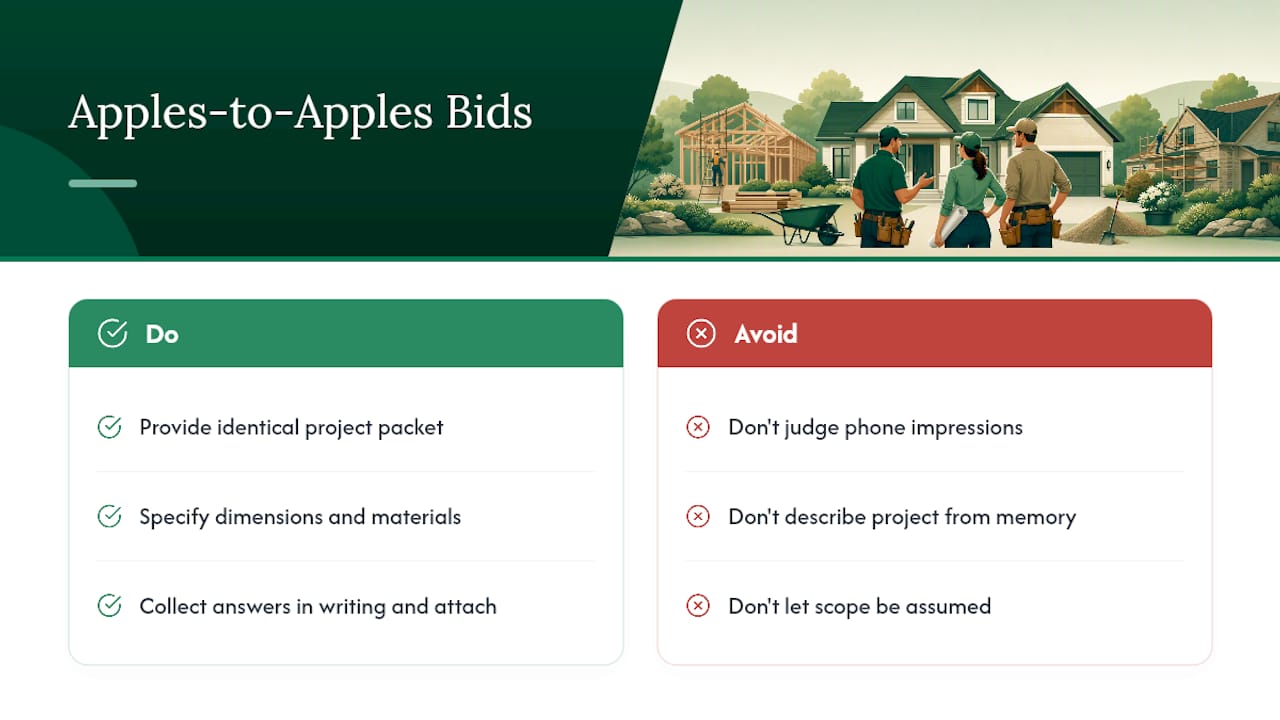
Collect every answer in writing and attach it to the matching bid. That’s the only way to compare contractors fairly instead of guessing which one sounded more trustworthy on the phone.
The biggest reason bids come back wildly different isn’t pricing, it’s scope. One contractor assumes a 6 foot fence, another assumes 4 feet. One quotes cedar, another quotes pressure treated pine. When the project packet you hand out is identical for every contractor, down to dimensions and material choices, the bids you get back finally mean something. That’s the whole idea behind building a site-specific plan before you request quotes, rather than describing your project from memory over the phone.
— Christian
Get Precise, Comparable Bids With Property Improvement Estimator
Ambiguous bids are the root cause of most of the red flags covered above. When a contractor guesses at your project’s scope, you end up with vague pricing, unexpected change orders, and answers that don’t match project to project. Property Improvement Estimator fixes that by letting you draw your fence, deck, pool, or lighting project directly on a satellite map of your property before you ever contact a contractor.

Every drawing generates a detailed packet with exact measurements, material options, and photos, so contractors bid on the same scope instead of their own assumptions. That means fewer surprise change orders, faster apples-to-apples comparisons, and quotes that reflect your actual property instead of a generic estimate. Try the satellite project estimator for your next fence, deck, or lighting project, or start with the project cost calculator to see what your plan might cost before you contact a single contractor.
Where to Check These Claims Yourself

The FEMA contractor checklist covers permits, warranties, and lien waivers in detail. Travelers’ hiring checklist walks through insurance verification and comparing bids. Your state’s licensing board site confirms whether a contractor’s license is active.
Sources
Getting answers is step one. Confirming they’re true is what actually protects you.
Start with the certificate of insurance. A real COI lists the insurer’s name, policy number, coverage limits, and effective dates. Don’t just glance at it. Call the insurance company directly using a number you find independently, not one printed on the document, and confirm the policy is active and matches the coverage the contractor described.
For licensing, go to your state’s contractor licensing board website and search the license number. Check that the status reads “active” or “in good standing,” not “expired,” “suspended,” or “revoked.” Most state boards also list any disciplinary history or complaints, which is worth five minutes of reading.
References take more effort, but they matter more than any other check on this list, so review our remodeling contractor interview questions to prepare effectively. FEMA recommends gathering 3 to 5 references from jobs similar to yours in scope and size, not just any past client.
When you call, ask:
- Checklist to Ask Your General Contractor | FEMA
- Checklist for hiring the right contractor | Travelers
- Questions to Ask General Contractors Before Starting a Project | Redfin
- What to Ask a Contractor Before a Renovation | Kiplinger
Pro Tip: Keep a simple notes file, one page per reference, with the date you called and their answers in their own words. When you’re comparing three contractors two weeks later, you won’t remember which reference said what.