Pool Cost for Homeowners: Real Ranges and How to Estimate Yours
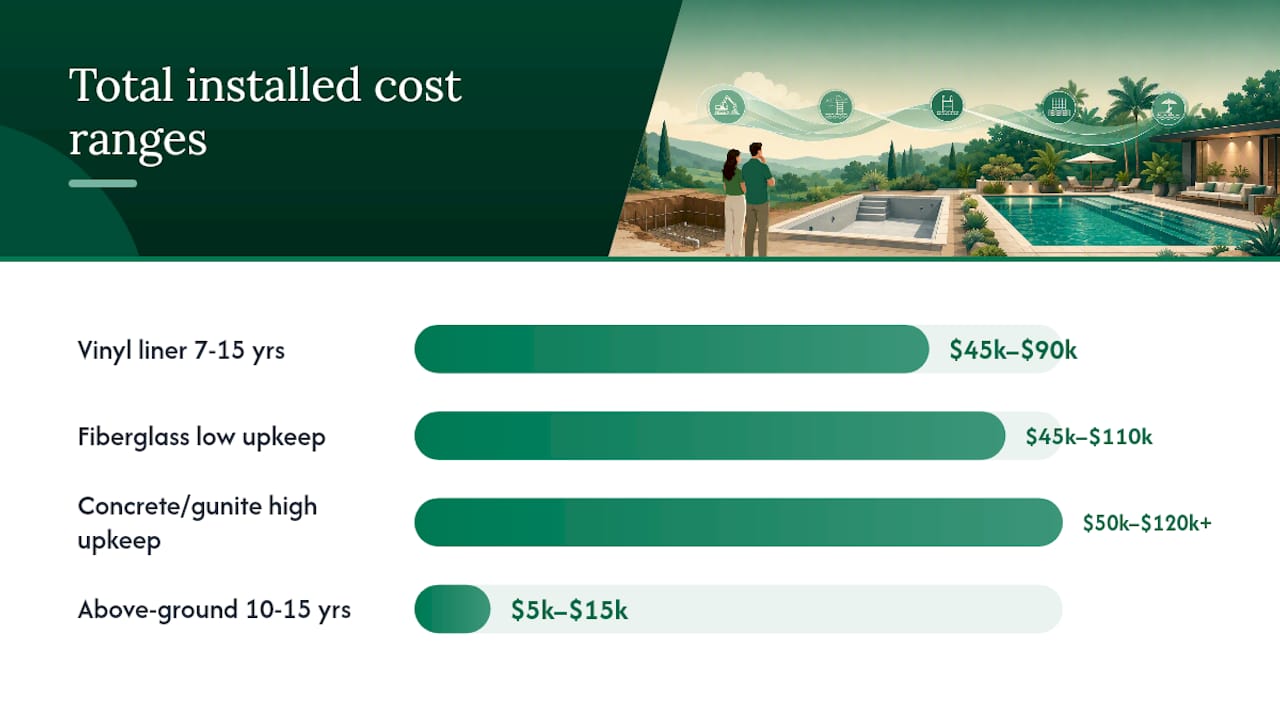
A complete inground pool project typically runs $55,000 to $120,000, while a basic above-ground pool can land as low as $5,000 to $15,000. Fiberglass shells generally cost $45,000 to $110,000 installed, vinyl liner pools fall in a similar $45,000 to $90,000 band, and concrete gunite pools run $50,000 to $120,000 or more once you add deck, fence, and equipment.
- Fiberglass: $45,000–$110,000 installed
- Concrete/gunite: $50,000–$120,000+ installed
- Vinyl liner: $45,000–$90,000 installed
- Above-ground: $5,000–$15,000 installed
Contractor quotes for the shell alone almost never include decking, fencing, electrical upgrades, or permits. The fastest way to turn these ranges into a real number for your yard is to run a pool cost calculator and sketch your lot with a site drawing tool before you call anyone for a bid.
Key Takeaways
Installed pool cost depends far more on site conditions and add-ons than on the shell price alone, and a site-specific drawing tool closes that gap faster than phone-call bids ever will.
| Point | Details |
|---|---|
| Fiberglass offers the best ownership value | Lower installed cost than concrete and annual upkeep around $800–$1,500 with no resurfacing cycle. |
| Shell quotes are incomplete by default | Expect base bids to grow 40–60% once decking, fencing, and permits are added. |
| Site conditions drive the biggest surprises | Rock excavation or crane access alone can add $5,000–$20,000 to a project. |
| Budget a real contingency | Set aside 10–20% for unexpected site work before finalizing any pool budget. |
| Get a local, itemized number first | Propertyimprovementestimator’s pool estimator turns your yard’s dimensions and site constraints into a comparable, contractor-ready quote request. |
Table of Contents
- How installed costs differ by pool type
- What does a typical pool quote actually include?
- How does pool size change the price per square foot?
- What site conditions push the quote higher?
- What does pool ownership cost after installation?
- How long does a pool project take, and what permits are needed?
- How do you get a site-specific pool cost estimate?
- What do low, mid-range, and high-end pool budgets actually look like?
- How do you get accurate, comparable contractor quotes?
- Budget defensively, not optimistically
- Get a site-specific pool estimate before you call a contractor
- Where to check pool cost numbers and run your own calculations
- Frequently Asked Questions
- Sources
How installed costs differ by pool type
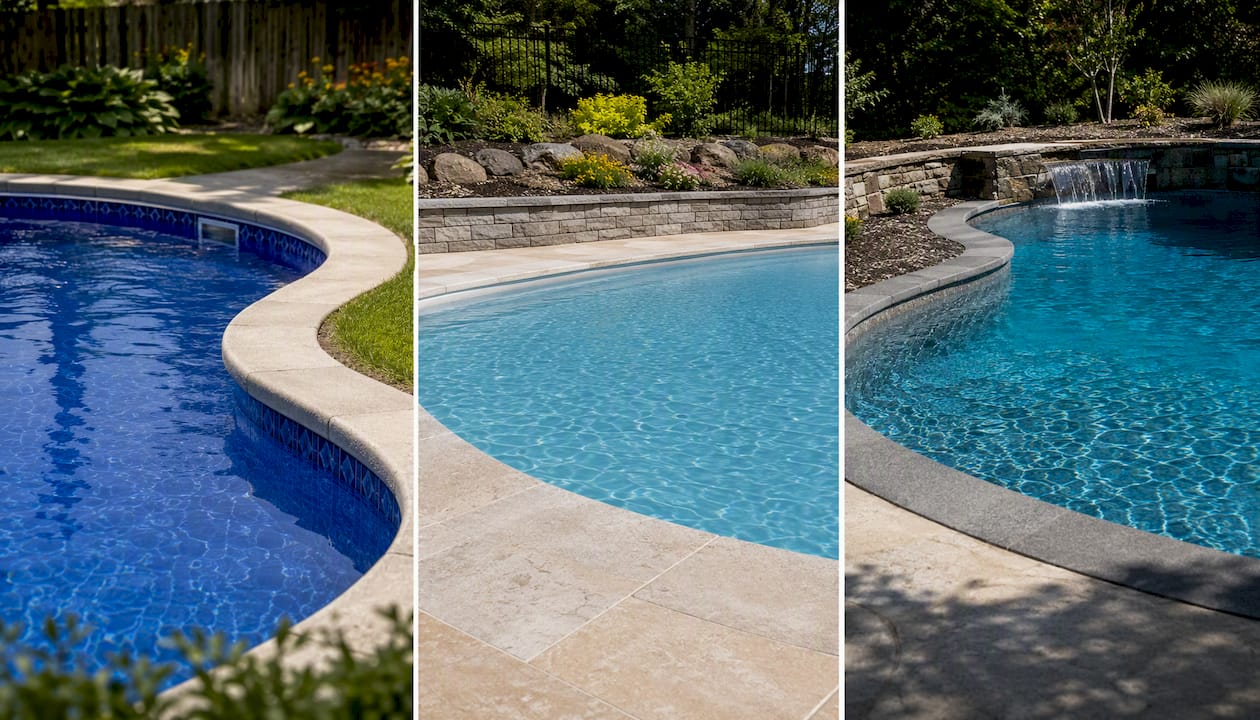
The pool type you pick drives your upfront price, your monthly upkeep, and how long the surface lasts before it needs major work. Vinyl liner pools cost the least to install but need a liner swap roughly every 7 to 15 years. Fiberglass costs more upfront than vinyl but tends to need the least ongoing attention, since annual maintenance often runs just $800 to $1,500 with no resurfacing cycle at all. Concrete gives you the most design freedom, custom shapes, tanning ledges, raised spas, but it costs the most to build and the most to maintain over time.
| Pool type | Total installed (low–high) | Cost per sq ft | Lifespan/maintenance burden | Customization |
|---|---|---|---|---|
| Vinyl liner | $45,000–$90,000 | $50–$120 | Liner swap every 7–15 yrs; moderate upkeep | Limited shapes, budget-friendly |
| Fiberglass | $45,000–$110,000 | $65–$150 | Low upkeep, no resurfacing needed | Fixed molds, some size limits |
| Concrete/gunite | $50,000–$120,000+ | $80–$250 | High upkeep; resurface every 10–15 yrs | Fully custom shapes and features |
| Above-ground | $5,000–$15,000 | $15–$40 | Liner/frame wear in 10–15 yrs | Minimal |
A quote for “the pool” and a quote for “the finished backyard” are two different documents. Always ask whether a number covers the shell only or the complete installed project, since that gap is usually where sticker shock happens.
What does a typical pool quote actually include?
Most base contractor bids cover excavation, the shell or liner, plumbing, a standard pump and filter, and startup chemicals. What they typically leave out: decking, fencing, electrical panel upgrades, landscaping repair, and in some markets, permit fees. That’s why a $55,000 to $120,000 complete project can start life as a $35,000 “base price” quote that grows by 40 to 60% once every real cost gets added.
Mid-range dollar bands for common line items:
- Ask whether the bid includes final grading and topsoil restoration around the excavation zone.
- Confirm GFCI protection and bonding wire are already in the electrical scope, not billed later.
- Get the deck material spelled out (stamped concrete vs. pavers changes the number fast).
Pro Tip: When you get a quote that seems unusually low, ask directly whether permit fees, final inspections, GFCI, and bonding are included. A missing answer is often the first sign of a bid that’s going to grow later.
How does pool size change the price per square foot?
Bigger pools cost more in total but often less per square foot, since excavation mobilization, plumbing runs, and equipment costs get spread across more water. A tiny plunge pool can carry a higher per-square-foot rate than a full-size family pool because fixed costs don’t shrink with the footprint. National figures put the typical per-square-foot range around $80 to $250, with the national average project landing near $62,500.
Sample size-to-cost lines for a mid-range fiberglass or gunite build:
- 10×20 ft (200 sq ft): roughly $40,000–$65,000 installed
- 12×24 ft (288 sq ft): roughly $50,000–$80,000 installed
- 16×32 ft (512 sq ft): roughly $65,000–$110,000 installed
- 20×40 ft (800 sq ft): roughly $85,000–$150,000+ installed
- Adding depth (a diving well or deep end past 6 feet) usually adds a flat premium, not a proportional one, since it’s mostly extra excavation and shell material.
- A simple scaling rule: budget roughly $250 to $500 more for every extra 50 square feet of surface, adjusted up if you’re also adding depth or a custom shape.
What site conditions push the quote higher?
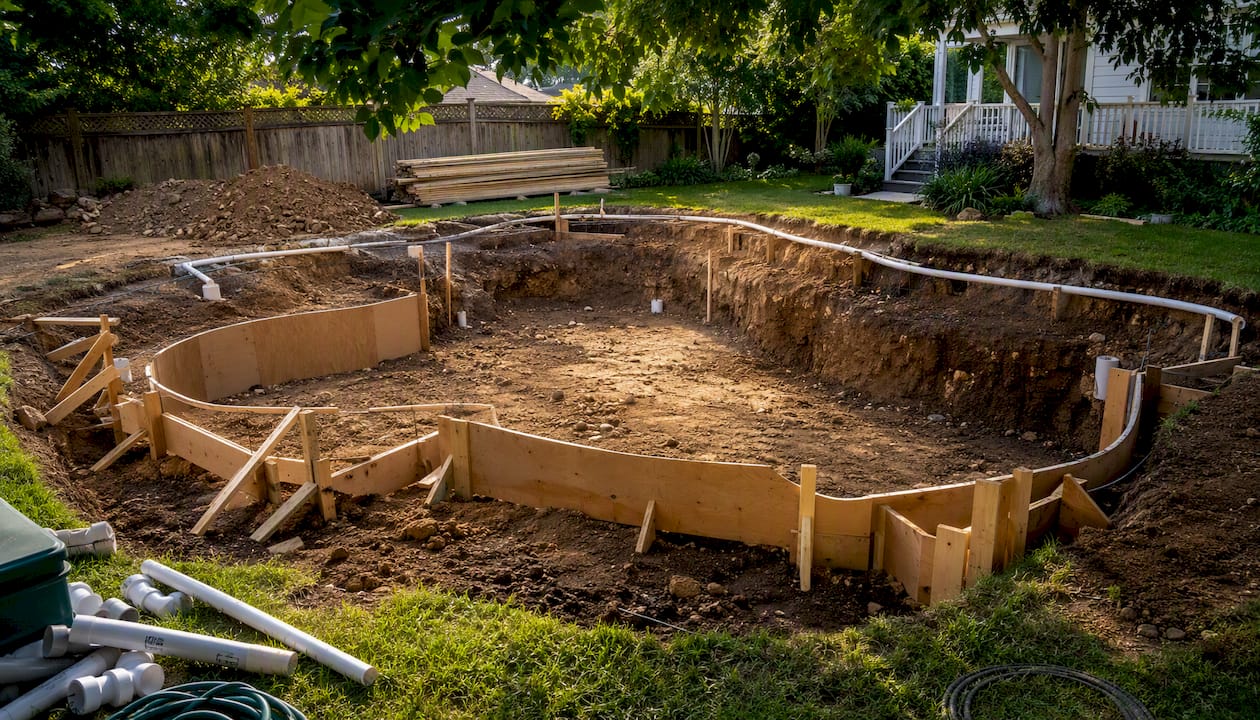
Your yard, not the pool catalog, usually decides the final number. Rock or bedrock hit during excavation, a high water table, tight side-yard access requiring a crane, slope requiring retaining walls, buried utilities, and tree removal can all add real money fast. Rock excavation or a crane for restricted access can tack on $5,000 to $20,000 or more, and retaining wall work for sloped lots adds further cost on top of that.
- Ask your excavator about known rock or high water table issues in your neighborhood before you sign anything.
- Photograph your gate width and side-yard clearance so a contractor can flag crane needs early.
- Note any large trees or buried lines near the dig zone before your first site visit.
Pro Tip: Bring a rough sketch of your yard with existing utilities marked to your first contractor meeting. It saves a second visit and often shaves days off the quote turnaround.
What does pool ownership cost after installation?
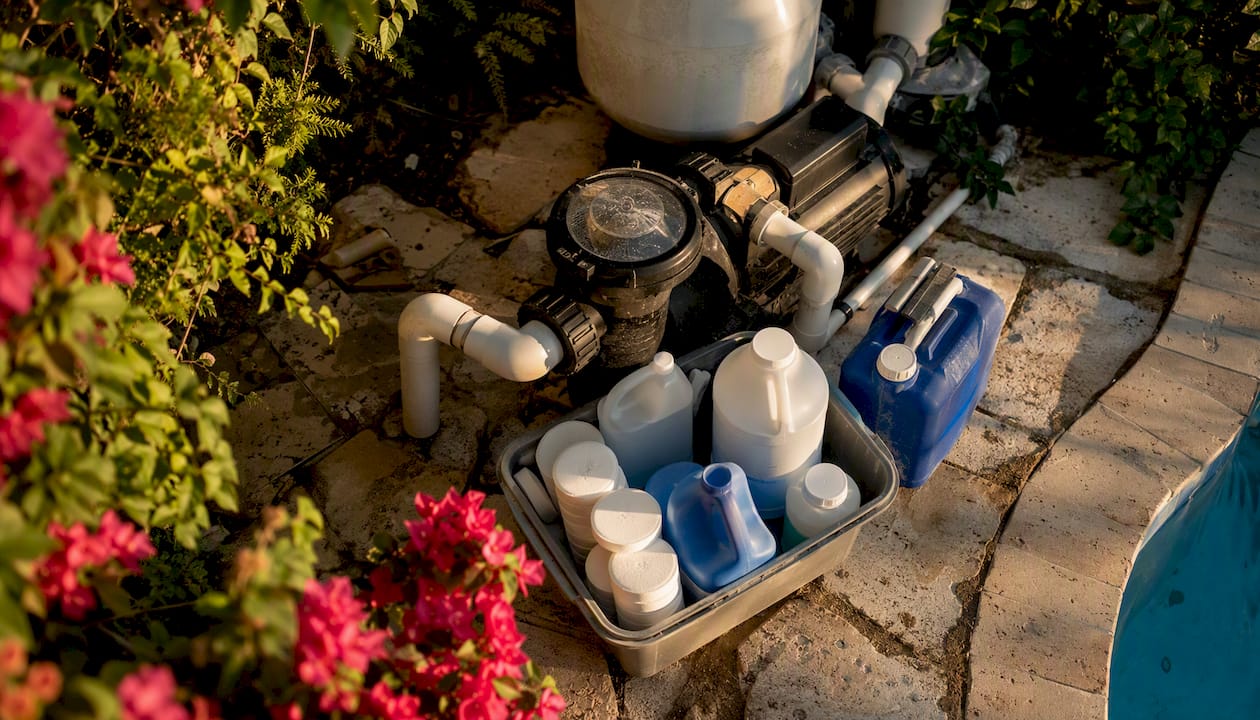
The build price is only half the equation. Chemicals, electricity for pumps and heaters, and routine cleaning typically run $100 to $300 a month depending on pool size and climate, or roughly $1,200 to $3,600 a year. Fiberglass owners tend to land at the low end of that range, with full annual upkeep around $800 to $1,500 since there’s no plaster to protect.
Major scheduled costs to plan for: vinyl liner replacement every 7 to 15 years ($3,000–$5,000), and concrete resurfacing every 10 to 15 years costing $8,000 to $10,000. Over a 10-year ownership window, fiberglass often ends up cheaper overall than concrete once resurfacing and higher chemical use are considered, despite sometimes similar upfront prices. Vinyl pools incur costs from liner replacements, fiberglass avoids resurfacing expense, and concrete pools generally have higher total costs over time.
How long does a pool project take, and what permits are needed?
Site prep through startup typically runs:
- Above-ground: 1 to 2 weeks
- Vinyl liner: 4 to 8 weeks
- Fiberglass: 3 to 6 weeks
- Concrete/gunite: 8 to 14 weeks, since curing time between phases adds delay
Weather, permit backlogs, and 2025–2026 labor shortages are stretching lead times further in many markets. Expect to budget for building permits, electrical permits, and a fencing or barrier permit, since most states require pool barriers and safety features under local code. Permit costs vary widely by county but commonly run several hundred to a couple thousand dollars combined.
- Confirm your municipality’s setback rules before finalizing pool placement.
- Ask whether the contractor pulls permits or if that’s the homeowner’s job.
- Check fence height and self-latching gate requirements before you design your barrier.
How do you get a site-specific pool cost estimate?
Ballpark ranges are a starting point, not a budget. A real estimate needs your exact dimensions, target depth, chosen material, site access conditions, and your local labor market, since regional pricing swings 20 to 40% above or below the national average depending on where you live.
Here’s how the process works in practice:
- Draw your lot boundaries and existing structures on a satellite-based property map.
- Place the pool footprint at your desired dimensions and pick a material (vinyl, fiberglass, or concrete).
- Add site constraints, slope, access width, existing utilities, so the estimate reflects real conditions, not a generic average.
- Run the numbers through a pool estimate calculator that factors depth, excavation, and equipment.
- Export the scope and request quotes from local contractors using the same drawing and dimensions.
Propertyimprovementestimator’s pool estimator lets you build that map yourself, save multiple design options, and generate a structured project packet, measurements, finish choices, and photos included, so every contractor bids on the exact same scope instead of guessing from a phone call.
Pro Tip: Run your pool design alongside a pool material cost calculator before you request quotes. Seeing shell, liner, and coping costs broken out separately makes it much easier to spot an incomplete bid later.
What do low, mid-range, and high-end pool budgets actually look like?
- A financed mid-range project (roughly $93,000 total) at a typical home improvement loan rate often lands around $700 to $900 a month over 10 to 15 years, depending on your credit and lender terms.
- High-end builds with automation and water features frequently need a contingency closer to 15% given the added mechanical complexity.
How do you get accurate, comparable contractor quotes?
Ask every bidder the same questions so you’re comparing real numbers, not marketing language:
- Does this quote cover the complete project or just the shell?
- Who pulls and pays for permits, and is that cost itemized?
- What happens if excavation hits rock or requires dewatering, is there a contingency clause?
- What’s the warranty on the shell, equipment, and workmanship separately?
- What’s the payment schedule, and how large is the deposit?
- Red flag: a deposit over 30% before any work starts.
- Red flag: no local references or a warranty that’s vague about what’s actually covered.
- Red flag: a bid missing a line for electrical, permits, or final grading entirely.
Request an itemized scope from your top two or three bidders using identical dimensions, so any price gap reflects labor or material differences, not scope differences.
Budget defensively, not optimistically
Site surprises, rock, water tables, access issues, are the norm, not the exception. Prioritize the structural shell, safety equipment, and code-required barriers first, and defer purely decorative extras like water features or elaborate lighting until the pool is running. Multiple competitive quotes, built from the same drawing and scope, remain the single best defense against a budget blowing past its range.
*— Christian
Get a site-specific pool estimate before you call a contractor
Propertyimprovementestimator replaces the guesswork of phone-call estimates with a virtual property map that turns your actual yard, dimensions, slope, access, existing structures, into a local, itemized budget before a single contractor sets foot on your lot.

The flow is straightforward: draw your lot, place the pool footprint and finish options, add site constraints, and run the pool cost calculator to generate a structured scope. That scope, complete with measurements and photos, goes out to contractors as one consistent package, so the bids that come back are actually comparable instead of each one guessing at a different version of your project. Start your project and request a site-specific pool estimate today to see what your exact yard would cost to build.
Where to check pool cost numbers and run your own calculations
- Thursday Pools’ 2026 cost breakdown for regional pricing multipliers and add-on ranges.
- PHTA for industry safety standards and construction best practices.
Frequently Asked Questions
What is the average pool cost for a typical backyard installation? Most complete inground projects fall between $55,000 and $120,000, while above-ground pools run $5,000 to $15,000. The final figure depends heavily on material, size, and site conditions.
Is fiberglass or concrete cheaper over time? Fiberglass usually wins on total cost of ownership. It costs less to maintain annually and never needs the resurfacing that concrete requires every 10 to 15 years.
Why did my contractor’s quote come in so much lower than these ranges? It’s likely a shell-only bid. Ask directly whether decking, fencing, permits, and electrical work are included, since those additions commonly raise the total by 40 to 60%(https://www.angi.com/articles/how-much-does-it-cost-to-build-a-pool.htm).
Does adding a pool increase my home insurance premium? Many insurers raise liability coverage requirements once a pool is added, since it’s classified as an “attractive nuisance.” Check with your carrier before installation to budget for any premium change alongside your fencing and safety costs.
Can a pool actually increase my home’s resale value? In warm climates with strong pool demand, a well-built pool can recoup a meaningful share of its cost at resale. In cooler climates or neighborhoods where pools are uncommon, the return is often more limited, so treat it primarily as a lifestyle investment rather than a guaranteed value boost.
Sources
- Inground Pool Cost Calculator – Estimate Price & Financing
- Fiberglass Pool Cost: What Homeowners Pay in 2026
- Inground Pool Prices: Cost and Price Ranges for U.S. Buyers 2026 – Current Cost
- Inground Pool Cost in 2026: What Buyers Are Actually Paying - Thursday Pools
Recommended
- Pool Estimate Calculator | Type, Depth, Excavation, Equipment, and Local Factors
- Pool Labor Cost Calculator | Excavation, Depth, Equipment, Utilities, Access, and Local Wages
- Pool Material Cost Calculator | Shell, Liner, Equipment, Coping, Safety, and Local Factors
Made with BabyLoveGrowth to create better content