Pickleball Fence Height: 10 ft Backstop and Map Estimate for Backyards
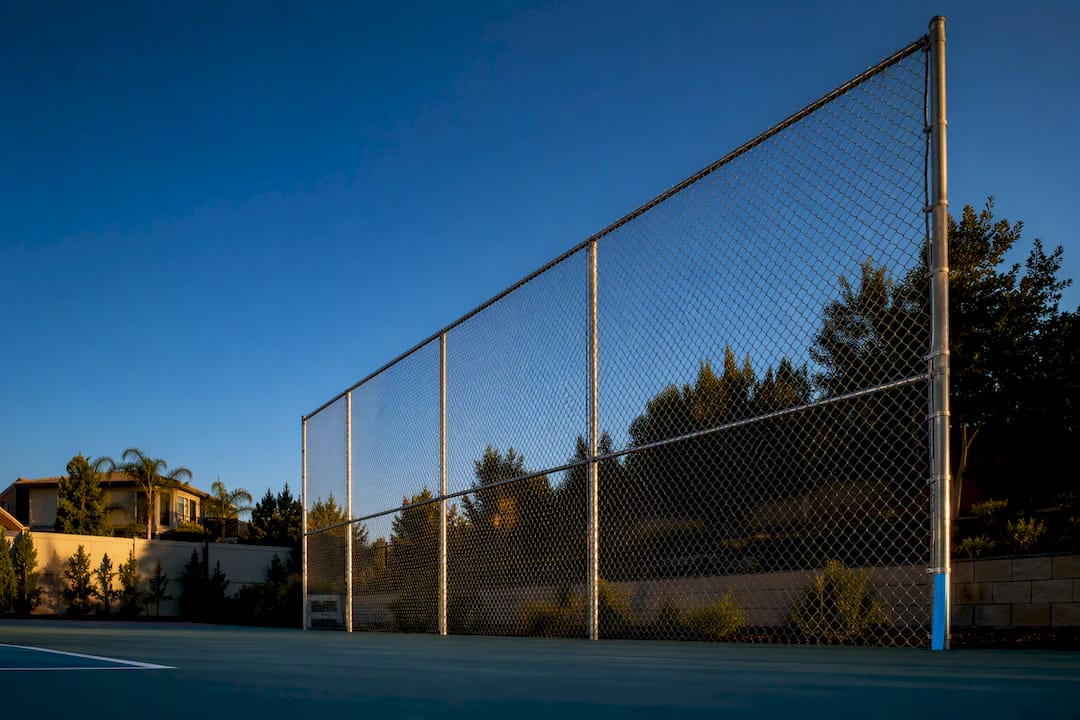
For most home and club courts, a 10 foot backstop with 4 to 6 foot sideline fencing balances containment and sightlines. Indoor courts need at least 18 to 20 feet of ceiling clearance, ideally 20 to 24 feet. Standards like ASTM F3558-24 offer a starting range, but your lot size, neighbors, and budget will shift the final number.
TL;DR:
- Most backstop fences should be around 10 feet tall to withstand ball impacts and avoid costly engineering, especially behind baselines.
- Sideline fences taper from 16 feet at the corner to 42 inches to balance containment and sightlines, with taller options needed for limited run-out spaces.
- Taller fences require careful support posts and footings, and permits are typically needed for fences over 6 feet in height due to local regulations.
- Choosing the right fence material involves balancing visibility, noise reduction, and cost, with vinyl-coated mesh and windscreens offering quieter options.
- Measure your court’s run-out and site conditions first, then use local estimates to plan materials, permits, and contractor scope for an efficient build.
Table of Contents
- Recommended Pickleball Fence Height by Court Location
- How to Choose the Right Fence Height for Your Site
- Fence Materials, Visibility, and Noise Trade-Offs
- Installing Taller Fences: Posts, Footings, and Netting
- Permits and Cost for Taller Pickleball Fences
- Plan Your Fence and Court Layout on a Property Map
- What I’d Tell a Neighbor Building Their First Court
- Get a Site-Specific Fence Estimate Before You Buy Materials
- Sources
- FAQ
Recommended Pickleball Fence Height by Court Location
Fence height isn’t a single number. It changes depending on where the fence sits relative to the ball’s flight path.
Backstops (behind the baseline) take the most abuse. ASTM F3558-24 sets a typical baseline height around 8 feet, while USA Pickleball facility guidance leans toward a 10 foot minimum for competitive play. Most installers split the difference and land on 10 feet, since it stops more errant lobs without tipping into the cost and engineering demands of a 12 foot fence.
Sidelines don’t need the same height, because balls rarely fly hard and high off the side of the paddle. The standard calls for the first 16 feet of sideline fence from each corner to match the backstop height, then taper down to 42 inches for the rest of the run. That taper keeps corner shots contained while opening up sightlines along the middle of the court.
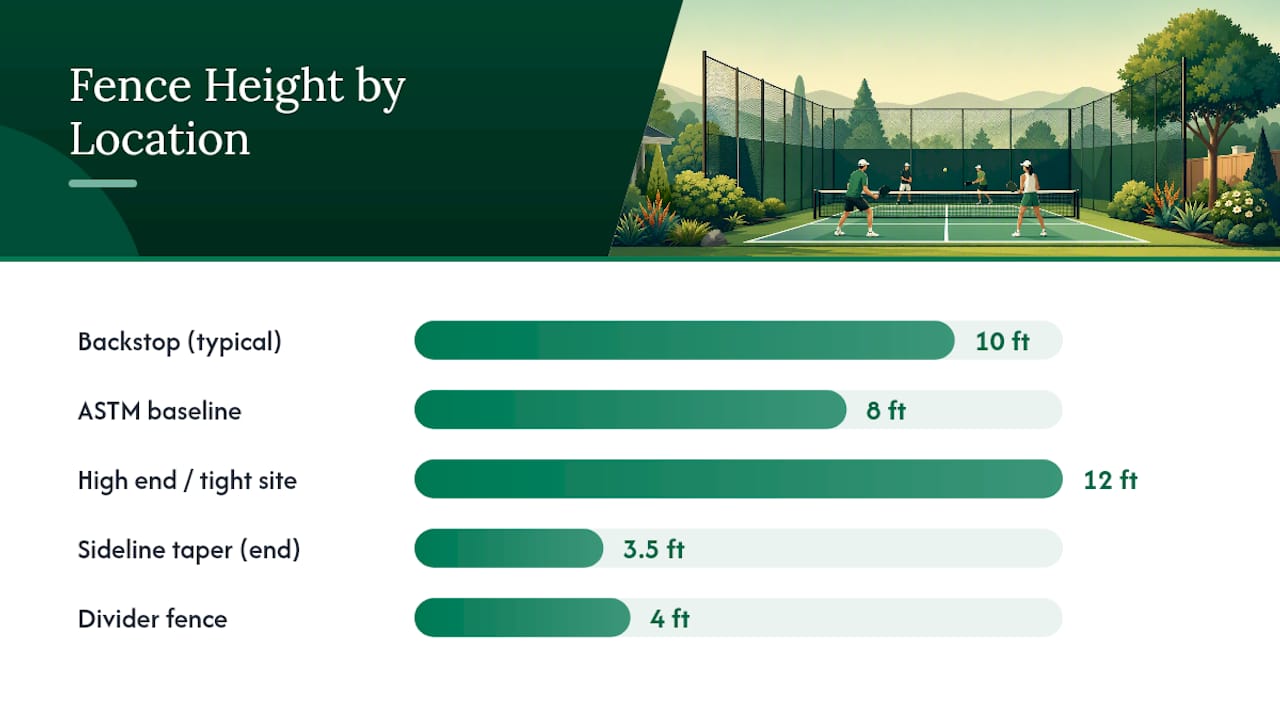
Divider fences between adjacent courts usually run 42 inches to 4 feet, just enough to stop a rogue ball from rolling into the next game without blocking players’ view of neighboring action.
Here’s how those numbers shift with site conditions:
- Rooftop or elevated courts: go taller (10 to 12 feet) or add netting extensions, since there’s no run-out below to catch a ball.
- Tight lots with limited run-out: favor the 12 foot end of the range behind baselines.
- Casual backyard courts with generous space: 6 to 8 foot backstops are often fine if you have 20+ feet of run-out.
- Adjacent hazards (pools, streets, neighboring yards): push toward the taller end regardless of run-out.
Run-out matters as much as fence height itself. A 30 by 60 foot minimum court footprint, with 34 by 64 feet preferred, gives balls enough room to lose momentum before they’d ever reach a fence. Less run-out means you lean on a taller fence to do the containment work that space would otherwise handle.
How to Choose the Right Fence Height for Your Site
Picking a height isn’t a guess. Run through these factors first:
- Player level: competitive players hit harder, higher lobs than casual or family players.
- Run-out distance: less space behind the baseline means you need more fence.
- Adjacent hazards: pools, roads, and parked cars raise the stakes for a missed shot.
- Neighbors and noise: tighter lots often call for solid or acoustic-treated fencing, not just height.
- Wind exposure: taller fencing catches more wind load, which affects posts and footings.
- Sightlines: spectators and players both want to see the game, not a wall.
- Budget: every extra foot of height adds material, labor, and sometimes engineering cost.
A simple three-step process works for most sites:
- Measure your actual run-out behind each baseline and along the sides.
- Match that measurement against the ranges above. Under 15 feet of run-out, add height; over 20 feet, you have more flexibility.
- Check local permit thresholds before committing to anything over 6 feet.
Pro Tip: If containment and visibility are pulling you in opposite directions, split the difference by height, not material. A 10 foot backstop paired with 4 foot sidelines keeps balls in while leaving the sides open for spectators to actually watch the game.
Fence Materials, Visibility, and Noise Trade-Offs
Height decides how much the fence contains. Material decides how much you notice it, and how much the neighbors notice the game.
- Galvanized chain-link is the cheapest option and disappears visually, but it rattles and rings loudly every time a ball hits it.
- Vinyl-coated chain-link costs more but cuts down on that impact noise and looks less industrial in a backyard.
- Solid panels block sound and sightlines both, which helps with privacy but can make a court feel closed in for spectators.
- Windscreens and netting added to existing chain-link reduce noise and wind load without a full material swap, and they’re easy to retrofit later.
If your priority is a quiet court for close neighbors, vinyl-coated mesh with a windscreen tends to outperform bare galvanized chain-link on impact noise. If sightlines matter more, a lighter mesh with no windscreen keeps the view open. Explore fence materials, costs, and climate fit to see how these choices compare for your region.
Installing Taller Fences: Posts, Footings, and Netting
An 8 to 12 foot fence puts real lateral load on posts, especially in windy areas, so the foundation work matters more than it does for a typical 4 foot yard fence.
- Post embedment and footing depth need to scale with height. Soil type and wind exposure are the most common reasons posts lean or fail over time.
- Rooftop installs, netting extensions, and solid panels often call for engineered supports, which adds cost but prevents failure under load.
- Gates and access points deserve early planning. A fence that’s hard to open becomes a fence nobody bothers to close.
- Routine maintenance, checking tension, hardware, and post plumb twice a year, keeps taller fencing performing for its full lifespan.
Permits and Cost for Taller Pickleball Fences
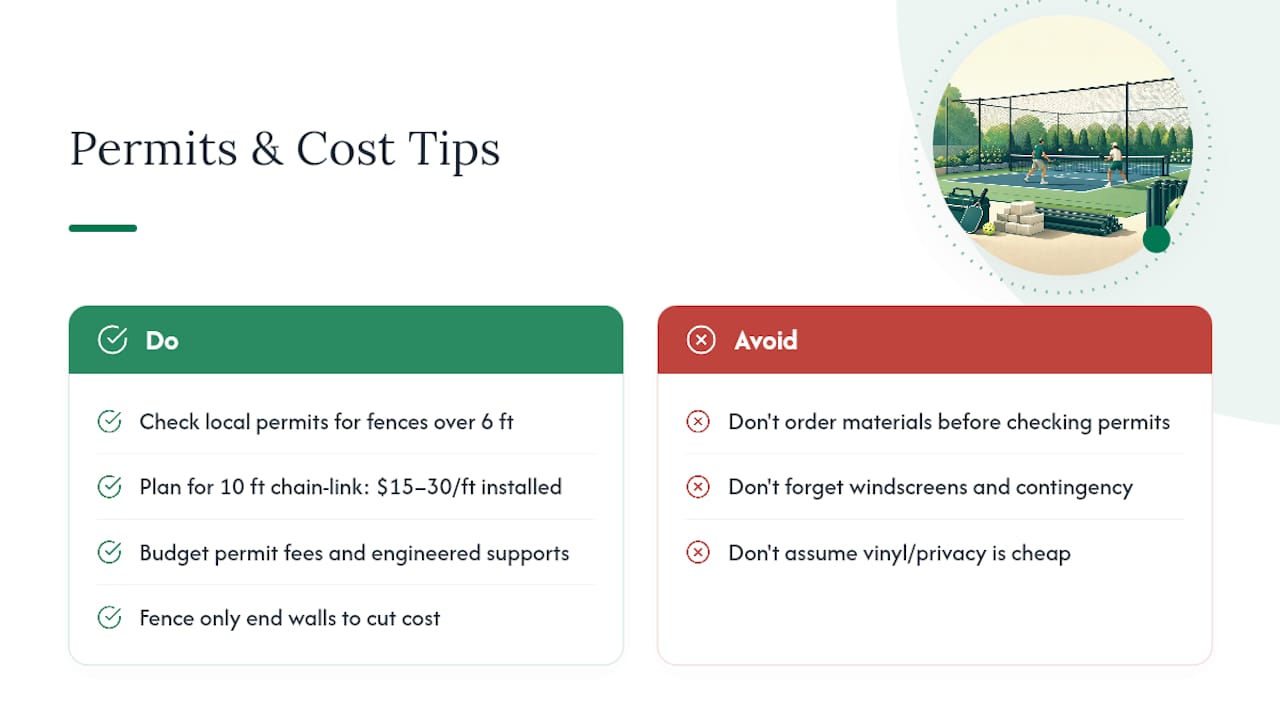
Many jurisdictions require a permit once a fence exceeds 6 feet, and that threshold catches most backstop heights on this list. Check with your local building or zoning department before ordering materials, and a general permit guide can help you understand what’s typically involved.
Cost climbs with height and material. A 10 foot galvanized chain-link fence runs roughly $15 to $30 per linear foot installed, with vinyl-coated and privacy panels costing noticeably more. Fencing only the end walls behind each baseline, instead of a full perimeter, is a common way to cut costs while still containing the shots that matter most.
Budget for permit fees, any engineered post supports, windscreens, and a contingency line before you finalize a quote.
Plan Your Fence and Court Layout on a Property Map
Numbers on a page only get you so far. Drawing your court and fence directly on an aerial map of your property shows whether your run-out actually hits 30 by 60 feet or falls short, and whether a gate placement will block a walkway you forgot about.
Property Improvement Estimator’s Pickleball Court Estimator lets you sketch the court and fence line together, then generates localized material and labor cost ranges along with a scope packet contractors can quote against directly. It’s a useful gut check before you commit to 12 foot posts or solid panels that require engineering. Run the numbers there before you call three contractors and get three wildly different bids.
What I’d Tell a Neighbor Building Their First Court
My default recommendation for most homeowners: a 10 foot backstop, 4 to 6 foot sidelines, and the first 16 feet from each corner matched to the backstop height. Go taller only if your run-out is tight, you’re on a rooftop, or a pool sits close behind the baseline. Go lower or leave sidelines more open if you have room to spare and want better sightlines for spectators.
Check your local codes before you buy materials, and bring in a contractor once you’re past 8 feet or adding engineered supports.
— Christian
Get a Site-Specific Fence Estimate Before You Buy Materials
Guessing at post depth or skipping a permit check is how a fence project turns into a change order. Some platforms give a faster, more accurate starting point than a generic online calculator: draw your exact fence line and court on your own property’s aerial map, and get localized material, labor, and permit guidance based on the dimensions you actually drew, not a rough average.

That specificity matters most once you’re above 6 feet, where permit requirements, wind load, and post engineering start driving cost. Run your layout through the Fence Estimator to see localized cost ranges for your chosen height and material, or use the Pickleball Court Estimator if you’re planning the full court alongside the fence. Either way, you’ll walk away with a contractor-ready scope packet instead of a rough guess.
Sources
- Pickleball court dimensions and layout guidance
- Pickleballcosts
FAQ
How High Do Pickleball Ceilings Need to Be?
Indoor pickleball courts need a minimum ceiling clearance of 18 to 20 feet, with 20 to 24 feet preferred so high lobs don’t clip lights or ductwork. Facilities converting gyms or warehouses should measure clearance at the lowest obstruction, not just the roofline.
Is a 7 Foot Fence Too High?
A fence less than 8 feet is reasonable for sidelines or divider fences but falls short of the 8 to 10 foot range most guidance recommends for backstops. ASTM F3558-24 places typical backstop heights around 8 feet, and most jurisdictions require a permit once you cross 6 feet anyway, so a 7 foot fence usually needs the same paperwork as an 8 or 10 foot one.
What Are Some Good Ideas for Fencing a Pickleball Court?
Match backstop height to your run-out. Use a 10 foot fence behind baselines, taper sidelines to 42 inches beyond the first 16 feet from each corner, and add a windscreen if noise or neighbors are a concern. Fencing only the end walls instead of the full perimeter is a common way to cut cost while still containing most shots.
Which City Banned Pickleball?
Several cities and homeowners’ associations across the country have restricted or banned outdoor pickleball courts in residential zones, usually over noise complaints from the sport’s distinctive paddle-on-ball sound. Checking local zoning and noise ordinances before building, and choosing vinyl-coated fencing with windscreens, reduces the odds of running into the same conflict.
Do I Need a Permit for a Tall Pickleball Fence?
Many jurisdictions require a permit once a fence exceeds 6 feet, which covers most recommended backstop heights. Confirm requirements with your local building or zoning department, since thresholds and engineering requirements vary by location.