Map Your Pickleball Court Cost: $25,000–$55,000 for Homeowners
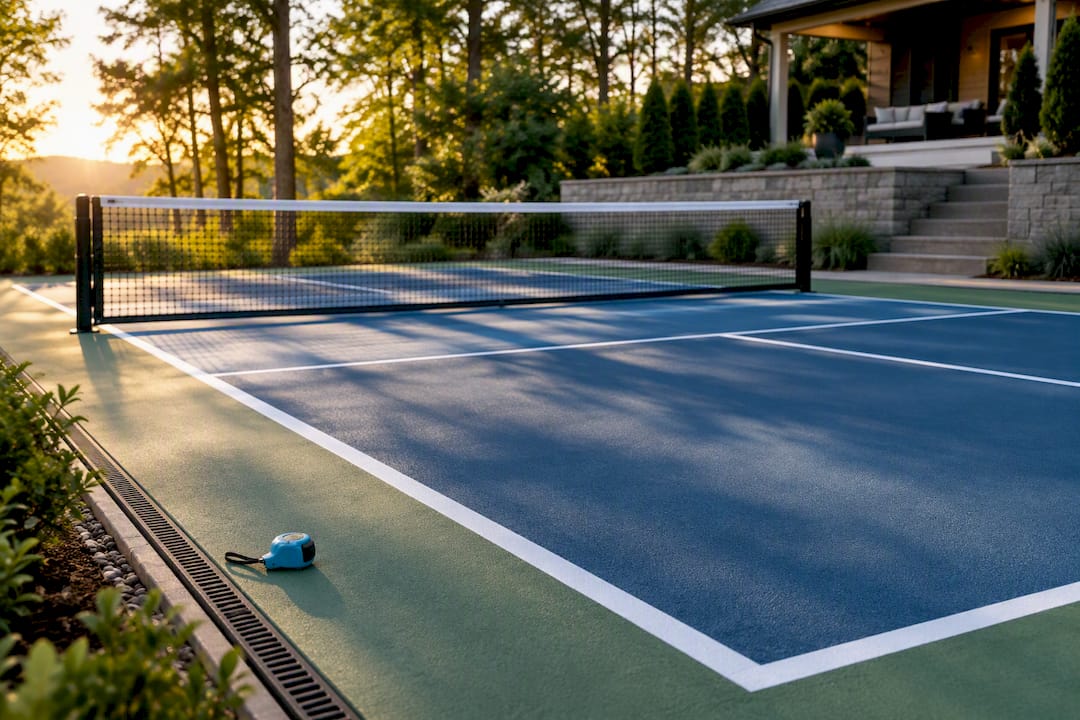
A single outdoor pickleball court runs $25,000 to $55,000 for a full new build, with most homeowners landing in the typical price range once site work, surfacing, fencing, and lighting are all accounted for. The three factors that swing a quote the most are site preparation, the base you pour, and the surfacing system you choose. A resurface over an existing slab, by contrast, typically costs just $5,000 to $15,000. Before calling contractors, get two or three quotes on the same scope, or run the numbers through a site-specific estimator first.
TL;DR:
- A standard 30 by 60 foot outdoor court costs between $27,000 and $36,000 when built with concrete, fencing, lighting, and surfacing, depending on quality.
- A site-specific estimate, drawn on your property map, can provide a more accurate budget than national averages by adjusting for local variables.
- Prioritize getting the slab and drainage right before investing in premium surfacing or fencing to avoid budget overruns later.
Table of Contents
- What Does a Pickleball Court Cost at Each Budget Tier?
- What Drives the Cost of a Pickleball Court?
- Should You DIY, Go Hybrid, or Hire a Full Pro Crew?
- How Do You Compare Pickleball Court Quotes?
- How Long Does It Take and What Does Upkeep Cost?
- How a Site-Specific Estimate Narrows Your Budget
- Where Homeowners Get Pickleball Court Costs Wrong
- Get a Site-Specific Quote With Propertyimprovementestimator
- Sources
- FAQ
What Does a Pickleball Court Cost at Each Budget Tier?
Contractors quote pickleball courts across four rough tiers, and knowing which one you’re aiming for before you call anyone saves a lot of confused back and forth. A budget or hybrid DIY build, where you handle painting and some labor yourself, can start at lower cost. A standard professional install with a proper base and coating typically lands in a moderate price range. A full residential build with lighting, fencing, and premium coatings pushes toward $55,000 or higher, and high-end builds can exceed $75,000. Indoor courts generally cost significantly more once you factor in climate control and structural work.
For a standard 30 by 60 foot court pad (1,800 square feet), installed cost per square foot is the fastest way to sanity-check a bid:
| Build level | $/sq ft installed | Typical total (1,800 sq ft) |
|---|---|---|
| Budget asphalt | $8 to $11 | $14,400 to $19,800 |
| Standard concrete | $15 to $20 | $27,000 to $36,000 |
| Premium concrete, full build | $25 to $40 | $45,000 to $55,000 |
These figures cover the pad, base, and surfacing; fencing and lighting are separate line items covered below.
What Drives the Cost of a Pickleball Court?
Every bid breaks down into the same handful of components, and site prep, base type, surfacing, fencing, and lighting cause almost all the variance you’ll see between contractor quotes.
- Site prep, grading, and drainage: Costs jump fast on sloped lots, sites with trees or stumps to remove, or yards with poor truck access, making pool demolition benefits a consideration when removing old pools to prepare the site. Drainage isn’t optional either. Planning guidance treats grading as essential, since skipping it is one of the most common causes of early slab failure.
- Base: Asphalt is cheapest but cracks sooner. Standard concrete lasts longer and resists heaving better. Post-tensioned concrete costs more upfront but handles freeze-thaw cycles and expansive soil far better over time.
- Surfacing: Standard acrylic coatings are the budget default. Cushioned acrylic adds shock absorption and costs more per court. Modular tiles install fast and suit DIY builds, but they wear differently than poured coatings.
- Fencing and windscreens: Priced per linear foot, with galvanized or coated finishes costing more in salt-air climates where standard chain-link corrodes quickly.
- Lighting: A basic 2-pole LED setup runs $4,000 to $8,000, while a 4-pole tournament-style system runs $8,000 to $15,000. Extending electrical service to a backyard court adds its own cost if your panel isn’t nearby.
- Nets, hardware, striping, and permits: These are the smallest line items individually but add up, and plan review or permit fees typically add a few hundred to a couple thousand dollars depending on your jurisdiction.
Statistic to remember: Lighting alone can add $4,000 to $15,000, and fencing commonly runs $3,000 to $15,000 depending on height and material. Together those two line items can equal the entire cost of the concrete pad.
Should You DIY, Go Hybrid, or Hire a Full Pro Crew?
- Hybrid DIY. A contractor pours and grades the slab, and you handle surface coating and striping yourself. Savings mostly come from labor on the coating step, but the risk is uneven application or a coating that doesn’t bond properly to an improperly cured slab.
- Full professional install. This costs more, but it’s what buys you engineered drainage, post-tensioned concrete where soil demands it, and a real warranty on materials and workmanship.
- Modular tiles or portable systems. These go down quickly and cost less upfront, but expect a shorter usable lifespan and a different playing feel than poured surfacing.
- Tennis-to-pickleball conversion. Simple line-striping on an existing tennis court can cost just a few hundred dollars, while a full surface rebuild to fix cracks or improve bounce consistency runs into the thousands. Striping alone won’t fix a court with drainage or crack problems.
How Do You Compare Pickleball Court Quotes?
A complete quote should spell out scope, subgrade specification, slab thickness, reinforcement, drainage plan, coating specification, lighting specification, project timeline, and payment schedule. If a bid skips any of these, ask for a revision before comparing price against another contractor’s more detailed proposal.
Ask every bidder the same set of questions: how long is the warranty, who supplies materials, can they provide references from similar backyard builds, and what’s the process for change orders once work starts.
Watch for these red flags:
- No defined drainage plan or grading spec
- Slab thickness or reinforcement left unspecified
- A mobilization fee that’s unusually low compared to other bids
- No mention of permits or who’s responsible for pulling them
Pro Tip: Paste this into your first email to every bidder: “Please confirm subgrade prep, slab thickness and reinforcement, drainage approach, coating brand and system, lighting spec if included, estimated timeline, and payment schedule.” Contractors who answer all six in one reply are usually the ones worth pursuing.
How Long Does It Take and What Does Upkeep Cost?
Most builds run four to eight weeks once the schedule is locked, and concrete cure time is the real bottleneck. A slab needs roughly 28 days to cure fully before coating goes on, so rushing this step is the single most common cause of coating failure down the line. Cold weather stretches cure time further, and rainy-season scheduling can push a project back by weeks if grading and pours get delayed.
Once the court is built, ongoing costs are modest but predictable:
- Routine cleaning and crack sealing, done annually
- Resurfacing every 4 to 8 years for asphalt or 8 to 15 years for higher-quality acrylic systems
- Typical asphalt resurfacing cost of $4,000 to $8,000 when it’s due
- Electricity for court lighting, which usually adds a modest amount to monthly utility bills depending on usage
How a Site-Specific Estimate Narrows Your Budget
National ranges are useful for a first gut check, but they can’t account for your slope, your soil, or your local labor rates. That’s the gap a map-based estimator closes: you draw the court footprint on your own property’s aerial image, and the tool adjusts pricing for access, grading needs, and regional cost differences instead of guessing at a flat per-square-foot number.
Say you map a typical 40 by 70 foot backyard, pick a Tier 2 spec (standard concrete, cushioned acrylic, 2-pole lighting, chain-link fencing), and let the tool factor in your local labor rates. Instead of a vague $20,000 to $40,000 range, you get a tighter target built around your actual site.
- Draws exact court dimensions and clearances on your property map
- Applies local material and labor cost adjustments automatically
- Itemizes options (coating type, fence height, lighting tier) so nothing is a surprise later
- Produces a packet you can hand to multiple contractors for apples-to-apples bids
Running your numbers this way, rather than guessing off a national average, is what separates a rough budget from a bid you can actually trust when contractors respond.
Where Homeowners Get Pickleball Court Costs Wrong
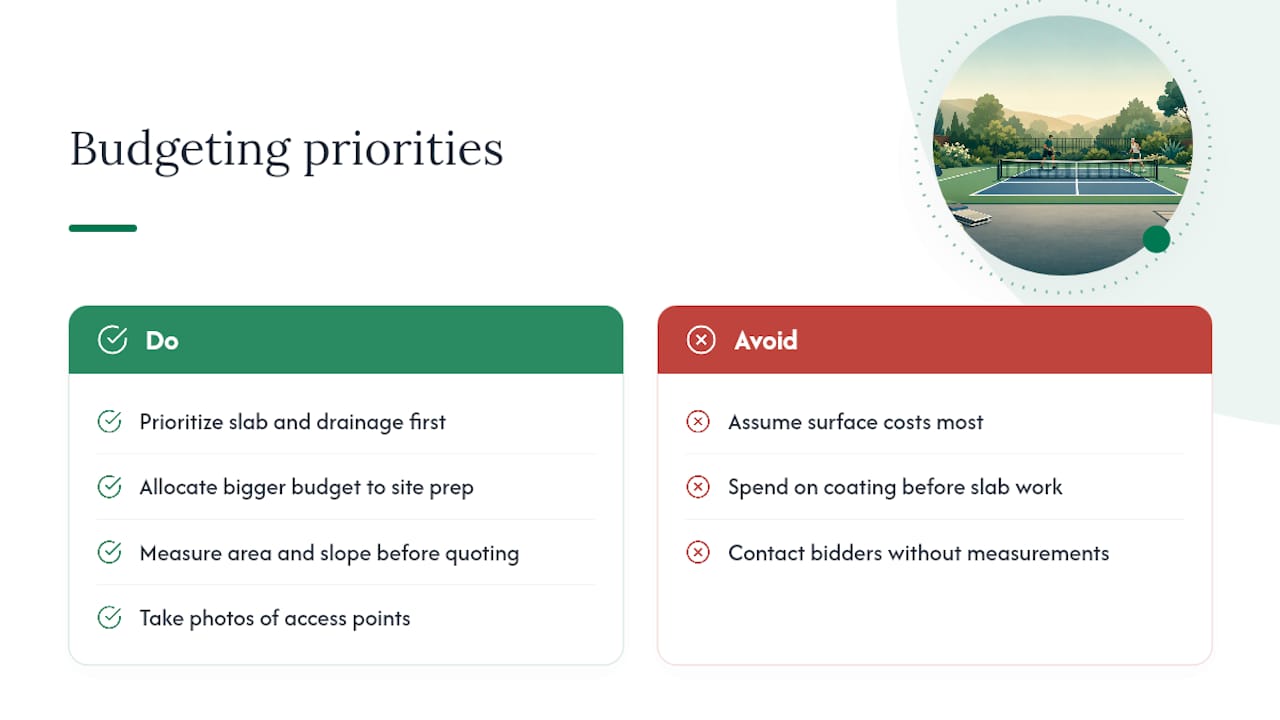
Most people assume the surface is what costs the most. It isn’t. Site prep and drainage are where budgets quietly blow up, especially on sloped lots or yards with poor soil, because that work is invisible once the court is finished. If you’re going to spend more anywhere, spend it on the slab and drainage before you spend it on a fancier coating or a taller fence.
My practical advice: get your slab and drainage right first, then treat surfacing, fencing, and lighting as the tier you adjust based on what’s left in the budget. Before you contact a single bidder, measure your planned area and take photos of the slope and access points. That single step will make every quote you receive faster and more accurate.
— Christian
Get a Site-Specific Quote With Propertyimprovementestimator
National ranges tell you what’s possible, but they can’t tell you what your yard will actually cost. Some online platforms let you draw your court’s exact footprint on a satellite image of your own property, mark fencing and lighting placement, and get a real-time estimate adjusted for your local costs, sometimes without creating an account first.
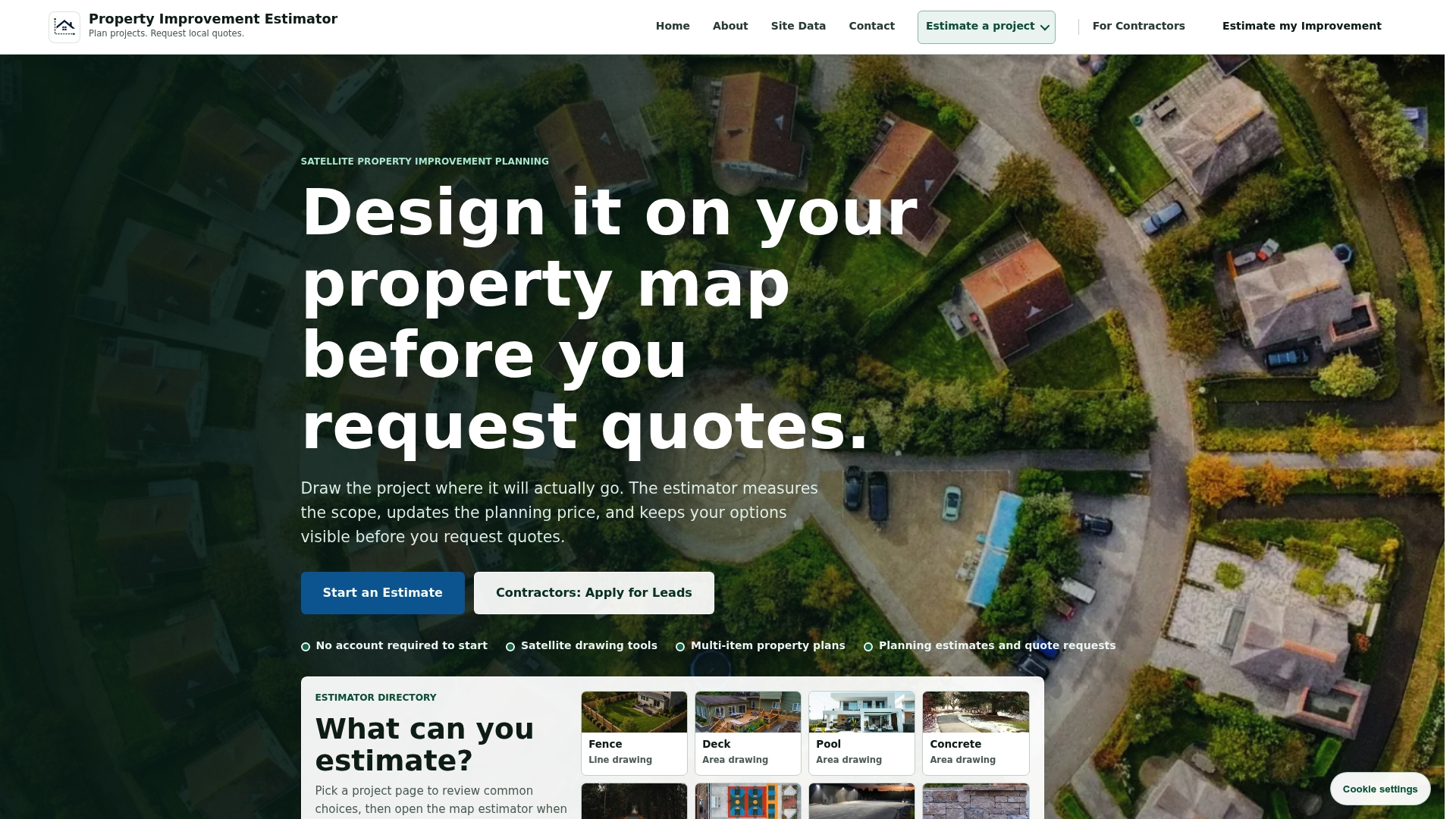
That site-specific detail is what turns a general mid-range price estimate into a number contractors can actually bid against consistently. Instead of three contractors quoting three different assumptions about your slope or access, they all receive the same scope package: drawings, measurements, and your chosen options for base, surfacing, fencing, and lighting. Use the pickleball court calculator to map your court and price out new-build or resurfacing options, or start with the pickleball court estimator to compare tiers side by side. If your yard needs grading or a slab poured first, the concrete estimator can help price that piece separately. Draw your court, pick your options, and download the project packet to send to two or three contractors this week.
Sources
- Pickleball Court Cost in 2026: Ranges and What Drives …
- Pickleball Court Cost: How Much It Costs to Build a Court in 2026 — Precision Sports CT
- Planning to build a pickleball court? Consider this first
FAQ
How Much Do Pickleball Courts Cost to Build?
A new outdoor court typically costs between $25,000 and $55,000, with most homeowners landing in the $20,000 to $40,000 range for a standard build. Basic DIY builds can start near $11,000, while high-end residential courts with premium surfacing and lighting can exceed $75,000.
Why Are Pickleball Courts So Expensive?
The cost comes from combining several specialized systems in one project: engineered concrete or asphalt base, multi-layer acrylic coating, perimeter fencing, and dedicated lighting. Site prep and drainage alone can add thousands of dollars, especially on sloped or poorly draining lots, which is why site prep, base, and surfacing drive most of the variance between quotes.
Is Owning a Pickleball Court Profitable?
A residential court is generally a lifestyle investment rather than an income source, since most homeowners build for personal or family use rather than rental income. Some owners offset costs by renting court time to neighbors or local players, but that depends heavily on local demand and any HOA or zoning restrictions.
Does a Pickleball Court Add Value to a Home?
A well-built court can add appeal for buyers who play the sport, particularly in warmer climates where outdoor courts see heavy use, but it rarely returns its full cost dollar for dollar at resale. Homeowners weighing this trade-off can map out realistic build costs with the sport court estimate calculator before committing to a design.