Stop Guessing, Homeowners: Paver Patio Cost, Site Estimates $12–$50/ft
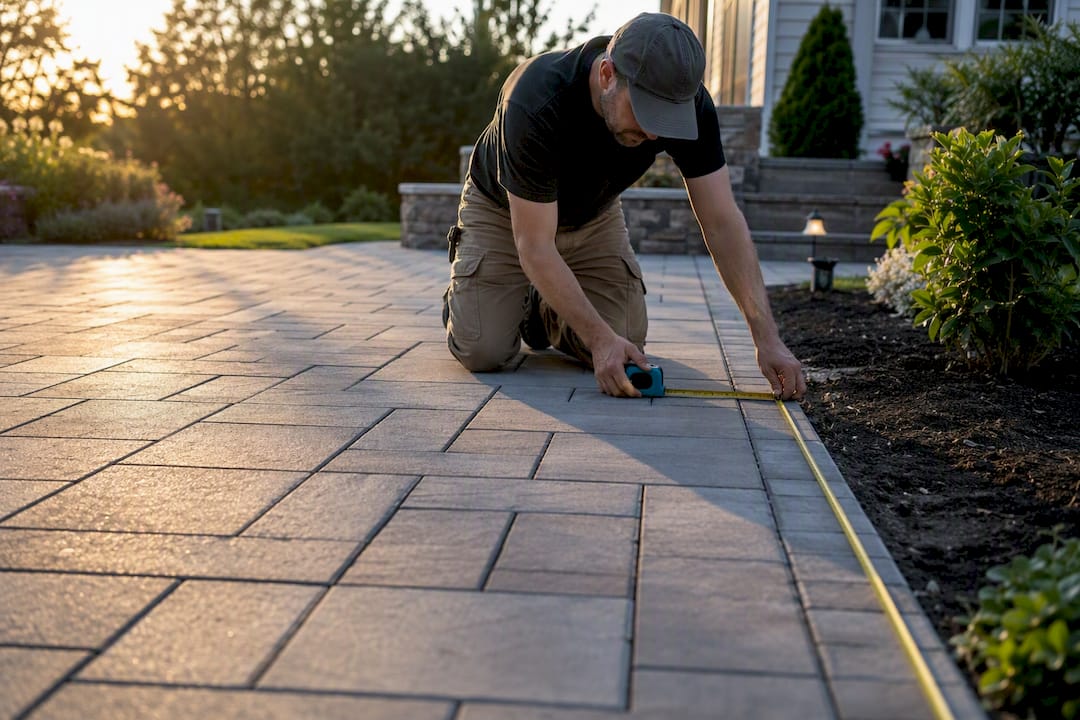
Installed paver patios typically run $12 to $30 per square foot, with premium natural stone climbing to $40 or $50. A 144-square-foot patio (12x12) lands around $1,728 to $4,320, while a 400-square-foot patio (20x20) costs roughly $4,800 to $12,000. Labor and base prep, not the pavers themselves, drive most of that spread.
TL;DR:
- Most of the cost variance in paver patio installation comes from labor and base preparation, which represent 60% to 80% of the total expense.
- Site conditions such as soil type, drainage, and yard slope can significantly increase excavation and base material needs, raising costs.
- Choosing natural stone can increase the price per square foot to as much as $50, while concrete remains the most affordable option at $12 to $20.
- Larger patios reduce the cost per square foot because fixed setup costs are spread over a bigger area, but smaller projects can have disproportionately high expenses.
- Using a detailed, site-specific estimate based on a satellite drawing helps prevent budget overruns by ensuring bids reflect actual conditions and scope.
Table of Contents
- How Much Does a Paver Patio Cost by Size?
- What Do Different Paver Materials Cost Installed?
- What Actually Drives Paver Patio Installation Cost?
- Is DIY Cheaper Than Hiring a Paver Patio Contractor?
- How Does Location Affect Paver Patio Pricing?
- How Do You Estimate Your Own Paver Patio Cost?
- A Note on Trusting the Lowest Bid
- Get a Site-Specific Paver Patio Estimate, Not a Guess
- Sources
- FAQ
How Much Does a Paver Patio Cost by Size?
Bigger patios cost more in total but less per square foot, because excavation equipment, delivery fees, and crew setup get spread across more area. A tiny 100-square-foot patio might pay almost as much per foot as one three times its size, simply because the crew still has to show up, unload gear, and grade the base.
Here’s how the math plays out using the $12 to $30 per square foot installed range that most cost calculators and contractors quote:
- 100 sq ft: $1,200 to $3,000 (small seating area or entryway pad)
- 144 sq ft (12x12): $1,728 to $4,320 (common starter patio size)
- 300 sq ft: $3,600 to $9,000 (typical mid-size backyard patio)
- 400 sq ft (20x20): $4,800 to $12,000 (family-sized entertaining space)
Real-world quotes back this up. Thumbtack’s data shows a national average range of $1,425 to $6,387 for typical residential projects, which lines up closely with the 144 to 300-square-foot band most homeowners actually build.
A rough rule of thumb: multiply your square footage by $18 to $20 for a “middle of the road” concrete or brick estimate, then adjust up for natural stone or intricate patterns. It won’t replace a real quote, but it gets you in the right neighborhood before you start calling contractors.
What Do Different Paver Materials Cost Installed?
Material choice swings your total cost more than almost any other decision you’ll make. Concrete pavers sit at the affordable end, natural stone at the top, and your pick affects not just the upfront bill but how much you’ll spend maintaining the patio over the next 20 years.
- Concrete pavers: Roughly $12 to $20 per square foot installed. Widely available, comes in dozens of colors and textures, and holds up well with basic sealing every few years.
- Brick pavers: Typically $15 to $25 per square foot installed. Classic look, very durable, but individual bricks can chip over decades of freeze-thaw cycles.
- Porcelain pavers: Usually $20 to $35 per square foot installed. Nearly stain-proof and fade-resistant, though they demand precise, level base work since they’re less forgiving of settling.
- Natural stone (flagstone, travertine, bluestone): Often $25 to $50 per square foot installed. Unmatched visual character and long-term value, but irregular shapes mean more cutting and labor time.
Pattern matters too. A simple running-bond layout in any material installs faster than herringbone or circular designs, which add 10% to 15% more material waste and $1 to $3 extra per square foot in labor from all the extra cutting. Large-format pavers cut installation time but need a flawlessly flat base to avoid rocking or uneven edges.
What Actually Drives Paver Patio Installation Cost?
Here’s the number that surprises most homeowners: labor and base preparation account for 60% to 80% of your total installed cost, while the pavers themselves are often just 20% of the budget. You’re not really paying for stone. You’re paying for the work underneath it.
That labor and base share typically breaks down into:
- Excavation — removing existing turf, soil, or old hardscaping to the correct depth
- Base gravel — a compacted crushed stone layer that prevents shifting and drainage problems; a 300-square-foot patio needs roughly 5 cubic yards of gravel
- Sand leveling layer — about half a cubic yard for that same 300-square-foot job, providing the fine, level surface pavers sit on
- Compaction — mechanical plate compacting at multiple stages to lock the base and prevent future settling
- Edge restraints and finishing — plastic or metal edging that keeps the whole system from spreading over time
Site conditions push those numbers higher fast. Clay-heavy soil, poor drainage, or a sloped yard all demand deeper excavation and more base material than a flat, well-drained lot. Site access matters just as much: if heavy equipment can’t reach your backyard, crews hand-carry every bag of gravel and every paver, which can multiply the labor line item compared to an easy-access site.
Pro Tip: Ask any contractor bidding your project exactly how many inches of base depth they’re quoting, and get it in writing. A lowball bid almost always shortcuts the gravel base first, since it’s invisible once the pavers go down, and that’s the corner cut that causes shifting, sinking, and cracked pavers three years later.
Is DIY Cheaper Than Hiring a Paver Patio Contractor?
DIY can cut your labor cost dramatically, since you’re paying only for materials, tool rentals, and disposal fees instead of a crew’s hourly rate. Materials and rentals alone often land well below professional installed pricing for the same square footage.
The catch is what you don’t see priced anywhere: a plate compactor rental, a paver saw, level and string lines, and the physical stamina to move several tons of gravel by hand. Homeowners consistently underestimate the equipment needed for clean cuts and a truly level base.
- Hire a professional when your site has slope, drainage issues, or clay soil that needs engineering judgment.
- Hire a professional if local permits require licensed installation or you want a workmanship warranty.
- DIY makes sense for small, flat, well-drained areas where a mistake costs you a weekend, not a rebuild.
One more thing to weigh: DIY door replacement projects show the same pattern as paver patios. The upfront savings look great until a skipped step forces a costly redo.
How Does Location Affect Paver Patio Pricing?
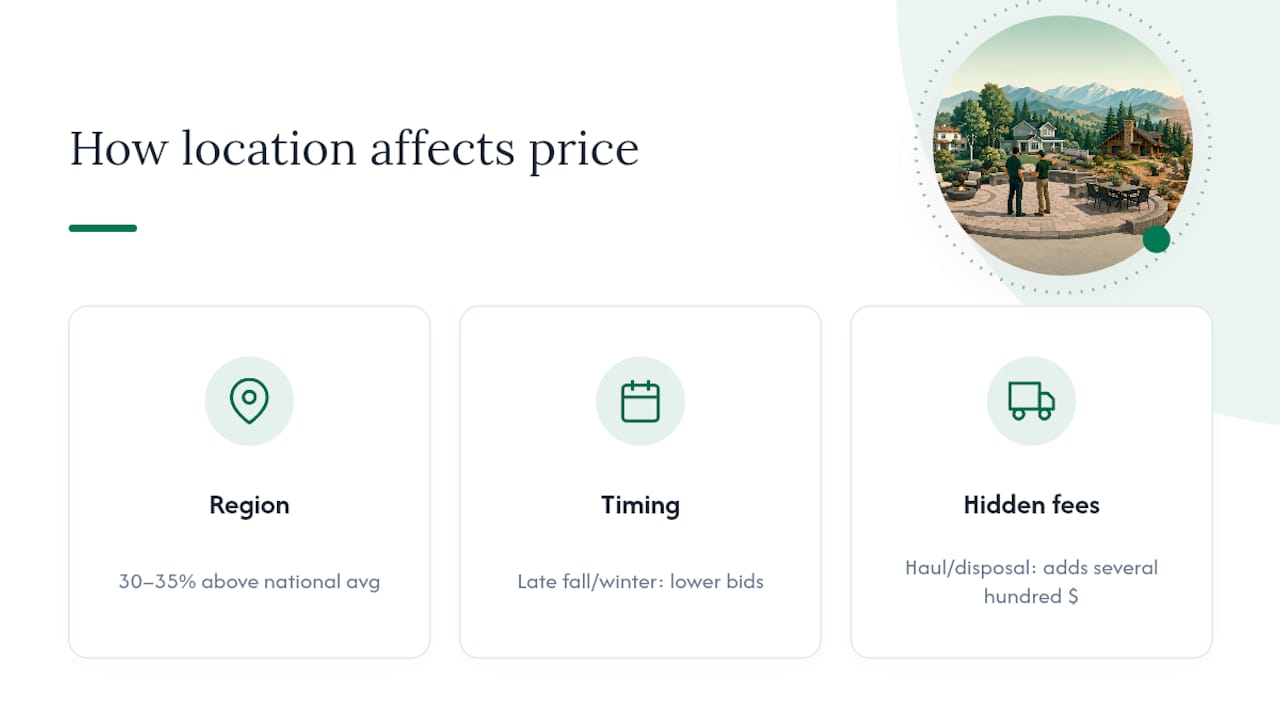
Where you live changes your installed price more than most homeowners expect. High-cost labor markets like California and New York run roughly 30% to 35% above the national average, while smaller metros and rural areas often land near or below it.
Timing matters too. Contractors are booked solid from spring through early fall, and that demand shows up in the quote. Scheduling your project in late fall or winter, where climate allows, often gets you a lower bid and a faster start date, since crews have open calendar slots.
Two line items homeowners frequently forget to ask about: hauling away excavated soil and old hardscaping, and any fees for dumping that material at a local disposal site. Both can add several hundred dollars to a project that otherwise looked fully quoted.
How Do You Estimate Your Own Paver Patio Cost?
A reliable estimate follows the same five steps a contractor uses internally, just scaled down for a homeowner doing research before the first phone call.
- Measure and define your scope. Get exact square footage and note any curves, steps, or grade changes.
- Pick your paver tier. Choose concrete, brick, porcelain, or natural stone based on the price ranges above and your visual goals.
- Assess site prep needs. Check drainage, slope, and soil type using a tool like the USDA Web Soil Survey, which shows local soil composition that affects base depth.
- Compute base and material volumes. Use your square footage to estimate gravel and sand quantities, or run the numbers through a paver patio cost calculator that models pattern and excavation variables.
- Add labor and contingency. Build in 10% to 15% extra for surprises like buried utilities or unexpected soil conditions.
A map-based tool that lets you draw the patio footprint directly on your property gives contractors exact dimensions and access notes up front, which cuts down on the back-and-forth that inflates bid variance.
Pro Tip: When you request quotes, hand every contractor the same packet: measurements, a site sketch, your paver tier preference, and photos of the access route. Apples-to-apples bids are impossible when one contractor is guessing at square footage and another is working from a hand-drawn napkin sketch.
A Note on Trusting the Lowest Bid
The biggest mistake I see homeowners make isn’t picking the wrong paver. It’s picking the lowest bid without asking what’s happening underground. Base work is invisible once the project’s finished, which makes it the easiest thing for a struggling contractor to shortcut and the hardest thing for a homeowner to catch until the patio starts sinking two years later.
A detailed, map-based estimate you can hand every bidder forces an apples-to-apples comparison. When every contractor is pricing the same drawn scope instead of guessing at your yard from memory, the bids that come back low usually reveal exactly where they’re cutting corners.
— Christian
Get a Site-Specific Paver Patio Estimate, Not a Guess
Every range in this guide is a starting point. Your actual number depends on your soil, your access, your slope, and your paver choice, which is exactly why generic per-square-foot math only gets you so far. A map-based tool lets you draw your patio directly onto a satellite view of your own property, so the estimate reflects your dimensions and site conditions instead of a national average.
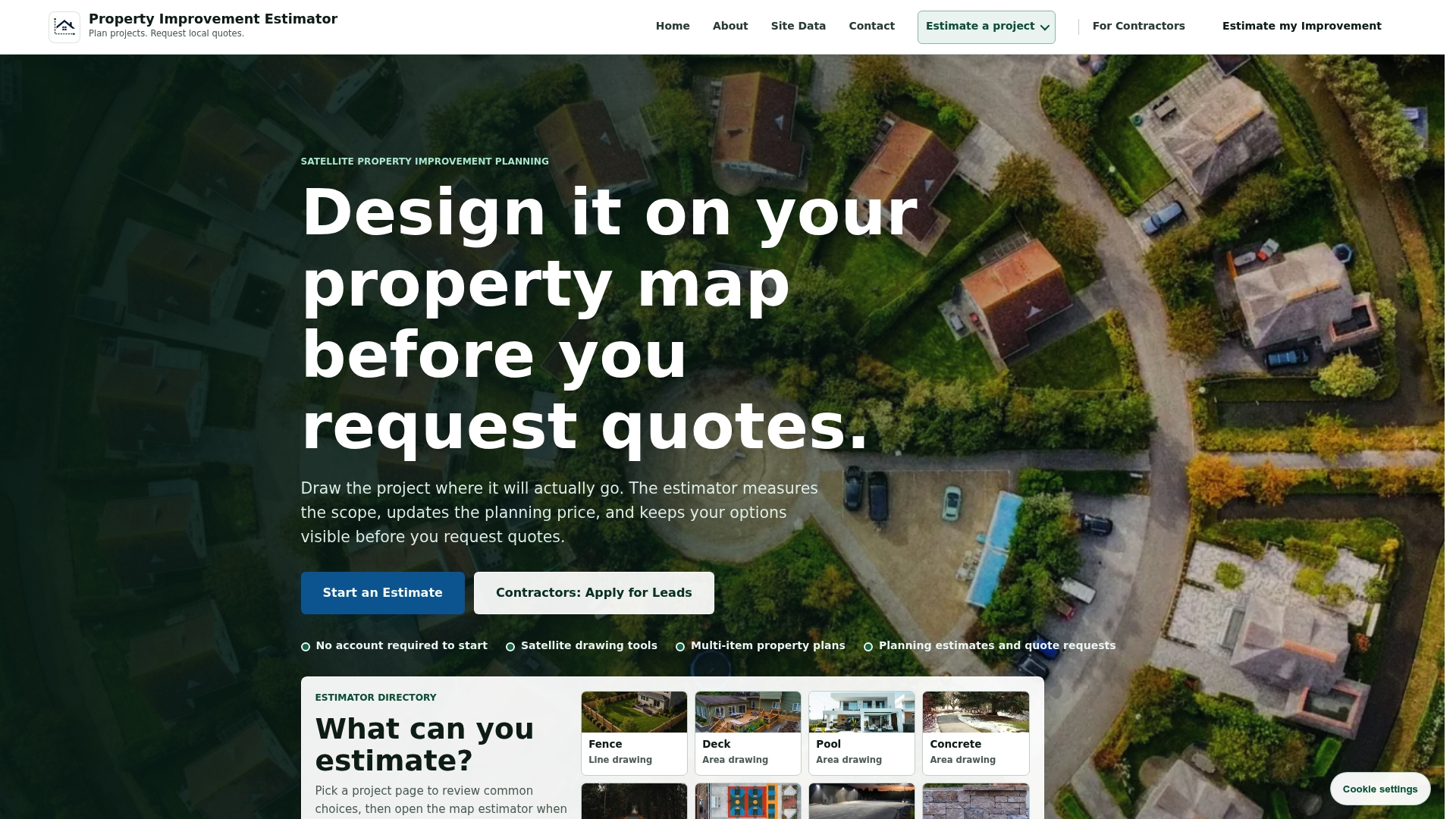
The tool runs your drawn footprint through material and labor calculators that factor in local cost data, then packages everything into a clear scope you can send to multiple contractors at once. That packet, measurements, access notes, and material tier included, is what keeps bids consistent and cuts down on the change orders that blow up budgets mid-project. Try the satellite property cost estimator and turn your patio idea into numbers you can actually plan around.
Sources
- How Much Does a Paver Patio Cost? | Unilock
- How Much Does a Paver Patio Cost in 2026? (Materials, Labor & Size) | UseCalcPro
- Paver Patio Cost Calculator (2026) | ProjectCostPro
FAQ
How much does a 20x20 paver patio cost?
A 20x20 patio (400 square feet) typically costs $4,800 to $12,000 installed, depending on your paver material and site conditions.
Is a paver patio cheaper than concrete?
Plain poured concrete is often cheaper upfront than pavers, but pavers tend to hold value better since individual units can be replaced instead of resurfacing the entire slab.
How much does a 12x12 paver patio cost?
A 12x12 patio (144 square feet) generally runs $1,728 to $4,320 installed, with the final number depending on material choice and how much base prep the site needs.
How much does a 300-square-foot patio cost?
A 300-square-foot patio typically falls between $3,600 and $9,000 installed, which is the size range most consumer cost data, including Thumbtack’s national averages, tends to reflect.
Recommended
- Asphalt Cost Calculator | Estimate Driveways, Overlays, Sealcoating, and Local Costs
- Deck Cost Calculator | Materials, Stairs, Railings, Elevation, and Local Costs
- Deck Labor Cost Calculator | Footprint, Elevation, Stairs, Railings, Access, and Local Wages
- Retaining Wall Cost Calculator | Height, Drainage, Soil, and Local Costs