Low Voltage vs. Line Voltage Lighting: Which to Choose
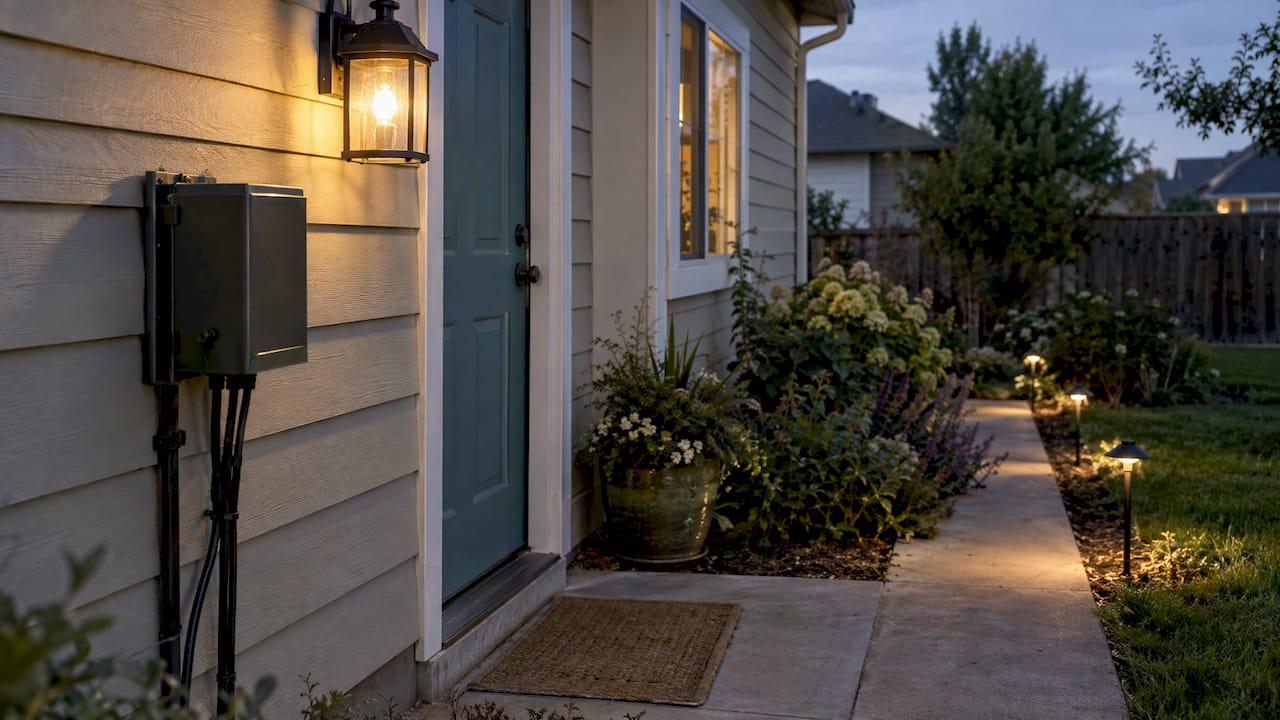
For most homeowners lighting a yard, a 12V low-voltage system is the better starting point. A transformer steps household 120V power down to a safe level, the cable is easy to move, and fixtures are simple to add later. Line-voltage (120V) lighting makes sense for a few fixed, high-output spots, such as a tall pole light or a long driveway run. Either way, the choice is easier once you know where each fixture goes and how far the cable has to travel. That is why we suggest drawing your layout on a map of your property before you compare quotes.
TL;DR
- Low voltage (12V) uses a transformer to step 120V household power down for the fixtures. It is the usual choice for DIY and flexible garden lighting.
- Line voltage (120V) feeds fixtures directly at household voltage. It suits fewer, brighter fixtures and large areas, and the wiring follows standard electrical rules.
- Low-voltage design limits are transformer capacity and voltage drop on long cable runs, so plan the total load and the run lengths first.
- Cable burial depth, GFCI protection and permits depend on your local code. Confirm them with your local building department or a licensed electrician.
- A measured layout makes every quote more accurate, whichever system you pick.
Table of Contents
- What the two systems actually are
- Side-by-side comparison
- Why voltage drop and transformer size decide the layout
- Safety, code and permits
- Cable, trenches and burial depth
- When 12V fits, and when 120V is the better call
- What each option does to your estimate
- A simple way to decide
- Plan your lighting layout before you ask for quotes
- FAQ
- Sources
What the two systems actually are
Line voltage is the power in your walls. In the U.S. that is 120 volts for most outdoor fixtures on a home. A 120V fixture connects to a regular circuit, so it is wired like any other outdoor electrical device.
Low voltage adds one component: the transformer. The Association of Outdoor Lighting Professionals (AOLP) guidelines describe it as a listed power supply that takes 120V on its input side and delivers low voltage on its output side, with single-tap or multi-tap outputs. The fixtures and the cable in the yard only ever see that reduced voltage.
In a column for Irrigation & Lighting, Kevin Smith compares the transformer to a pressure regulator. Energy passes between the input and output windings by electromagnetic induction, so the 120V side does not directly touch the 12V side. The transformer is the one place where household power enters the system. Everything past it is the low-voltage circuit.
The AOLP guidelines also state that UL 1838-listed low-voltage power supplies are limited to 15 volts AC and 25 amps on the secondary output. That is why 12V landscape lighting is a distinct category with its own listed equipment, not just thinner wire on a regular circuit.

You will see “12V” and “24V” used for low voltage. Many consumer kits use 12V. The same logic applies to both: a listed transformer steps power down and the fixtures run on the reduced output.
Side-by-side comparison
| Factor | Low voltage (12V) | Line voltage (120V) |
|---|---|---|
| Power at the fixture | Reduced by a transformer | Full household voltage |
| Typical use | Paths, beds, trees, walls, steps, deck accents | Tall poles, floodlights, long driveways, large open areas |
| Fixture count | Many small fixtures on one transformer | Fewer, brighter fixtures |
| Moving or adding fixtures | Easy, within transformer capacity | Usually needs more electrical work |
| Main design limit | Transformer capacity and voltage drop | Circuit capacity, protection and code rules |
| Shock risk during adjustments | Lower, which is why homeowners can maintain it | Treat as live household wiring |
| Typical installer | Homeowner or landscape lighting contractor | Licensed electrician in most places |
Fine Homebuilding’s guide to low-voltage landscape lighting describes 12V systems as safer and more flexible for homeowners to adjust and maintain. It also names the two constraints you design around: limited transformer capacity and voltage drop on long cable runs.
Why voltage drop and transformer size decide the layout
Voltage drop is the loss of voltage along a long cable. According to the same Fine Homebuilding article, the effect on a long low-voltage run is that distant lamps look dimmer and yellower than the ones near the transformer. Line voltage, with its higher voltage, is less sensitive to this over typical yard distances, which is one reason it appears on long driveways and big properties.
Two habits keep a low-voltage system even:
- Leave headroom on the transformer. The AOLP guidelines recommend sizing the transformer with room for future load and wiring losses, typically keeping the load at or below 80% of its full capacity. A 300-watt transformer then carries about 240 watts of fixtures.
- Keep runs short and balanced. Splitting a yard into two or three shorter runs, or using multi-tap outputs, usually beats one long daisy chain.
This is also where measurements pay off. You cannot size a transformer or choose cable until you know how many fixtures you want and how far each one is from the power source. The 12V versus 120V question often answers itself once the distances are on paper.
Safety, code and permits
The safety case for low voltage is real, but it does not remove the need to follow code at the power source. Some points that matter for both systems:
- Wet and damp ratings. The Spruce’s overview of NEC outdoor wiring rules says fixtures in exposed wet areas must be listed for wet locations, and those in sheltered damp areas for damp locations. Surface-mounted fixtures need weatherproof outdoor boxes.
- Outdoor transformers. The AOLP advises using transformers rated for wet locations in exterior applications and installing them per their listing, the manufacturer’s directions and local code.
- GFCI protection. A ground-fault circuit interrupter (GFCI) cuts power quickly when current leaks to ground. The 2026 NEC was issued on August 20, 2025 and took effect on September 9, 2025, according to UL Solutions. UL notes that 210.8(F) requires GFCI protection for outdoor outlets at covered dwellings, with exceptions. The Minnesota Department of Labor and Industry’s 2026 NEC FAQ says outdoor lighting outlets are not covered by 210.8(F), though other outlet rules may still apply. The power source feeding your transformer is usually an outdoor receptacle, so ask your electrician which GFCI rule applies to it.
- Which code edition applies. States and cities adopt the NEC on their own schedules. The AOLP guidelines say to follow the locally applicable NEC, state and local rules, permit requirements and inspections. They do not set one nationwide permit rule. Check with your local building department before you dig.
We get one question constantly: can 120V and low-voltage wiring share a box or conduit? The NEC generally requires separating different systems, and the details depend on the equipment and the code edition your area has adopted. Leave that decision to a licensed electrician or your inspector. For a general look at how electrical code shapes the lighting plan in another part of the home, see this overview of NEC lighting code rules.
If you are estimating permit and review costs for lighting, our outdoor lighting permit cost calculator covers electrical work, poles, trenching and local review.
Cable, trenches and burial depth
The wire question comes up as soon as people start planning. Regular household wire is not the answer for a low-voltage run. The AOLP states that landscape-lighting cable must be listed for direct burial, and recommends burying direct-burial runs at least 6 inches deep.
Line-voltage runs follow the NEC’s wiring-method rules. The 2017 NEC Table 300.5, summarized by the Independent Electrical Contractors, sets minimum cover depths by wiring method and location. It also allows a lesser depth when the installation instructions for a listed low-voltage lighting system specify one. Because the code edition and local amendments vary, treat the depth for your yard as something to confirm before digging, and call 811 to have utilities marked.
Trenching is often the largest labor item in a lighting job, so route length is a cost driver, not a detail. Our guide to landscape lighting trench depth walks through how deep to dig and what it means for the plan.
When 12V fits, and when 120V is the better call
Choose 12V low voltage when:
- You want path, garden, tree, wall or step lighting spread over a modest area.
- You expect to move fixtures as plants grow or the yard changes.
- You want the option to add fixtures later, within the transformer’s capacity.
- You prefer a system that a homeowner can safely adjust.
Choose 120V line voltage when:
- You need fewer, brighter fixtures to cover a large open area, such as a big parking pad, a barn yard or a long driveway.
- You are mounting on poles or structures where a licensed electrician will already be running circuits.
- The distances are long enough that voltage drop would force many separate low-voltage runs.
Many properties use both. A 120V pole light near the driveway entrance and 12V fixtures along the front walk is a common split. It also works as a way to phase the project: the line-voltage circuit goes in with an electrician, and the low-voltage garden lighting follows.
Modern LED fixtures have widened what low voltage can do. Lighting makers note that LED low-voltage systems now handle many jobs once associated with line voltage, so brightness alone is rarely the deciding factor now. Fixture count, distance and mounting height usually are.
What each option does to your estimate
The cost difference between systems is not just the fixtures. It is the sum of fixtures, transformer or circuit work, cable, trenching and labor. In a 2007 article, Fine Homebuilding noted low-voltage kits could cost as little as $100, with individual fixtures from $25 to $180 depending on type. Those are historical figures, so use them only to see the range of fixture types, not as a budget.
For a real budget, the inputs that move the number are:
- Fixture count and type. Path lights, uplights, floodlights and pole lights are priced very differently.
- Run length. More feet of cable means more trenching, and long low-voltage runs may need extra transformer taps.
- Power source distance. The farther you are from a suitable outlet or panel, the more the electrician has to do.
- Ground conditions. Rock, roots and hardscape change the trenching.
- Local labor and permit rules. These vary by city and county.
Our landscape lighting cost estimate guide breaks down these drivers. The outdoor lighting labor cost calculator shows how local wages, trenching and controls affect the labor line. For the voltage question itself, our post on landscape lighting voltage goes deeper.
A simple way to decide
- Walk the yard and list what you want lit. Think entry, path, steps, trees, deck, driveway.
- Find the power source. Note where an outdoor GFCI-protected receptacle or panel is.
- Measure the distances. Measure from the power source to each group of fixtures.
- Total the wattage. Add up fixture wattage, then keep the transformer load at or below roughly 80% of its rating.
- Mark the long or high-output spots. These are your candidates for line voltage.
- Confirm the rules. Ask your local building department about permits, GFCI and burial depth.
- Get quotes from the same drawing. When every contractor prices the same layout, the quotes can be compared fairly.
Step 7 is where most homeowners lose time. Contractors who are quoting from a verbal description each assume something different, and the bids come back far apart. Our post on turning your yard into a bid-ready lighting layout shows how to prepare for that.
Our view on voltage
We built Property Improvement Estimator around one frustration: generic price guesses that ignore your actual yard. Lighting is a clear example. The “12V or 120V” question cannot be answered in the abstract, because it depends on how far the fixtures sit from power, how many you want and where the trenches would run.
That is why we let you draw the project on aerial imagery of your own property, with the exact locations of each element, and get a planning estimate based on your dimensions and local cost data. You do not need an account to start. When you request quotes, contractors receive the drawing, the measurements, the options and the photos, so they price the same scope instead of guessing at it.
Our advice is to settle your layout first and let the layout inform the voltage choice, not the other way around. A homeowner who walks into a bid conversation with a map of fixture locations gets better answers about low voltage, line voltage or a mix of both.
Christian
Plan your lighting layout before you ask for quotes
If you are weighing 12V against 120V, the most useful next step is to see the yard as the installer will. With our Outdoor Lighting Estimator, you draw fixture positions on a satellite view of your property, adjust the design and see a locally adjusted planning estimate. You can then send the scope to contractors as a complete packet. The estimator is one of several we offer for outdoor projects, and you can see them all on the Property Improvement Estimator home page.

If you are adding lighting with a fence, deck or pool, you can plan those in the same place. Real estate agents and contractors also use the drawings to keep a scope clear between everyone involved.
FAQ
Is low-voltage lighting safer than line-voltage lighting?
Low-voltage lighting is described as the safer system for homeowners to handle and adjust, because the fixtures and cable carry reduced voltage from a transformer. The transformer’s 120V input side and the outlet that powers it still need proper wet-location equipment and installation. Have that part checked by a licensed electrician where your local code requires it.
Can I use regular wire for low-voltage landscape lighting?
No. The AOLP says landscape-lighting cable must be listed for direct burial, and it recommends burying direct-burial runs at least 6 inches deep. Code edition and local rules vary, so confirm the depth with your building department.
How big a transformer do I need?
Add up the wattage of all the fixtures on it, then choose a transformer where that total is at or below about 80% of its rating, as the AOLP guidelines recommend. The spare capacity covers wiring losses and lets you add fixtures later.
Do I need a permit for outdoor lighting?
It depends on where you live and the system. The AOLP guidelines say to follow the locally applicable NEC, state and local rules, permits and inspections, and there is no single nationwide rule. Line-voltage work is more likely to need a permit and a licensed electrician. Call your local building department before starting.
Can I mix 12V and 120V in one yard?
Yes, and many properties do. Keep the two circuits as separate systems, and ask your electrician how local code handles wiring in shared boxes or conduit before anything is installed.
Sources
- AOLP Landscape Lighting Guidelines
- Understanding transformers, Irrigation & Lighting
- Low-Voltage Landscape Lighting, Fine Homebuilding
- National Electrical Code (NEC) Rules for Outdoor Wiring, The Spruce
- The Coordination Between Model Codes and Standards: 2026, UL Solutions
- 2026 National Electrical Code FAQ, Minnesota Department of Labor and Industry
- Changes to the 2017 National Electrical Code, Independent Electrical Contractors