Map Your Driveway: FHWA Backed Geotextile Under Gravel for Homeowners
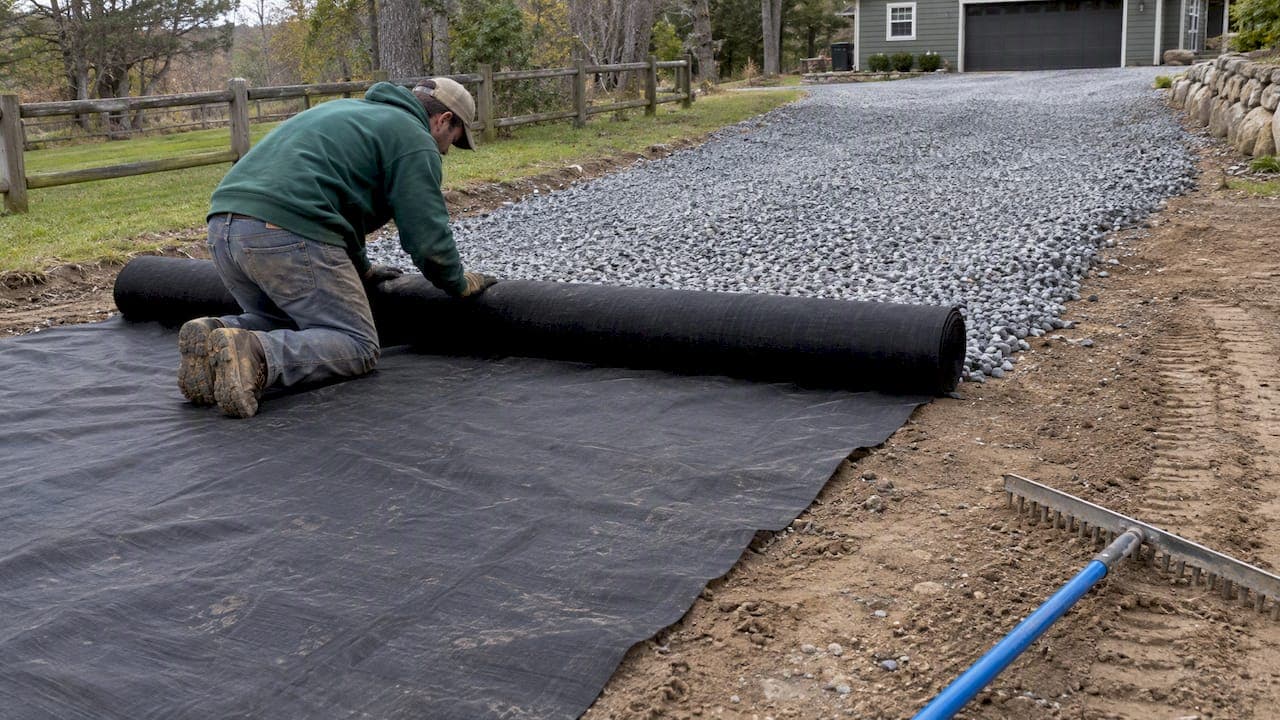
Use engineered geotextile under gravel when your subgrade is soft, holds a lot of silt or clay, or drains poorly; skip it on firm, well-draining granular soil where it adds cost without adding performance. Geotextile fabric is not the same product as garden landscape fabric, and swapping one for the other is a common, expensive mistake. Below, we cover how to pick the right fabric, where to buy it, and how to install it so your gravel driveway or path actually holds up.
TL;DR:
- Geotextile fabric is essential only when the subgrade is weak, such as with clay or silt soils, or where drainage and filtration are poor.
- Woven geotextiles are stronger for separation, while nonwoven fabrics drain better and are better suited for driveways and paths.
- Proper installation, including seam overlap and avoiding fabric damage during grading and gravel placement, is critical for effectiveness.
- Using landscape fabric from a garden center instead of engineered geotextile can lead to tearing and failure under vehicle loads.
- Geotextile’s lifespan depends on correct installation and coverage, with properly specified fabrics lasting for the life of the gravel surface.
Table of Contents
- What geotextile fabric actually does under gravel
- When you actually need geotextile under gravel
- Choosing the right geotextile: woven, nonwoven, and survival class
- How to install geotextile under gravel the right way
- Common mistakes and the real downsides of geotextile
- Maintenance and how long geotextile actually lasts
- Why I treat geotextile as cheap insurance, not an upsell
- Plan your gravel driveway before you buy a single yard of material
- FAQ
- Sources
What geotextile fabric actually does under gravel
Geotextile works through three mechanisms: separation, filtration, and reinforcement. Separation keeps subgrade soil and gravel from mixing, which stops the “pumping” effect where soft ground works fines up into clean aggregate over time. Filtration lets water pass through the fabric while holding back soil particles, which matters because trapped water in the base is what softens a driveway in the first place. The Federal Highway Administration’s geotechnical guidance describes geotextiles as preventing base contamination while allowing pore water to dissipate through the fabric plane, which extends the service life of the aggregate layer above it.
Reinforcement comes into play when fabric is paired with aggregate or geogrid in soft spots, sometimes called a confining or “snowshoe” effect that spreads load over a wider area.
- Separation stops fines from migrating upward into clean gravel.
- Filtration keeps water moving while blocking soil particles.
- Reinforcement spreads wheel loads over soft, weak spots.
One function garden fabric cannot replicate: engineered geotextile is designed and tested against specific filtration and strength criteria; woven polypropylene weed barrier sold for flower beds is not.
When you actually need geotextile under gravel
Not every gravel project needs it. If your driveway already ruts, sinks, or needs regular top-ups of fresh stone, that is a strong sign the subgrade is too weak or too fine-grained to support gravel alone. Clay and silt soils are the biggest red flags, especially where the ground stays wet into spring or sits near a low area that holds water.
- Rutting, sinking, or frequent gravel top-ups point to a weak or contaminated base.
- Fine-grained soils like silt and clay almost always call for separation fabric.
- Seasonal saturation, poor drainage, or heavy vehicle traffic raise the stakes further.
- Firm, coarse granular subgrade with good drainage can often skip geotextile entirely.
FHWA guidance ties the benefit of geotextile directly to subgrade strength, noting it matters most where bearing capacity is low or fines content is high, and matters far less on firm, well-draining granular ground.
Choosing the right geotextile: woven, nonwoven, and survival class

Woven geotextiles are generally stronger in tension and suit pure separation jobs. Nonwoven geotextiles drain better and are the common choice for driveways and paths where filtration and some reinforcement both matter. Either way, buy a product sold for subgrade separation or road and driveway use, not a garden center weed barrier.
Product specs follow AASHTO M288, which the Wisconsin DOT’s geosynthetics specification references when classifying survivability. For most homeowner gravel driveways, a Class 2 nonwoven separation fabric is a reasonable default unless your soil is unusually poor or construction traffic will be heavy. Check permittivity, apparent opening size, tensile and puncture resistance, and UV rating before buying.
- Woven fabric: higher strength, best for straightforward separation.
- Nonwoven fabric: better drainage, common for driveways and paths.
- Check permittivity, AOS, puncture resistance, and UV rating before you buy.
Pro Tip: Search for “subgrade separation geotextile” or “driveway fabric,” not “landscape fabric,” when shopping online or at a building supply counter.
How to install geotextile under gravel the right way
Good installation matters as much as buying the right fabric. Skipping steps here is how an otherwise correct product still fails within a season.
- Clear the area of vegetation, roots, and debris, then grade the subgrade to the slope you want the finished surface to follow.
- Roll out the fabric directly on the prepared subgrade, keeping it as wrinkle-free as possible and orienting rolls to minimize the number of seams.
- Overlap seams by 12 to 18 inches, a standard noted in construction guidance for geosynthetics, so water and fines cannot work through the joint.
- Place the first lift of clean aggregate by back-dumping or pushing material from the edge, avoiding driving loaded equipment directly on exposed fabric.
- Build an initial lift of at least about 6 inches, a minimum the FHWA’s gravel roads construction guide recommends before any compaction equipment runs over the area.
- Compact that lift, then add and compact subsequent lifts until you reach your target gravel depth.
- Slope the finished surface for drainage, add edge restraint where needed, and run perforated drain pipe if the site stays chronically wet.
- Use a utility knife or fabric shears for clean cuts, not scissors.
- Anchor edges with landscape pins or staples before placing aggregate.
- Walk the finished surface after the first rain to check for low spots or fabric showing through.
Pro Tip: If a contractor is doing this work, ask to see the fabric before the first lift goes down. It’s your one chance to verify overlap and coverage before gravel buries the evidence.
Common mistakes and the real downsides of geotextile
The most expensive mistake is substituting garden landscape fabric for engineered geotextile. It tears under vehicle loads and offers none of the tested filtration or strength properties a driveway needs. Beyond product choice, installation errors cause most failures.
- Skimping on seam overlap lets fines work through the joint over time.
- Driving on exposed fabric before cover is placed can puncture or shift it.
- Thin initial lifts or poor compaction defeat the fabric’s separation benefit.
- Extremely contaminated or unstable subgrade sometimes needs excavation and replacement rather than fabric alone.
Fabric adds modest upfront material cost, but the lifecycle payoff is fewer top-ups and a base that stays intact for years instead of months.
Maintenance and how long geotextile actually lasts
Buried geotextile is largely maintenance-free once properly covered; UV exposure before cover, heavy traffic, freeze-thaw cycles, and base contamination from skipped steps are what shorten its working life.
- Regrade low spots and top up aggregate as it settles or migrates.
- Keep drainage paths and edge channels clear of silt and debris.
- Inspect after major storms; visible fabric or sudden rutting signals a problem worth digging into.
Why I treat geotextile as cheap insurance, not an upsell
The right fabric is a small line item next to the cost of re-grading a failed driveway two years later. I’d rather spend a little more upfront and skip the excavation bill. Before buying material, verify your soil type and drainage, and use a local project report to map your driveway and size the aggregate you’ll need.
— Christian
Plan your gravel driveway before you buy a single yard of material
We built our local project report tool so you can draw your driveway or path directly on aerial imagery, get a locally adjusted price range, and hand a contractor a plan instead of a guess. No account required.

- Outline your driveway footprint on the map and get an instant area measurement.
- See material volume estimates for aggregate so you’re not over-ordering or under-ordering.
- Share the finished plan with contractors so their quotes reflect your actual site, not a generic range.
Say your driveway is 20 feet by 40 feet: mapping it first tells you the fabric area and the aggregate volume you need before a single contractor shows up, which keeps quotes grounded in your real dimensions instead of a rough guess. If you’re also comparing gravel against a concrete or asphalt surface down the line, the same map carries over.
FAQ
Is it a good idea to put landscape fabric under gravel?
Garden landscape fabric is not a good substitute for engineered geotextile under a gravel driveway or path carrying vehicle traffic. It lacks the tensile strength and filtration properties that separation-grade geotextile is tested for, and it tends to tear under repeated loading.
What is the best thing to put under gravel?
For driveways and paths, an engineered nonwoven or woven geotextile rated for subgrade separation is the standard choice, placed directly on prepared subgrade before the first aggregate lift. The FHWA’s geotechnical guidance ties the right product to your subgrade’s strength and fines content rather than a single one-size-fits-all answer.
What are the downsides of geotextile fabric?
Geotextile adds material cost and an installation step, and it can fail if seams are under-lapped, aggregate cover is too thin, or equipment drives directly on exposed fabric. Used and installed correctly, those downsides are minor compared to the cost of a driveway that needs regrading within a year or two.
How long does landscape fabric last under gravel?
Properly specified geotextile, covered promptly and never exposed to prolonged UV light, performs for the working life of the gravel surface above it with little to no maintenance. Garden-grade landscape fabric, by contrast, often fails within one to two seasons of vehicle traffic because it was never engineered for that load.
Sources
- Chapter 7 (continued) - NHI-05-037 - Geotech - Bridges & Structures - Federal Highway Administration
- 645 Geosynthetics - Wisconsin Department of Transportation