Fence Post Spacing: How Far Apart to Set Posts
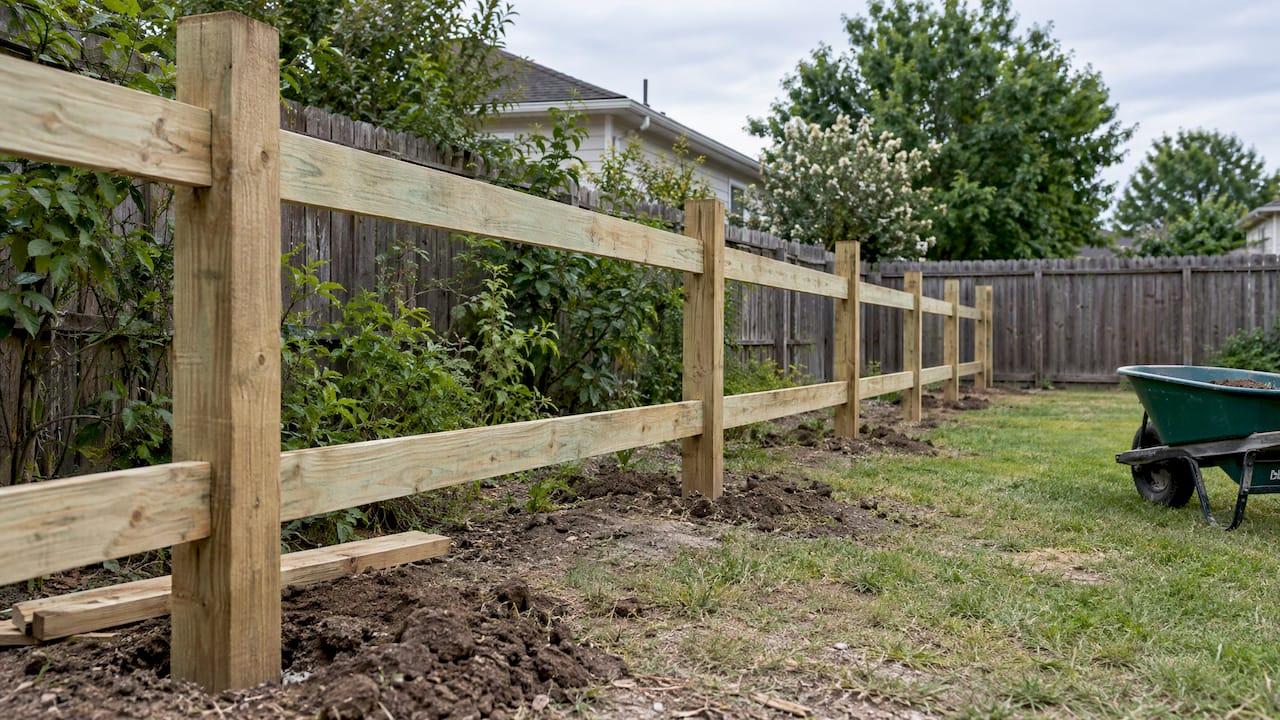
For most residential wood fences, set posts 6 to 8 feet apart, measured from the center of one post to the center of the next. Chain-link line posts can go up to 10 feet apart, and vinyl spacing follows the width of the panel you buy. Wind, soil, slope and fence height can all push those numbers tighter. This guide gives you the numbers by fence type, then walks through layout, post counts and corner bracing so your fence line comes out even and stays straight.
TL;DR
- Wood fences: 8 feet on center is the usual maximum, and 6 feet is safer for heavy, tall or solid privacy designs in windy or sandy locations.
- Chain link: up to 10 feet on center, dropping to 6 feet for privacy slats or heavy snow.
- Vinyl: on-center spacing equals the panel width plus one post width, so buy the panels first and set posts to match.
- A 100-foot straight run at 8-foot spacing takes 14 posts. Add two posts for every gate opening.
- Divide the line into equal sections instead of leaving a short odd bay at the end.
Table of Contents
- How fence post spacing is measured
- Standard spacing by fence type
- 4x4 or 6x6: does post size change the spacing?
- When to tighten the spacing
- How to lay out a fence line
- How many fence posts do you need?
- Corners, gates and bracing
- Our perspective
- Plan the fence on your own property map
- Common spacing mistakes to avoid
- FAQ
- Sources
How fence post spacing is measured
Spacing is measured on center: from the middle of one post to the middle of the next. Fence contractors measure post spacing on center, not by the gap between the posts. That matters because a 4x4 post is actually about 3.5 inches wide, so the clear opening between two posts set 8 feet on center is a little under 8 feet.
On a slope, measure along the ground rather than flat on a level. Along-the-ground measurement on slopes keeps your section length accurate to the rails or panels you will actually hang.
Standard spacing by fence type
| Fence type | Typical on-center spacing | What drives it |
|---|---|---|
| Wood privacy or picket | 6 to 8 feet | Rail length and sag |
| Chain link, residential | Up to 10 feet | Top rail strength, mesh |
| Chain link with privacy slats or heavy snow | About 6 feet | Added wind and snow load |
| Vinyl | Panel width plus one post width | Pre-made panel size |
| Ornamental or wrought iron, 4 feet or less | Up to 8 feet in one municipal code | Local code |
| Ornamental or wrought iron, over 4 feet | Up to 6 feet in the same code | Local code |
The sections below explain each row.
Wood fence post spacing
Most wood fences use 8-foot post spacing. Posts set farther apart may not hold the fence up in wind, while posts set too close mean extra digging and extra cost.
The 8-foot number has a practical reason. Dimensional lumber is commonly sold in 8-foot and 16-foot lengths, and spacing beyond 8 feet is likely to leave rails sagging. Standard rails are cut for 8-foot bays, so you waste little lumber.
Wood is also less forgiving than chain link. There is no mesh to share the load, so each section is an independent panel hung between two posts. A 6-foot dog-ear privacy fence weighs roughly 12 to 15 pounds per linear foot, which is 96 to 120 pounds of dead weight in an 8-foot section before any wind hits it.
If you are choosing between 6 and 8 feet, ask four questions:
- Is the fence a solid privacy design, which catches more wind than a spaced picket?
- Is it 6 feet tall or more?
- Is your yard open, with little shelter from wind?
- Is the soil sandy or loose?
Three or four yes answers point to 6-foot spacing. One or none usually means 8 feet is fine.
Chain-link fence post spacing
The national chain-link product standard sets the ceiling. ASTM F1043 caps chain-link post spacing at 10 feet on center, and that figure assumes a fence with 2-inch mesh, 9-gauge fabric, a 105 MPH wind gust, Category B exposure and no icing. If your site is more exposed or you add anything that catches wind, tighten it.
For homeowners, the practical version is this: chain-link posts can sit up to 10 feet apart, but the top rail can sag at that distance. Add line posts where needed, and use 6-foot spacing when installing privacy slats or in areas with heavy snowfall. Our chain-link fence planning guide covers the rest of the material choices.
Vinyl fence post spacing
Vinyl is the one type where you do not pick the spacing first. Vinyl post spacing is set by panel width. Most panels come in 6-foot or 8-foot widths, and the on-center distance equals the panel width plus the width of one post. Buy your panels, check the manufacturer’s installation sheet, then lay out the posts to match. Our vinyl privacy fence guide explains how panel choice affects the budget.
Ornamental, wrought iron and steel
Local codes sometimes spell out spacing. One California city’s fencing requirements, for example, set maximum post spacing for vinyl and wrought iron at 8 feet on center for fences 4 feet or less in height, and 6 feet on center for taller fences. That is one city’s rule, so check your own city or county before you dig.
For steel fences, a six-foot fence generally performs best with posts no more than six to seven feet apart, while fences of four feet or less may tolerate wider spacing.
4x4 or 6x6: does post size change the spacing?
Post size changes strength, but it does not by itself let you stretch past the rail or panel length. Standard 4-by-4 posts work for most residential fences, and 6-by-6 posts give extra strength for taller or heavier designs. Most fence posts are still spaced 6 to 8 feet apart either way.
Use 6x6 posts for gate posts, corners and fences 6 feet or taller. Keep the 8-foot maximum for the line posts in between, because the rails are the limit, not the post.
When to tighten the spacing
The standard numbers assume average conditions. Adjust for these.
Wind
In high-wind areas, reduce standard post spacing by 15 to 25 percent. One contractor guide puts the rule more specifically: in zones with winds of 110 MPH or more, solid fences call for 6-foot spacing and about 25 percent more post depth. Wind-driven open ground, like the high desert and valley flats in Idaho and Utah, is a good reason to lean toward the tighter number on a solid fence.
Soil
Sandy or loose soil gives posts less to grip. The same guide suggests reducing wood-fence spacing to 6 feet and adding 25 to 30 percent more post depth in sandy conditions. Rocky ground has the opposite problem: it is hard to dig, so a layout with fewer, well-placed posts saves labor, but only if the rails still span safely.
Slopes and uneven ground
Steep yards need their own plan. You can step the fence, keeping rails level and filling the gap below, or let it follow the grade with rails parallel to the ground. A manufacturer installation guide describes both approaches, including miter-cutting rails to fit and trimming pickets on extreme slopes. We cover how this changes your layout and your quote in planning a fence on a slope.
Frost and depth
Spacing and depth work together. A common rule of thumb is to bury about one third of the post length, and many areas call for going below the local frost line. Ask your city or county building department for the frost depth and any permit or height rules before you set a single post.
How to lay out a fence line
Good layout is what makes spacing come out even. Here is the order that works.
- Mark the key points. Stake the corners, endpoints and gate openings, then run a taut mason’s string line between them to set the fence line.
- Confirm your property line. Check your survey or plat before you stake. Setting a fence a few inches inside the line is cheaper than moving it later.
- Square the corners. Use the 3-4-5 method: measure 3 feet from where the string lines cross, 4 feet along the other line, and adjust until the two marks are 5 feet apart.
- Set terminal posts first. Corners, ends and gate posts go in first, then you divide the remaining distance equally for line posts.
- Divide evenly. Do not simply measure 8 feet at a time and accept a stub at the end.
Dividing the line evenly
A fence run rarely divides cleanly by 8. Divide the line length by your maximum spacing and round up, then divide the line length by that number of sections to get the real on-center distance. The same guide’s example: a 69-foot line becomes 9 sections at 92 inches on center.
Try it on a 50-foot side with an 8-foot maximum. 50 ÷ 8 is 6.25, so round up to 7 sections. 50 feet ÷ 7 is about 7.14 feet, or roughly 85.7 inches on center. Every bay is the same, and no bay exceeds your maximum.

For pre-built panels the math flips: your panel size is fixed, so you set posts to the panel and let the last section be a custom cut or a shorter panel.
How many fence posts do you need?
For a straight run with no gates, divide the length by the spacing, round up, and add one. A 100-foot run at 8-foot spacing needs 14 posts: 100 ÷ 8 is 12.5, rounded up to 13 sections, plus one. Add two extra posts for every gate opening. At 6-foot spacing, the same run needs 17 sections and 18 posts.
| Fence length | 8-foot spacing | 6-foot spacing |
|---|---|---|
| 50 feet | 8 posts | 10 posts |
| 100 feet | 14 posts | 18 posts |
| 150 feet | 20 posts | 26 posts |
These assume a straight line with no gates and each figure rounded up. If you are using pre-assembled panels, divide the linear footage by the panel length and add two for the number of posts, with the added posts for corners and gates counted on top of that.
On a fence that turns corners, count each side as its own run, because every corner post is shared by two runs and you will want to add extra bracing.
Corners, gates and bracing
Corners and gates carry the most stress, so they get the biggest posts and the deepest holes. For most wood privacy fences, a 6x6 post at every corner and gate post, set in concrete, keeps the line square for years.
Bracing styles come from wire-fence building, and the two you will hear about are the H-brace and the diagonal brace. One state wildlife agency’s fencing handbook describes an H-brace as two vertical posts set 10 feet on center with a horizontal brace between them, held with a double loop of high-tensile wire. That assembly is meant for tensioned wire, such as livestock or deer fencing.

For a typical backyard wood or vinyl fence, the corner takes a different approach: rails are fastened into the corner post from both directions, and a well-set, deeper post does the bracing. If you build a tensioned wire or chain-link fence with a long run, brace the end, corner and gate posts, because those are the posts that take the pull. A chain-link kit’s instructions will tell you which brace style it expects.
Our perspective
Most spacing mistakes we see start before anyone picks up a post-hole digger. People guess at the length of the fence line, the number of gates and the slope, then order materials and get quotes based on those guesses.
That is why we built our planning tools around a map. You draw the fence on aerial imagery of your own property, mark the gates, and the measurements come from your drawing rather than a rough estimate. With a real length, you can divide the line evenly, count posts and compare spacing options before you buy anything.
The same drawing also helps contractors. When a quote request arrives with the dimensions, the gate locations and photos, a contractor has what they need to talk about spacing, depth and bracing for your actual yard. We think better-defined projects lead to better-matched quotes.
Christian
Plan the fence on your own property map
Once you know your spacing, the next step is the real length of your fence line. Our Fence Estimator lets you draw the fence on a satellite view of your property, mark gate locations, and get a site-specific planning estimate based on your dimensions and local cost data, with no account required.

When you are ready, you can send the drawing as a quote request to local contractors. If you want to price out materials first, the fence material cost calculator breaks out posts, boards, gates and hardware. For a guide to what to include in a request, see fencing quotes and yard measurement.
Common spacing mistakes to avoid
- Measuring edge to edge. Measure center to center, or your sections will not match your rails.
- Ignoring the end bay. Equal sections look better and keep every bay within your maximum.
- Forgetting gate posts. Count two extra posts per gate opening, and give gate posts extra size and depth.
- Using flat measurements on a hill. Measure along the ground.
- Skipping local rules. Height limits, setbacks and sometimes post spacing are set locally, so confirm before you dig.
- Setting shallow posts. Spacing cannot make up for posts that are too shallow for your soil and frost depth.
If you are also building a deck, post spacing there follows different rules, covered in our deck post spacing guide.
FAQ
How far apart should fence posts be?
For most wood fences, 6 to 8 feet on center, with 8 feet as the usual maximum. Chain link can go up to 10 feet, and vinyl follows panel width plus one post. Tighten the spacing in high wind, sandy soil or for tall solid fences.
How far apart should 4x4 fence posts be?
A 4x4 post is fine for most residential fences, set 6 to 8 feet apart. Use 6x6 posts for taller or heavier designs, and for corners and gates. The rail or panel length is still what sets the maximum.
How many posts do I need for 100 feet of fence?
At 8-foot spacing you need 14 posts: 100 ÷ 8 is 12.5, round up to 13 sections, and add one. At 6-foot spacing you need 18. Add two more posts for each gate opening.
Should I use an H-brace or a diagonal brace at corners?
The H-brace is a standard assembly for tensioned wire fences, built with two posts set 10 feet on center and a horizontal brace. Backyard wood and vinyl fences usually rely on larger, deeper corner posts instead. Follow the instructions for your fence kit or ask your installer.
Can I space posts farther apart to save money?
Only within the limits of your material. Spacing beyond 8 feet on a wood fence tends to cause sagging rails, and extra spacing can weaken the fence in wind. Equal sections at your maximum spacing are the efficient way to cut post count.
Sources
- Fence post spacing measured on center
- How Far Apart Should Fence Posts Be? (Family Handyman)
- Wood fence calculator and spacing notes
- Fence post spacing guide for contractors
- ASTM F1043 chain-link fence standard
- Guide to fence post sizes (Angi)
- Fence post spacing calculator
- Fence installation guide with slope and layout methods
- How to lay out a fence line
- How to build a fence (The Home Depot)
- How many fence posts do I need
- Fence calculator
- Energized fencing handbook, Minnesota DNR