320 Sq Ft Costs: Deck vs Patio for Homeowners
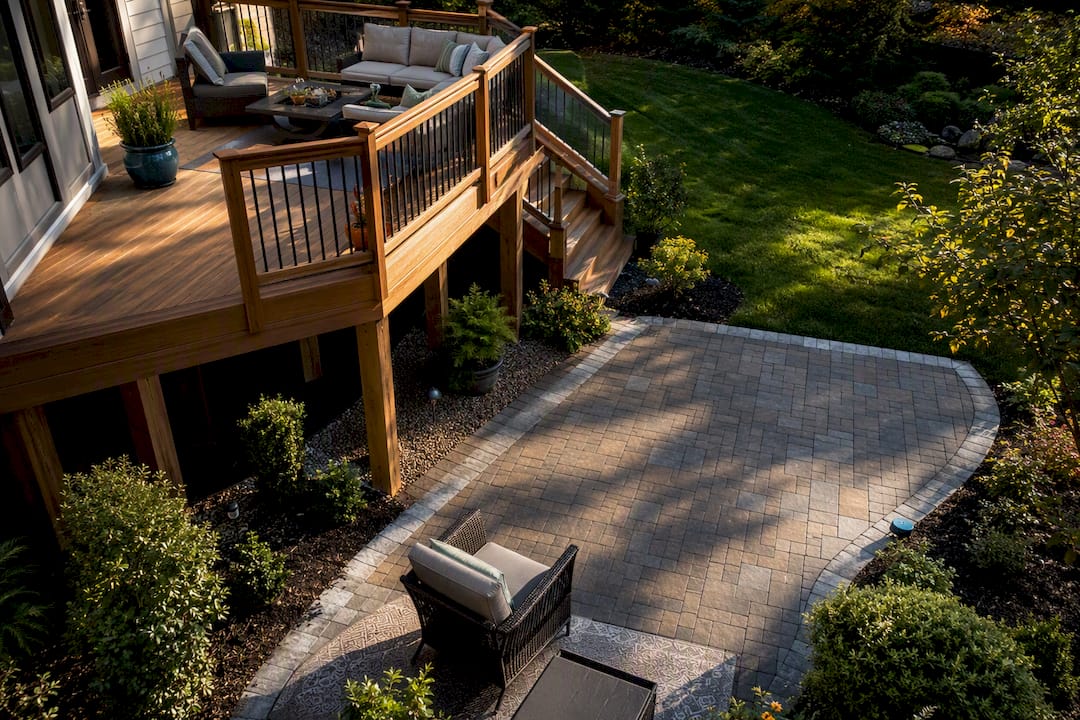
A patio usually costs less to build, running roughly $5 to $17 per square foot, while a deck typically runs $25 to $80 per square foot but often recoups more of its cost at resale. Which one is right for you comes down to two things: how flat your yard is, and how much upkeep you’re willing to tolerate.
TL;DR:
- The cost of a patio on flat ground typically ranges from $4 to $15 per square foot, while decks average $25 to $80 per square foot, impacting overall budget.
- Building on a slope often increases patio costs due to excavation and retaining walls, while decks can handle elevation changes with posts and footings at a lower expense.
- Over ten years, wood decks require regular staining and maintenance, whereas concrete and paver patios need minimal upkeep, potentially reducing long-term costs.
- Resale value generally favors decks, which tend to recover a higher percentage of their upfront cost compared to patios depending on regional preferences and project quality.
- Accurate project estimates depend on yard specifics, material choices, site conditions, and permits; using site-specific calculators with satellite mapping can prevent budget surprises.
Table of Contents
- What’s the Real Difference Between a Deck and a Patio?
- How Much Does Each Option Cost Per Square Foot?
- Does Your Yard’s Slope Change the Math?
- Which Costs More to Own Over 10 Years?
- Which One Adds More Value When You Sell?
- How Do You Build an Accurate Estimate for Your Own Project?
- Deck or Patio: A Quick Checklist Before You Decide
- Why So Many Homeowners Get This Comparison Wrong
- Get a Site-Specific Estimate Before You Call a Contractor
- Sources
What’s the Real Difference Between a Deck and a Patio?
A deck is a raised, framed structure, usually built with joists and posts, that sits above the ground on footings. A patio sits directly on the grade, built from poured concrete, pavers, or natural stone with no structural framing underneath.
That structural difference drives almost everything else: cost, permit requirements, and how each one ages.
Decks are typically built from pressure-treated pine, hardwood species like ipe or cedar, or composite boards like Trex. Patios use poured concrete, stamped concrete, brick pavers, or natural flagstone. Each material changes the price and the look dramatically, and each carries its own upkeep demands.
Here’s how they stack up on the basics:
- Decks work on sloped or uneven lots, feel like an elevated outdoor room, and are easy to furnish, but they generally need more upfront framing and more recurring maintenance if built from wood.
- Patios cost less per square foot on flat ground, need almost no structural maintenance, but a plain poured slab can look flat and cold without added landscaping or decorative finishes.
- Composite decking costs more upfront than wood but skips the staining cycle entirely.
- Pavers and natural stone cost more than plain concrete but hold up better and look better over decades.
How Much Does Each Option Cost Per Square Foot?
Numbers make this decision concrete, so start here. Poured concrete patios sit at the cheap end of the spectrum, around $4 to $15 per square foot. Stamped concrete and pavers push that range higher, and natural stone sits at the top of patio pricing. Decks cost more across the board because you’re paying for structural lumber, footings, and labor that a slab-on-grade project simply doesn’t need.
Patio cost ranges (per sq ft):
- Poured concrete: roughly $4 to $15
- Stamped concrete: mid-range, above plain concrete
- Pavers: moderate to high, depending on pattern and material
- Natural stone: the highest patio option, often $15 to $17 or more
Deck cost ranges (per sq ft):
- Pressure-treated wood: near the low end of decking, often starting around $25
- Hardwood (ipe, cedar): mid to high range
- Composite (Trex and similar): highest per-square-foot cost, but the lowest lifetime maintenance
Cost snapshot: On a 320 square foot footprint, a patio typically runs $1,600 to $7,000 total, versus $6,800 to $18,000 for a deck of the same size, before extras.
Two worked examples make this real. A 200 square foot patio in poured concrete lands around $800 to $3,000; the same footprint in composite decking runs closer to $5,000 to $16,000 once you add basic railings. Scale up to 320 square feet and the patio moves to roughly $1,600 to $7,000, while a deck of that size, with stairs and railings included, often finishes between $6,800 and $18,000. Add-ons like built-in lighting, custom railings, or a staircase to a second level push either number higher, but they hit deck budgets harder because more of a deck’s cost is labor and structural material.
Does Your Yard’s Slope Change the Math?
Site conditions can flip the entire cost equation, and this is the part homeowners underestimate most often. On flat, well-drained ground, a patio holds its price advantage easily. On a sloped lot, that advantage can shrink or disappear entirely.
Building a patio on a slope means excavation, grading, and often a retaining wall to hold soil back. Those costs add up fast, sometimes erasing the entire savings a patio was supposed to deliver. A deck, by contrast, uses posts and footings to handle elevation changes without moving a single yard of soil.
Permits matter too. Once a deck rises more than about 30 inches above grade, most building codes require guardrails, and footings typically need to reach frost depth, which adds both material cost and inspection time to the schedule.
- Sloped or uneven lots often favor a deck once excavation and retaining-wall costs enter the picture.
- Decks above 30 inches in elevation usually trigger permit review, guardrails, and deeper footings.
- Tight side yards or long carry distances for materials quietly add labor hours that per-square-foot averages never capture.
- Poor drainage under a planned patio site may require a French drain or extra base material before a single paver goes down.
Pro Tip: Walk your yard with a level or ask a contractor to check the grade before you fall in love with a patio design. A drop of even a few inches across the footprint can mean thousands in extra prep work.
Which Costs More to Own Over 10 Years?
Upfront price only tells half the story. Maintenance and lifespan decide what you’ll actually spend by year ten.
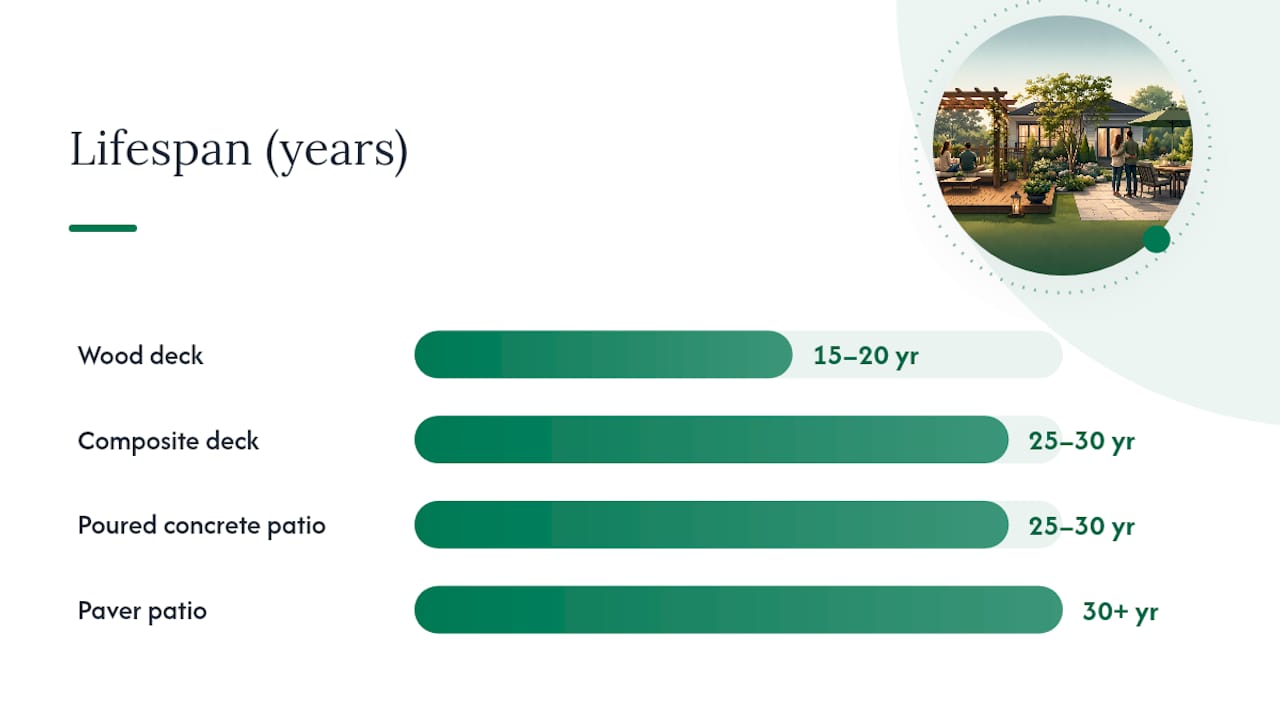
A pressure-treated wood deck typically lasts 15 to 20 years but needs staining or sealing every two to three years to prevent rot and warping. Composite decking lasts longer, often 25 to 30 years, and needs little more than an occasional wash. Poured concrete patios last 25 to 30 years with almost no upkeep, while paver patios can last even longer, provided you refresh the joint sand or polymer every few years.
- Wood deck: 15 to 20 year lifespan, staining every 2 to 3 years, occasional board replacement.
- Composite deck: 25 to 30 year lifespan, occasional cleaning, no staining.
- Poured concrete patio: 25 to 30 year lifespan, near-zero maintenance, possible resealing.
- Paver patio: 30-plus year lifespan, periodic joint sand refresh, individual pavers replaceable if damaged.
A wood deck owner who stains every three years over a decade spends several hundred dollars in materials and weekends alone. A paver patio owner over that same decade might spend nothing beyond an occasional sweep and joint touch-up.
That gap is where patios quietly win back some of their upfront price disadvantage against a wood deck, even though composite decking closes that gap considerably.
Which One Adds More Value When You Sell?
Resale value tends to favor decks, though the gap depends heavily on your region, the quality of materials, and how well the project matches your home’s style. Industry reports generally show decks recouping a higher percentage of their cost than patios, while patios often land closer to a 50% recoup in many markets.
That doesn’t mean a patio is a bad investment. In warm climates where outdoor living space is a bigger selling point, a well-finished patio with quality pavers and integrated landscaping can outperform a plain wood deck that’s starting to show its age.
- Decks tend to recoup more of their cost, but only when built with quality lumber or composite, not the cheapest treated pine available.
- Patios recoup less on paper but cost less to build, so the dollar gap at resale can be smaller than the percentage gap suggests.
- Buyers in colder regions with short outdoor seasons often value decks more; buyers in warm climates often lean toward patios and outdoor kitchens.
- Integrated lighting, built-in seating, and professional landscaping tend to lift recoup for either option.
How Do You Build an Accurate Estimate for Your Own Project?
Every number above is a regional average. Your actual cost depends on your yard, your labor market, and your material choices, so treat these ranges as a starting point, not a quote.
- Measure and draw your footprint. Sketch the exact dimensions of your planned deck or patio, including any curves or steps in elevation.
- Choose your material. Compare pressure-treated wood, hardwood, and composite for decks, or concrete, pavers, and stone for patios, against your budget ceiling.
- Add site modifiers. Factor in slope, drainage, retaining walls, or extra footing depth if your yard isn’t flat.
- List your extras. Railings, stairs, built-in lighting, and seating all add line items that a flat per-square-foot number won’t capture.
- Layer in permits and local labor rates. Permit fees and wage rates vary by county and swing your total more than most homeowners expect.
Property Improvement Estimator’s Deck Estimator turns those five steps into a single workflow. Draw your footprint on a satellite map, and the Deck Material Cost Calculator and Deck Labor Cost Calculator apply local pricing to your exact dimensions instead of a national average.
Pro Tip: Run your numbers through the calculator before calling a single contractor. You’ll spot unrealistic bids in seconds when you already know what your footprint should cost.
Deck or Patio: A Quick Checklist Before You Decide
Ask yourself these questions before committing to either project:
- Is your yard flat, or will you need excavation and retaining work?
- Do you want elevation, a view, or a raised outdoor living space?
- What’s your real budget, including permits and extras, not just the base build?
- How much recurring maintenance are you willing to do every few years?
Watch for these red flags in contractor bids: vague scope language with no material breakdown, missing footing or frost-depth details, no allowance for drainage work, and bids that come in suspiciously low because they’ve quietly skipped permitting altogether.
Why So Many Homeowners Get This Comparison Wrong
The biggest mistake isn’t picking the wrong material. It’s pricing the project before anyone accounts for the yard itself. Slope, drainage, and access routinely double a patio’s expected cost, and homeowners who priced based on a national per-square-foot average end up blindsided at bid time.
Mapping the project first, before requesting a single quote, catches that problem early. It’s the difference between negotiating from strength and discovering surprises mid-build.
— Christian
Get a Site-Specific Estimate Before You Call a Contractor
Propertyimprovementestimator is the alternative to guessing from a national cost average. Instead of applying a generic per-square-foot number to your yard, you draw your actual deck or patio footprint on a satellite map, and the platform factors in your specific dimensions, local material costs, and labor rates.
The Deck Material Cost Calculator and Deck Permit Cost Calculator break your project into the same line items a contractor would quote: materials, labor, footings, and permit fees. That means when you’re ready to request bids, you’re comparing contractor numbers against your own site-specific baseline instead of a rough guess pulled from an article. Start by drawing your project on the Satellite Property Improvement Cost Estimator and see what your yard actually costs to build on, before a single contractor walks the property.
Sources
- Deck vs Patio Cost (2026): Patio Is 40–60% Cheaper
- Decks vs Patios: Cost, Pros, Cons, & Comparisons