Corner Lot Fence Rules: Height, Setbacks and Sight Triangles
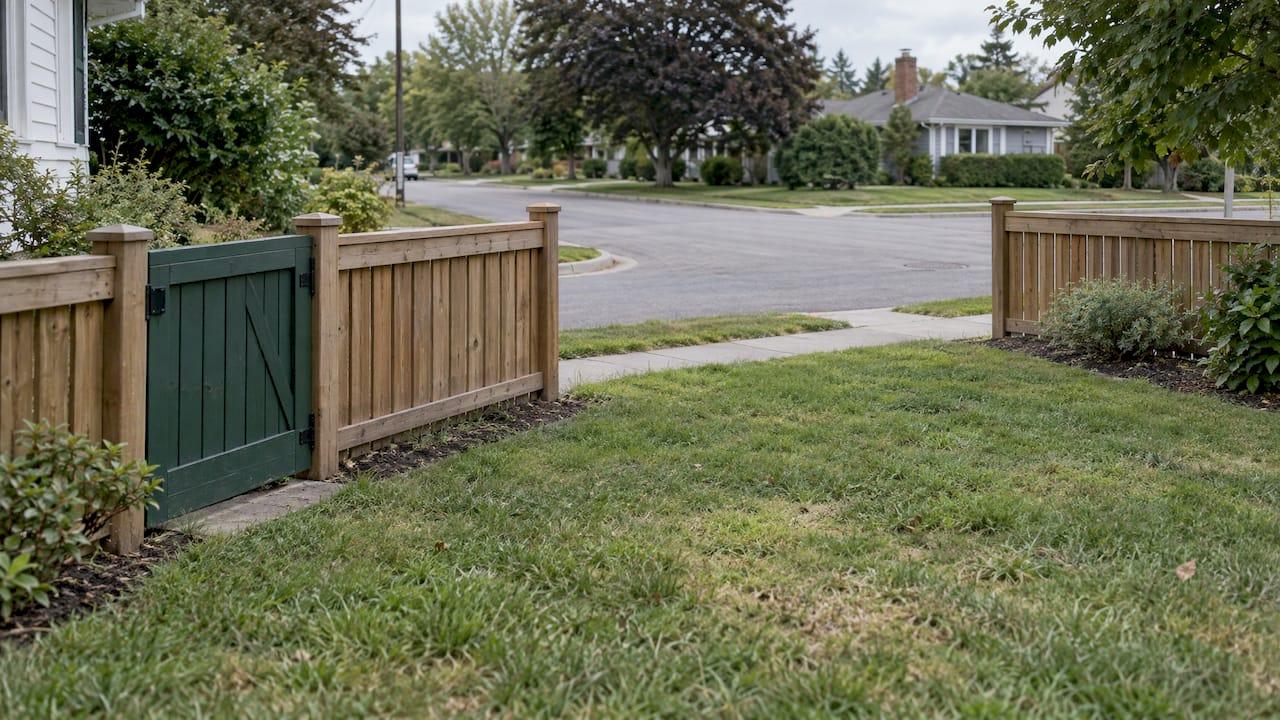
Corner lot fence rules are stricter than the rules for a mid-block lot, because your yard touches two streets and drivers need to see around the corner. Expect three things: a lower height cap (often about 3 feet, or 30 inches) inside a triangle at the intersection, a street-side yard that may count as a second front yard, and a setback from the street or sidewalk that is measured from the property line, not from the curb. The exact numbers are set by your city or county, so the examples below show the pattern, and your local code gives the figure that binds you.
TL;DR
- Corner lots usually have two street-facing yards, and many codes treat both as front yards or apply special “corner side” limits.
- Inside the sight (visibility) triangle at the intersection and at driveways, fences are commonly capped between 30 inches and 3 feet.
- Setbacks are measured from the property line. The curb or sidewalk edge is not the line, so get a survey before you dig.
- Many cities require a permit or zoning check for corner lot fences, and some do not, so confirm with your planning office first.
- Draw your layout on a map before you call anyone. Your planning office and your fence contractor will both work faster from a drawing.
Table of Contents
- Why corner lots get their own fence rules
- Which side is the front yard on a corner lot?
- How tall can a corner lot fence be?
- Sight triangles: the rule that catches most owners
- Setbacks: measure from the property line, not the curb
- Permits and approvals on a corner lot
- A step-by-step way to plan a corner lot fence
- Perspective: why we draw the lot first
- Plan your corner lot fence on the map
- FAQ
- Sources
Why corner lots get their own fence rules
A fence is not just a boundary marker. On a corner it can block the line of sight between a driver approaching the intersection and a child on the sidewalk or a car pulling out of the cross street. That is why codes write special rules for corners, and why those rules are enforced even in places that are relaxed about fences elsewhere.
Two ideas do most of the work:
- Yard classification. The code decides which of your sides is the front, which is the side and whether the street-facing side counts as something in between.
- Visibility. The code carves out a triangle at the corner, and sometimes at the driveway, where anything solid and tall is prohibited.
Everything else (height, materials, setbacks, permits) hangs on those two.
Which side is the front yard on a corner lot?
There is no national answer. Cities define it differently, and the definition changes how tall your fence may be.
- Fairfax County, Virginia says a yard abutting a street is a front yard, so a corner lot has more than one front yard.
- Concord, California defines the front property line as the shortest side fronting a public street and treats the longer frontage as the corner side.
- Norfolk, Virginia describes a corner lot as having a front yard, two side yards and a corner-side yard, rather than a rear yard.
Notice what this means in practice. The side your front door faces, the side your driveway uses and the side your mailing address names may not decide anything. The zoning code does. Read the definitions section of your city’s code before you read the fence section, because a fence that is legal in a “side yard” can be illegal in a “front yard” on the very same strip of lawn.
How tall can a corner lot fence be?
Height limits change by yard type. The table below shows how different official codes set them. Use it to see the pattern, not to plan your own fence.
| City or county | Front yard | Corner-side, street-side, side or rear | Inside the visibility area |
|---|---|---|---|
| Fairfax County, VA | 4 feet in most front yards | 7 feet in side and rear yards | Sight-distance rules apply |
| Concord, CA | 3 feet in the front setback (typically 20 feet) | Up to 6 feet on the corner-side line | 3 feet |
| Dublin, CA | 4 feet | 6 feet in side, street-side and rear yards | 2 feet 6 inches |
| Post Falls, ID | Per front-yard setback rules | 6 feet on the street side if it stays out of the front-yard setback | Check city code |
The common thread is a low cap near the street and the intersection, and a taller allowance once the fence sits behind the setback. If you want a 6-foot privacy fence along the street side, the real question is how far back from the property line it has to sit. A fence that is perfectly legal 12 feet back can be illegal 2 feet back.
Post Falls, Idaho is a useful reminder that a permit and a height rule are separate things: the city says no city permit is required for a fence, but the fence still has to meet the height and property requirements.

Sight triangles: the rule that catches most owners
A sight triangle (also called a visibility triangle or clear-view area) is measured from the point where the two street lines meet. You mark a set distance along each line, connect the two points, and the triangle that results is the restricted zone. Distances and heights vary a lot:
| Jurisdiction | How the triangle is measured | Height limit |
|---|---|---|
| Concord, CA | 40 feet along both street-frontage lines; driveway triangles 15 feet along the property line and 15 feet along the driveway | 3 feet |
| Puyallup, WA | 20 feet along each right-of-way line at an intersection; driveway triangle 10 feet along the street or alley and 15 feet along the driveway | 30 inches for fences, walls, trees and shrubs |
| Dublin, CA | 30 feet from the intersection along both street-side lot lines, points connected | No obstruction over 30 inches above the nearest curb |
| New Castle County, DE | Points 25 feet from the intersection of the two street lines | No visibility-blocking structures, fences or plantings |
| Augusta, GA | Corners where either or both streets are less than 60 feet wide | Nothing over 3 feet |
Two details trip people up.
It is not only the fence. Augusta’s rule covers a fence, hedge, bush or other construction, and Puyallup’s covers trees and shrubs too. A solid fence set back at the right distance can still be undone by an overgrown hedge.
Driveways have their own triangle. Puyallup also notes that additional sight-distance requirements can vary with street speed, so a fast collector street may need more clearance than a quiet residential one. If your driveway exits onto the side street, check both triangles.

When the code is ambiguous, ask. Eden Prairie, Minnesota advises owners abutting an intersection or public right-of-way to contact its Engineering Division for a sight-line review, and notes the fence must be set back as needed to preserve pedestrian and vehicle views.
What an “open” fence can change
Some codes allow a taller fence inside the triangle if it is see-through, such as wrought-iron style or open picket designs. Others do not, and cap every material at the same height. Never assume that a chain-link or open-rail fence is exempt. Look for the word “open” or a percentage of openness in your code, and if it is not there, assume the cap applies to everything.
Setbacks: measure from the property line, not the curb
Most corner-lot mistakes are measuring mistakes. The strip of grass between the sidewalk and the street, or the sidewalk itself, is often public right-of-way. Eden Prairie warns that the curb line is not the property line and recommends a property survey before installation.
Concord goes further: a property-line survey is the only accurate way to locate private property lines, and the city does not keep survey records for private property. Our guide on how to find property lines before you build, fence or dig walks through the records and tools to start with.
A few practical habits:
- Find the survey pins or your recorded plat before you sketch anything.
- Measure setbacks from the property line, then double-check against the sight triangle, which is measured from the street lines.
- Allow a small buffer. Amherst, Ohio, for example, generally requires fences to sit at least 4 inches inside the property line unless abutting owners give written authorization.
- Check private covenants and HOA rules, which can be stricter than the city’s. Eden Prairie specifically points owners to private covenants and restrictions.
A fencing professional who has seen your lot can help sanity-check boundaries and visibility before posts go in. If you want an outside set of eyes, having a fence layout reviewed by a local fencing company is a sensible step once you have a drawing and a survey in hand.
Permits and approvals on a corner lot
Permit rules range from “none” to “a survey and a zoning certificate.” Some examples from official city pages:
- Austin, Texas requires a permit for a residential fence more than 6 feet high along the public right-of-way, other than an alley.
- Norfolk, Virginia requires corner-lot fences to have a Zoning Certificate and a physical survey prepared within the previous 2 years by a licensed design professional.
- Sioux Falls, South Dakota requires a permit before putting up, moving or changing a fence and lists a $20 fence-permit fee in its 2024 brochure.
- Rio Rancho, New Mexico requires zoning plan review for all fences, including lot dimensions, existing structures and the proposed location and height.
Fees and forms change, so treat these as examples of what to expect and confirm the current numbers with your own city. If you want a sense of what permits and setbacks add to a budget, the fence permit cost calculator covers height, gates, setbacks and HOA context.
Do you need to talk to your neighbors?
Sometimes the code says yes. Canton, Michigan requires signed neighbor permission for a fence on a property line and makes the applicant responsible for HOA approvals before construction. Its application also asks for a survey showing the fence in relation to lot lines, streets, driveways, walkways, buildings and neighboring fences. Even where the law does not require it, a conversation before the posts go in is cheap insurance.
A step-by-step way to plan a corner lot fence
- Confirm the zoning district and your city’s yard definitions. Find out which of your sides is the front, the corner side and the rear.
- Get your survey or plat. Locate the property lines and any easements.
- Draw the sight triangles. Mark the intersection triangle and any driveway triangle using your city’s distances.
- Choose a height for each run. A low or open section near the corner, a taller section behind the setback.
- Check permits, HOA and neighbors. Ask the planning office whether a permit or zoning certificate is needed.
- Get quotes based on a real layout. Contractors price from linear feet, gates and height, so a drawing prevents surprises.
Perspective: why we draw the lot first
Most corner-lot fence problems start with a guess: a guess about where the line is, which yard is the front, or how big the triangle is. We built our tools so that guess becomes a drawing.
When you outline the fence on satellite imagery, you see the corner, the driveway and the street frontage together. You can shorten a run, split it into a low section and a tall section, or add a gate where the sight triangle would have blocked it, all before anyone is on your property.
That also helps contractors. A quote request with measured runs, gate positions and photos is a quote request they can price accurately, and it keeps you from paying for a design that the city will make you change. We designed the platform around that: a planning estimate that reflects your dimensions and local costs, with no account required.
Christian
Plan your corner lot fence on the map
With our Fence Estimator you can draw your fence runs and gates right on your property’s aerial view, adjust them as you learn your city’s setback and triangle rules, and see a locally adjusted planning range. When the layout is final, you can request quotes from local contractors with the drawing and measurements attached.

If you are still working out the budget, the fence cost guide covers materials, labor, gates and site factors, and our page on fencing quotes explains what to measure before you compare bids. Ready to compare? You can request local fence quotes from a property plan.
FAQ
What is considered the front yard on a corner lot?
It depends on your local code. Some places, such as Fairfax County, treat every yard that abuts a street as a front yard. Others define one front line, often the shortest street frontage, and call the other a corner-side yard with its own height limits. Check the definitions in your zoning code.
How high can a fence be on a corner lot?
Examples from official codes run from 3 to 4 feet in front yards and 6 to 7 feet in side, street-side and rear yards. Inside the visibility triangle the cap is lower, commonly 30 inches to 3 feet. Your city’s numbers are the ones that apply to you.
Do I need a permit for a corner lot fence?
Often, yes, but not everywhere. Some cities require a zoning certificate and survey for corner lots, others only require a permit above a certain height, and some, like Post Falls, Idaho, require no city permit while still enforcing height and property rules. Call your planning or building department before you buy materials.
Can I build a fence right at my property line?
Only if your code allows it and you know exactly where the line is. Some cities require fences to sit a few inches inside the line or need written consent from the abutting owner. A survey removes the guesswork, and your HOA may add its own rules.
Sources
- Residential Fences FAQ, City of Concord
- Code Compliance Corner, Fairfax County
- Fences Brochure, City of Norfolk
- Residential Fence, Wall, and Hedge Regulations, City of Dublin
- Fence Requirements FAQ, City of Post Falls
- Fences, City of Puyallup
- Fence and Corner Lot Requirements, Augusta, GA
- FAQ Fences, New Castle County
- Planning and Zoning FAQ, City of Eden Prairie
- Fence Guidelines, City of Amherst, Ohio
- Fencing Regulations, Austin Development Services
- Fence regulations brochure, City of Sioux Falls
- Fence, Shed, Retaining Wall and Reroof, City of Rio Rancho
- Fence Permit Application, Canton, MI