Concrete Pad Cost: A Homeowner's Budget Guide
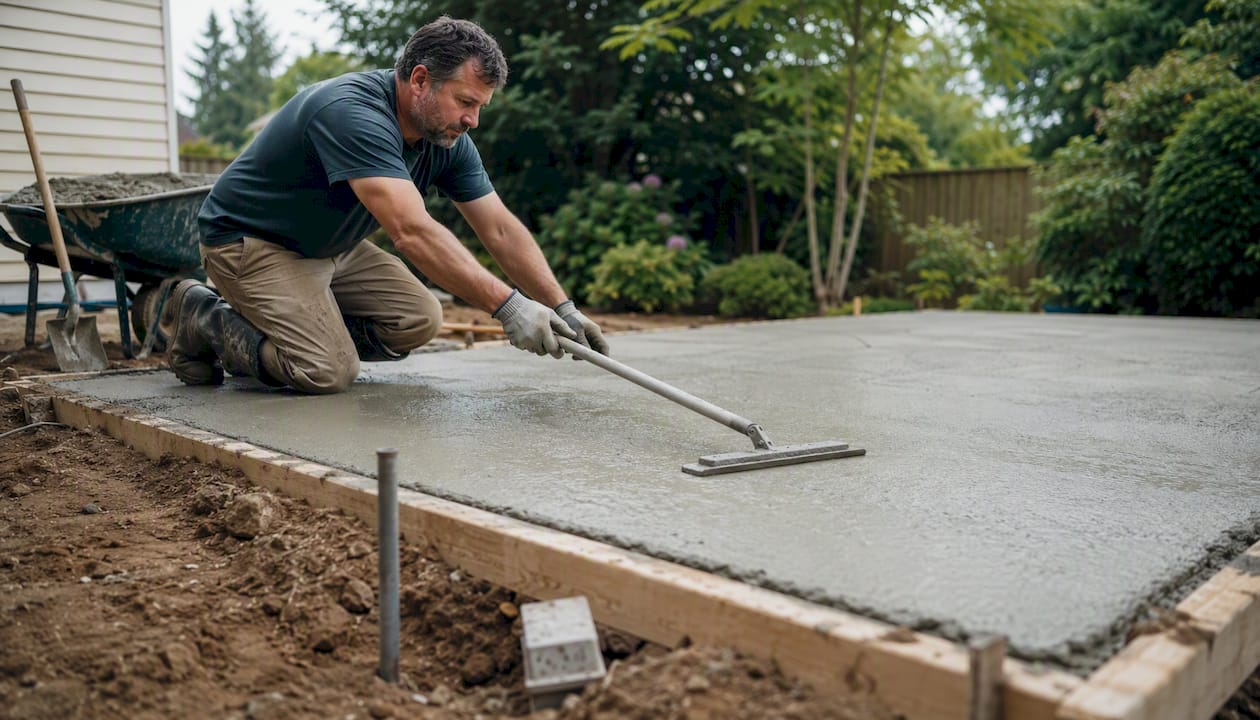
A concrete pad typically runs $6 to $12 per square foot installed, with most homeowners landing near the $8 national average for a standard 4-inch slab with basic broom finish. That price includes ready-mix material, labor, basic site prep, and a broom or trowel finish. It does not include demolition, engineered reinforcement, or permit fees, which get added on top.
Here’s what that looks like in real dollars:
- 12x12 pad: costs vary substantially depending on location and specifications
- 20x20 pad: costs vary substantially depending on location and specifications
- 30x30 pad (900 sq ft): $5,400 to $10,800
- 40x60 pad: costs vary substantially depending on location and specifications
Pro Tip: A quick formula gets you in the ballpark fast: Area (sq ft) × price per sq ft, adjusted upward for thicker slabs or reinforcement. For a site-specific number that accounts for your soil, access, and local labor rates, run your dimensions through a concrete estimator instead of guessing.
Key Takeaways
Concrete pad cost depends less on a single average and more on thickness, finish, access, and site conditions layered onto a $6 to $12 per square foot baseline.
| Point | Details |
|---|---|
| Baseline price range | Budget $6 to $12 per sq ft installed for standard residential flatwork with basic finish. |
| Size affects rate | Very small pads often hit contractor minimums, pushing per-square-foot cost higher. |
| Labor is the biggest variable | Labor typically makes up 45 to 55% of installed cost and swings most with access and crew size. |
| Add fixed costs separately | Budget $2 to $5 per sq ft extra for base and reinforcement, plus $50 to $300 for permits. |
| Verify with a site-specific tool | Use Propertyimprovementestimator’s concrete estimator to turn your exact dimensions into a bid-ready scope packet. |
Table of Contents
- What Drives Your Concrete Pad Cost Breakdown?
- How Much Should Different Concrete Projects Cost?
- What Would a 20x20 Concrete Slab Cost Look Like in Practice?
- What Factors Push Your Quote Up or Down?
- How Long Does a Concrete Pour Take, and What Permits Do You Need?
- How Do You Estimate Your Own Concrete Pad Cost?
- Why Does a Site-Specific Estimate Beat a Generic Price Range?
- Getting Consistent Bids the Second Time Around
- Get a Bid-Ready Concrete Pad Estimate in Minutes
- Sources
What Drives Your Concrete Pad Cost Breakdown?
Labor and materials aren’t split evenly. Labor typically eats up 45 to 55% of your installed price, with materials, site prep, and equipment covering the rest.
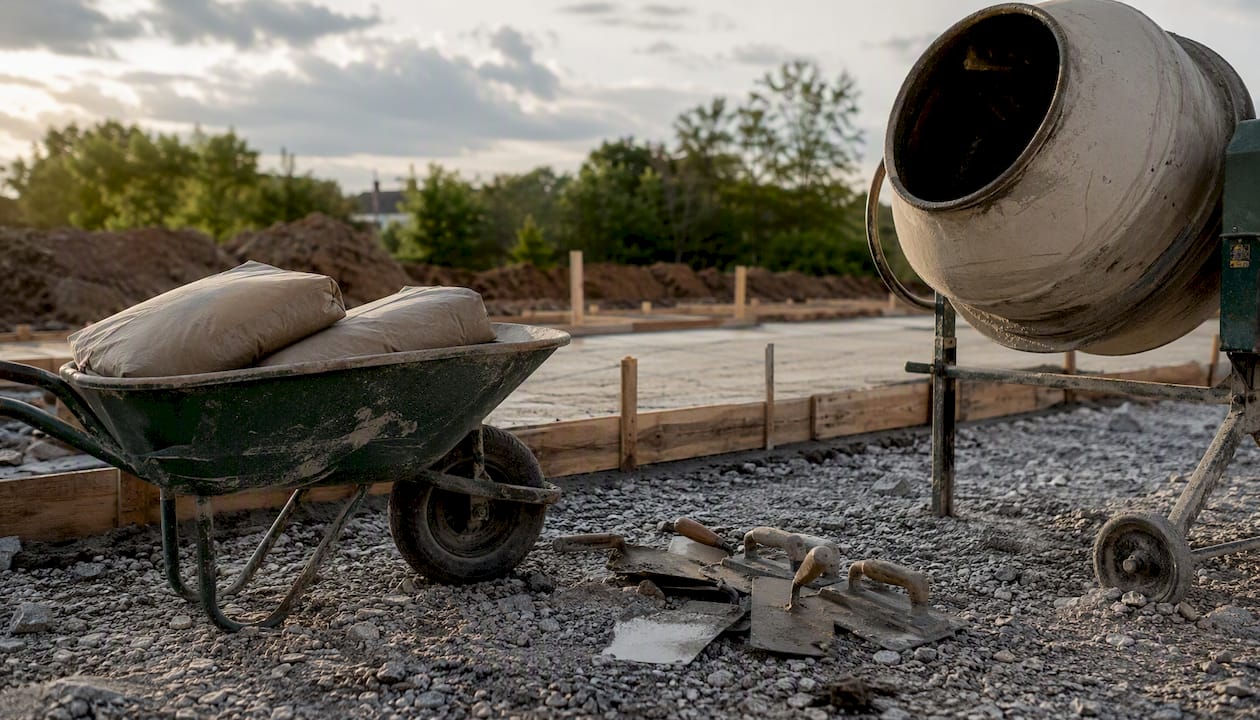
“Materials” isn’t just ready-mix concrete. It includes gravel base, a vapor barrier if you’re pouring near living space, wire mesh or rebar, and any fiber or color additives. Ready-mix alone usually runs $110 to $165 per cubic yard delivered, but once you add base rock and reinforcement, budgeting an extra $2 to $5 per square foot for those extras is common.
Labor rates track crew size and site access. A crew that can back a truck right up to the forms works faster than one hauling wheelbarrows through a side yard, and that difference shows up directly in the bid. Permits typically add $50 to $300 depending on your city, and removing old concrete before the new pour can tack on another $2 to $6 per square foot for demolition and haul-away.
- Labor: 45 to 55% of installed cost
- Materials including concrete, base, and reinforcement account for a substantial share
- Site preparation, permits, and equipment make up the rest
Pro Tip: The place contractors most often cut corners is the base. A thin, poorly compacted gravel base saves them money upfront but leads to cracking and settling within a few years. Ask specifically how many inches of compacted base they’re including.
How Much Should Different Concrete Projects Cost?
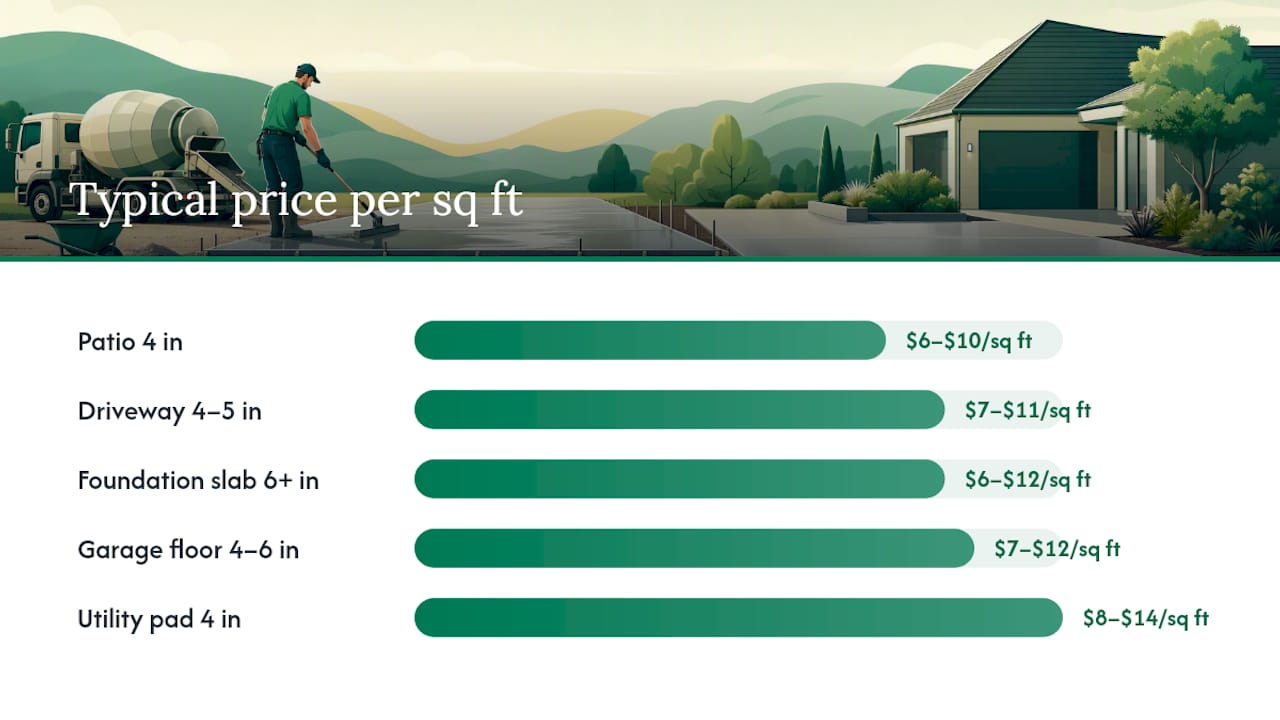
A patio and a garage floor look similar on paper, but they need different thickness, reinforcement, and finish work, and that changes the price per square foot substantially.
| Project type | Typical price/sq ft | Recommended thickness |
|---|---|---|
| Small utility pad (AC, shed) | $8 to $14 | 4 inches |
| Patio | $6 to $10 | 4 inches |
| Driveway | $7 to $11 | 4 to 5 inches |
| Garage floor | $7 to $12 | 4 to 6 inches |
| Home foundation slab | $6 to $12 | 6+ inches, engineered |
| Heavy equipment pad | $6 to $12 | 6 to 8 inches, reinforced |
Finish choice moves the number further. A basic broom finish sits at the low end of these ranges. Trowel finishes cost slightly more, stamped concrete can add $3 to $8 per square foot, and exposed aggregate finishes typically land somewhere in between.
Very small pads almost always cost more per square foot than large ones. A 32 square foot HVAC pad might hit a $500 to $900 contractor minimum simply because mobilizing a crew and truck for that little work has a fixed cost regardless of the size.
What Would a 20x20 Concrete Slab Cost Look Like in Practice?
The math is simple once you know your area and thickness. Area × price per square foot gives you the installed range; area × thickness ÷ 27 gives you cubic yards of concrete needed.
- 12x12 (144 sq ft): At $6 to $12/sq ft, that’s $864 to $1,728. A 4 inch pour needs about 1.8 cubic yards.
- 20x20 (400 sq ft): $2,400 to $4,800 installed. At 4 inches thick, that’s roughly 4.9 cubic yards.
- 30x30 (900 sq ft): $5,400 to $10,800. A 4 inch slab needs about 11.1 cubic yards; bump to 6 inches for a garage and you’re near 16.7 yards.
- 40x60 (2,400 sq ft): $14,400 to $28,800 for a large driveway or shop pad, needing 29.6 to 44.4 cubic yards depending on thickness.
Three-tier pricing helps frame the spread. A budget 20x20 pad with basic broom finish and minimal base lands near $2,400. A typical job with proper gravel base and standard finish runs closer to $3,600. A premium version with stamped or colored concrete and extra reinforcement can push past $4,800.
What Factors Push Your Quote Up or Down?
Every bid reflects a handful of site conditions, and knowing which ones matter most helps you read a quote instead of just reacting to the total.
- Site access: Low to medium impact. A pump truck adds cost but saves labor hours on tight lots.
- Soil conditions: Medium to high impact. Expansive clay or soft soil may require a deeper base or engineered design.
- Slope and drainage: Medium impact. Grading and drainage solutions add labor time.
- Old concrete removal: Medium to high impact. Demolition and disposal fees run $2 to $6 per square foot on top of the new pour.
- Reinforcement needs: Low to high impact. Wire mesh is standard; post-tensioning or engineered rebar for foundations costs significantly more.
- Weather timing: Low to medium impact. Winter pours need cold-weather additives; summer pours in hot climates need faster finishing crews.
Pouring over virgin, undisturbed ground is almost always cheaper than replacing an old slab, since you skip demolition and haul-away entirely. HUD’s rehabilitation guidance is a useful reference for when a project crosses into engineered-scope territory that requires permits and inspections beyond a standard flatwork pour.
Pro Tip: If your yard has a visible slope or standing water after rain, mention it before you get bids. Contractors who find drainage problems mid-job often charge change orders that run higher than if they’d priced it upfront.
How Long Does a Concrete Pour Take, and What Permits Do You Need?
Most residential pads follow a predictable schedule: one day for site prep and forming, one day for the pour itself, and three to seven days of curing before the area handles foot traffic. Full strength for vehicle loads takes closer to 28 days.
Labor rates for cement masons and concrete finishers vary regionally, but BLS wage data gives a solid baseline for what a two to four-person crew costs per day. Bigger crews finish faster but cost more per hour.
- Site prep and forming: 1 day
- Pour and initial finish: 1 day
- Cure before light use: 3 to 7 days
- Full cure for vehicle weight: 28 days
Check with your local building department before scheduling. Many jurisdictions require permits for driveways, foundations, and slabs over a certain size, and inspection timing can shift your schedule by a week or more. A permit cost calculator helps you budget for these fees before they show up as a surprise line item.
How Do You Estimate Your Own Concrete Pad Cost?
Start with a simple formula: Area (sq ft) × price per sq ft + fixed add-ons (base, reinforcement, permits) gets you a workable number before you call anyone.
- Measure your pad’s length and width, then calculate square footage.
- Decide on thickness based on use (4 inches for foot traffic, 6 inches for vehicles).
- Multiply area by your chosen price per square foot from the ranges above.
- Add $2 to $5 per square foot for base and reinforcement if not already included.
- Add permit fees based on your local requirements.
- Order roughly 10% extra ready-mix concrete to cover form spillage and uneven subgrade.
- Double-check your cubic-yard math using a material cost calculator or a retail tool like Lowe’s slab calculator.
- Collect at least three bids, and compare them using identical dimensions and finish specs so you’re not comparing apples to oranges.
Why Does a Site-Specific Estimate Beat a Generic Price Range?
A flat per-square-foot number is a starting point, not a quote. Your actual cost depends on inputs a generic range can’t account for: exact dimensions, slope, soil notes, access constraints, finish choice, reinforcement needs, and local labor rates.
Contractors bidding off inconsistent information give inconsistent numbers, which is why two bids for the “same” pad can differ by thousands of dollars. A visual, site-specific estimator solves this by generating a consistent scope packet, complete with measurements, photos, and access notes, so every contractor prices the exact same job.
- Exact dimensions drawn on a satellite map instead of eyeballed
- Slope and soil notes flagged upfront
- Access constraints (gates, slopes, tight yards) documented before bidding
- Finish and reinforcement choices locked in for apples-to-apples comparison
Pro Tip: Before requesting quotes, export your project’s measurements and photos into one packet. Contractors move faster on bids when they don’t have to schedule a site visit just to answer basic scope questions.
Getting Consistent Bids the Second Time Around
The first time I priced out a patio pad, three contractors gave me three wildly different numbers because they’d each assumed different thickness and base depth. The second project, I drew the exact footprint and noted the slope beforehand. Every bid came back within a few hundred dollars of each other.
The lesson: measure first, photograph the site, and hand contractors identical specs before you ask for a price.
Get a Bid-Ready Concrete Pad Estimate in Minutes
Generic per-square-foot ranges get you close, but your driveway’s slope, your yard’s soil, and your local labor rates are what actually set your final number. Propertyimprovementestimator lets you draw your exact pad on a satellite map of your property, then generates a site-specific estimate using your real dimensions, thickness, finish, and local cost data.
You’ll get a calculator built specifically for concrete work, factoring in reinforcement, base depth, and finish type, plus a downloadable scope packet contractors can bid against without guessing. You can still shop around and collect quotes the traditional way. Running your numbers through the satellite estimator first just means you’ll know whether those quotes are fair before you sign anything. Draw your project and get your estimate now.
Sources
Run your own cubic-yard math and check local labor and permit costs before finalizing a budget.
- Concrete Slab Cost: 2026 Prices ($6–12/sq ft Installed)
- Concrete Slab Cost in 2026 | $6–$12/Sq Ft Guide
- Occupational Employment and Wage Statistics (BLS OES)
- Concrete, Cement, & Masonry Calculator
- Rehabilitation guidance (HUDUSER)
Recommended
- Concrete Cost Calculator | Estimate Slabs, Driveways, Thickness, and Local Costs
- Composite Fence Cost per Foot | Property Improvement Estimator
- Composite Fence Cost and Planning Guide | Property Improvement Estimator
Made with BabyLoveGrowth to grow organic traffic