Plan Your Backyard Half Court: Map 47' x 50' Dimensions to Your Yard
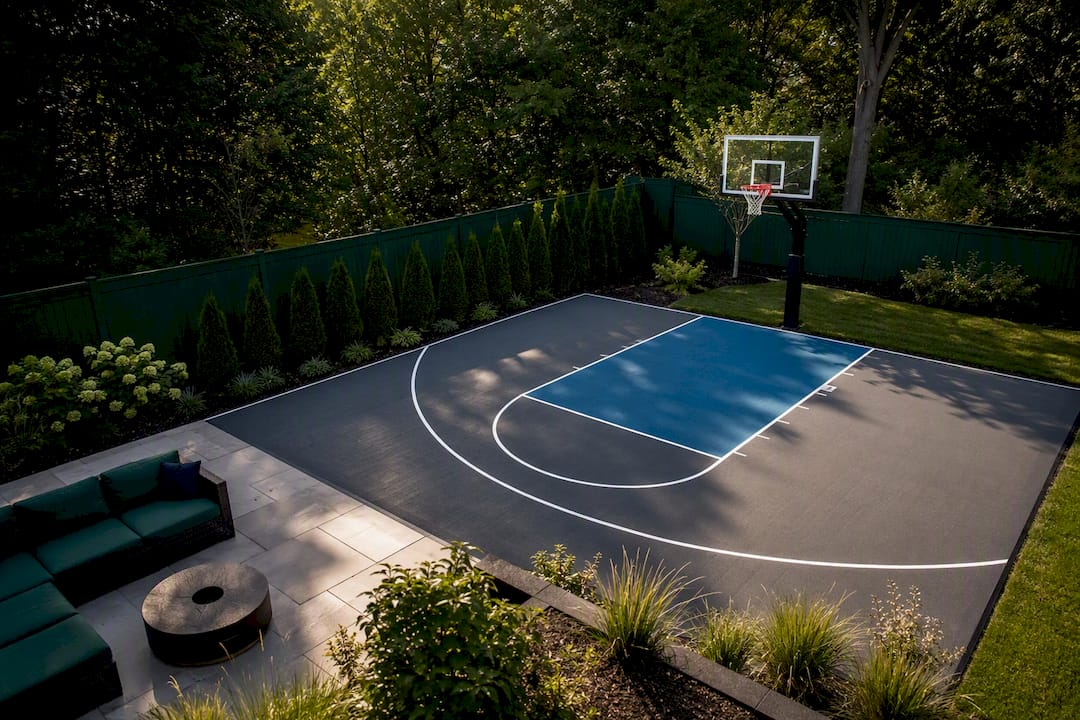
A regulation NBA or NCAA half court measures 47 feet by 50 feet, and a high school half court measures 42 feet by 50 feet, both derived from cutting a full court at midcourt. For a backyard, you don’t need anywhere near that much room: a solid shooting setup fits in 15 by 20 feet, and a popular driveway or backyard footprint runs 30 by 30 feet. Anyone with the space and budget can scale up toward that full 47 by 50 foot layout. The planning checklist and court estimator below turn either number into an actual build.
TL;DR:
- Most backyard half courts are realistically built between 15 by 20 feet and 30 by 30 feet, with full regulation size being 47 by 50 feet.
- The typical basketball court lines include a 15-foot free-throw lane and a three-point arc ranging from approximately 19 to 23 feet, depending on the level of play.
- Accurate site planning involves considering at least 6 to 10 feet of clearance around the court for safety and proper drainage, with slab thickness varying from 4 to 6 inches.
- Using map-based tools to draw your court footprint helps obtain precise contractor bids by reducing scope guesses related to grading, fencing, and lighting.
- Space limitations usually dictate the court size more than preference, so building a smaller, well-planned court often results in higher usage and better skill development.
Table of Contents
- Official Half Court Dimensions by Level, Explained
- Backyard Half Court Sizes That Actually Work
- What Line Dimensions Do You Need to Mark?
- Site Planning and Construction Checklist for a Half Court
- Turning Your Half Court Plan Into a Contractor-Ready Estimate
- What Size Should You Actually Build?
- Get Your Half Court Sized and Quoted Before You Break Ground
- Sources
Official Half Court Dimensions by Level, Explained
A half court is just what it sounds like: one basket, one free-throw lane, one three-point arc, and the boundary lines that belong to that end of the floor, according to OnCourt’s breakdown of basketball court layouts. The math behind the numbers is simple once you see it. Take a full court’s length, divide by two, and keep the width the same, since width never changes when you cut a court in half.
NBA and NCAA courts run 94 feet long by 50 feet wide. Split that at midcourt and each half becomes 47 feet by 50 feet, the number you’ll see cited most often for “regulation half court size.” High school courts run smaller at 84 feet full length, which produces a 42 by 50 foot half court. Youth leagues shrink things further, with many programs using a roughly 74 foot full court that yields a half court closer to 37 by 42 feet, though youth dimensions vary more by league than the pro and college numbers do.
Here’s the breakdown by level:
- NBA/NCAA half court: 47’ x 50’ (from a 94’ x 50’ full court)
- High school (NFHS) half court: 42’ x 50’ (from an 84’ x 50’ full court)
- Youth half court: roughly 37’ x 42’, varying by league and age group
The NBA, NCAA, and NFHS don’t always agree on every line and marking, even though the overall footprint tracks closely across levels. If you’re building for a specific league or trying to match school-level play exactly, the NCAA’s official rules reference and NFHS publications carry the diagrams and measurement tables that matter for precise layout. For a backyard, those official numbers are a ceiling, not a requirement. Most homeowners never need the full 50 feet of width.
Backyard Half Court Sizes That Actually Work
Nobody except a handful of well-funded homeowners builds a true 47 by 50 foot half court in their backyard. Space usually decides the size before budget does, and the good news is that a small footprint still teaches real skills.
A footprint as tight as 15 by 20 feet, about 300 square feet, gives you enough room for a hoop and a shooter’s arc for form shooting, ball handling, and short-range drills, according to PROformance Hoops’ court sizing guide. It won’t support real games, but it’s often the entry point for a side yard or a corner of a driveway.
Once you move past pure shooting drills, footprint choice comes down to what kind of play you want to support:
- 15’ x 20’: shooting and ball-handling drills only, no real driving lanes
- 30’ x 30’: a popular sweet spot for one-on-one, two-on-two, and quality shooting practice
- 30’ x 50’: enough width for half-court three-on-three with real spacing
- 40’ x 30’: a wider driveway layout that favors perimeter shooting over drives to the rim
- 47’ x 50’: full regulation half court, suited to serious training and small-group scrimmages
That 30 by 30 foot option deserves special mention. It’s become something of a go-to for premium backyard builds because it holds realistic width, which matters for passing and spacing drills, while trimming length to fit typical suburban lots, a trade-off PROformance Hoops calls out directly.
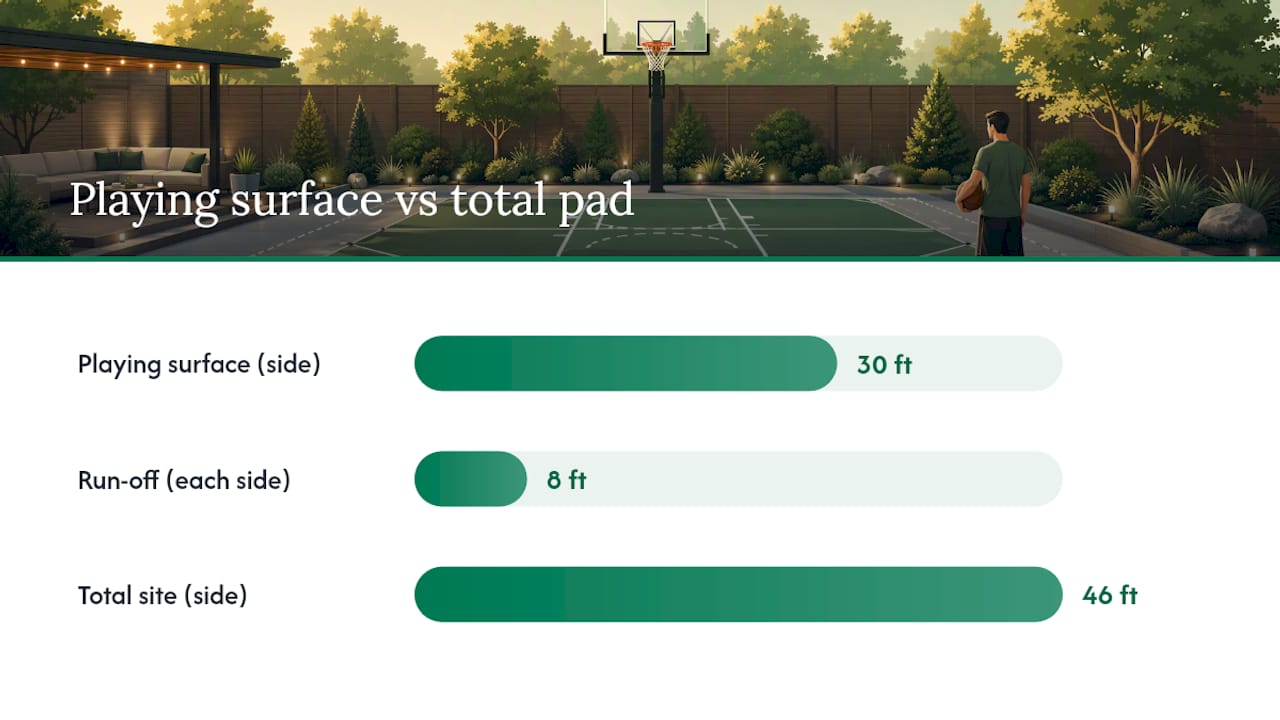
Whatever footprint you land on, add clearance before you commit to it. A 30 by 30 foot playing surface with 8 feet of run-off on each side needs a 46 by 46 foot total site, not 30 by 30. That gap between “playing lines” and “total pad” trips up more first-time builders than any other planning mistake.
What Line Dimensions Do You Need to Mark?
Getting the footprint right doesn’t help much if the lines inside it are wrong. A few numbers matter more than the rest.
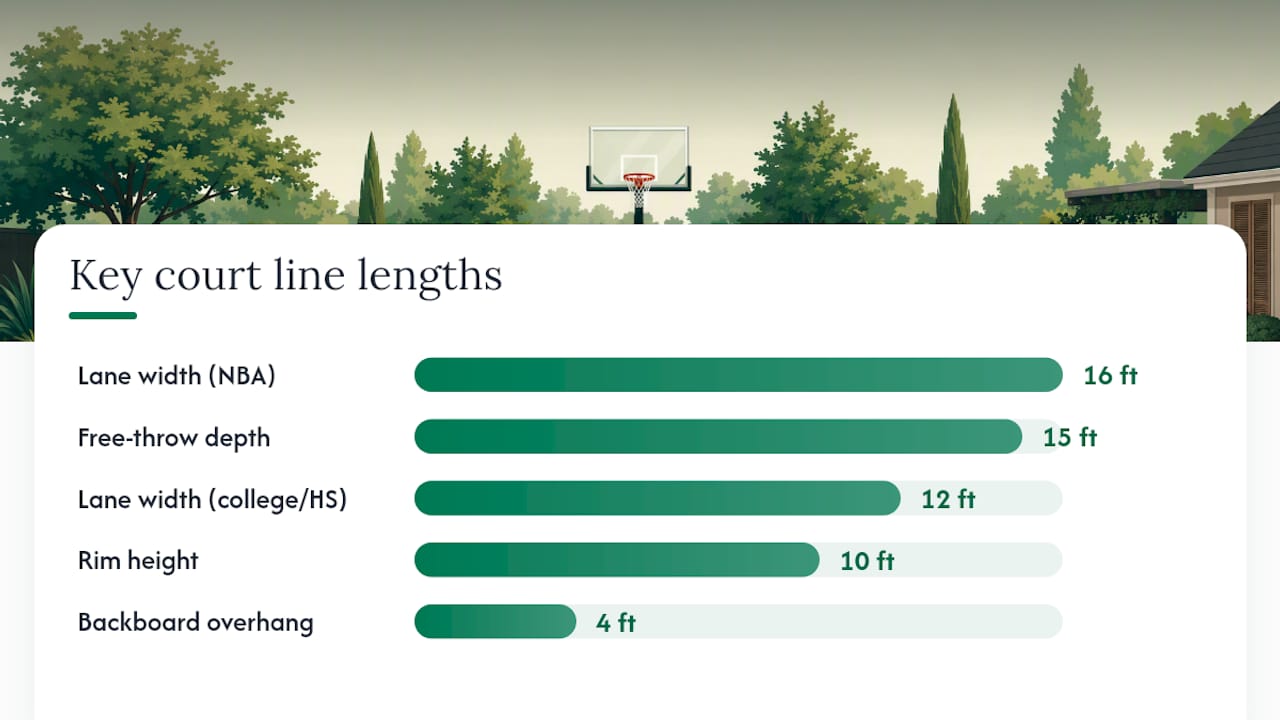
The free-throw lane, often called the paint, is 15 feet deep from the backboard to the free-throw line at every level of play. Width is where things split: the NBA uses a 16-foot-wide lane, while college, high school, and recreational courts all use a narrower 12-foot lane). If you’re building a backyard court and want it to feel like a real game, the 12-foot lane is the more forgiving and more commonly used choice.
Three-point distance is the number most backyard builders end up compromising on. NBA range tops out at 23 feet 9 inches at the top of the arc, tightening to 22 feet in the corners. High school and many recreational setups use a shorter arc, closer to 19 feet 9 inches. A shortened arc isn’t cheating; it’s a practical compromise that still teaches shot selection and spacing, and it’s the right call for most home installations where a full-distance arc simply won’t fit inside the playing surface.
A few more fixed points worth marking:
- Rim height: 10 feet for standard adult and teen play; youth hoops often adjust down to 8 or 9 feet for players still developing their shot
- Backboard overhang: typically 4 feet from the baseline to the face of the backboard
- Restricted area arc: a small semicircle under the basket, mainly relevant if you want full NBA-style markings
- Hash marks: placed along the lane for free-throw lineup spots in a full-rules setup
If space forces a trade-off, keep that 15-foot free-throw depth intact and shrink the three-point arc instead. Shooting mechanics depend on consistent free-throw spacing far more than they depend on regulation three-point range.
Site Planning and Construction Checklist for a Half Court
Once you know your target footprint and line dimensions, the real planning work starts below the surface, literally. This is where a good court and a court that cracks in two years part ways.
Run-off is the first number to lock in. Court sizing guides generally recommend 6 to 10 feet of clear, flat space beyond every boundary line, both for player safety on hard drives to the basket and to reduce installation headaches around obstacles.
Slab thickness depends on footprint and use. A compact 30 by 30 foot recreational pad typically runs 4 inches of concrete over a properly compacted base, while larger footprints intended for regular hard play often move to 5 or 6 inches, especially if a vehicle will ever cross the slab. Pole mounting is its own decision point: embedded sleeve systems let you remove or adjust a hoop system later, while surface-mounted bases are faster to install but harder to reposition once poured.
Pro Tip: Mock up your pole location on a drawing tool before you order concrete. Pole positioning is one of the most common causes of costly rework, since shifting a base after the slab cures usually means breaking and repouring a section of pad.
Before ordering materials, walk the site and check:
- Grade and slope — courts need a slight pitch (roughly 1% to 2%) for drainage, not a flat pour
- Underground utilities — call for a utility locate before any digging near the pad or pole footings
- Existing hardscape — note any patios, walkways, or irrigation lines the new pad might intersect
- Nearby obstacles — fences, trees, and overhead lines can all limit pole placement or clearance
- Drainage path — confirm where runoff water will go once the impervious slab is in place
Once those checkpoints are clear, it’s worth building an actual site plan before calling contractors. A drawn plan with real measurements gets you far more accurate bids than a verbal description, and it’s the fastest way to compare quotes on equal footing.
Turning Your Half Court Plan Into a Contractor-Ready Estimate
Numbers on a page are one thing. Getting accurate contractor bids on those numbers is another, and it’s usually where backyard court projects stall.
A map-based planning tool like the Basketball Court Estimator from Propertyimprovementestimator closes that gap by letting you draw the exact footprint on a satellite image of your own property before anyone shows up with a tape measure. The workflow is straightforward: measure your available yard space, draw the court footprint directly on the map, add your run-off and slab specs, then select surfacing and lighting options to generate a localized estimate.
The tool’s relevant features for a half-court project include:
- Draw-on-map footprint tools that size the court against your actual lot lines
- Slab and surfacing calculators that adjust for thickness and material choice
- Lighting and permitting cost inputs for evening play
- Direct quote submission to local contractors based on your drawn plan
Using a drawn, dimensioned plan instead of a rough description reduces bid variability because contractors are pricing the same scope instead of guessing at it. Grading work, lighting runs, slab thickness, and fencing tend to swing project costs more than any other line item, so nailing those inputs early is worth the extra ten minutes on the map.
What Size Should You Actually Build?
Space almost always makes this decision before preference does, and that’s fine. If your yard gives you 20 feet of usable width, don’t force a 50-foot layout on paper and hope it works out; build the best 20 to 30 foot court you can and protect that free-throw spacing above everything else.
My honest read after digging into the numbers: most backyard builders overvalue the three-point line and undervalue run-off. A shortened arc still teaches shot selection just fine. A court with 4 feet of clearance instead of 8 is where someone eventually rolls an ankle on a hard drive. If you’ve got the room and the budget, go regulation at 47 by 50 feet. If you don’t, a well-built 30 by 30 foot court with proper spacing will get more actual use than an oversized layout crammed against a fence line.
— Christian
Get Your Half Court Sized and Quoted Before You Break Ground
Propertyimprovementestimator gets you a contractor-ready plan without the guesswork of phone-quoted estimates that change once a crew sees your actual yard. Instead of describing your project over the phone and hoping the bid matches what you meant, you draw the real footprint, run-off, and surfacing on a satellite map of your own property first.

The Basketball Court Estimator lets you draw your court, calculate slab and surfacing costs, factor in lighting and permit costs, and get localized estimates based on your actual site conditions. If concrete work extends beyond the court itself, the concrete estimate calculator handles slab thickness and driveway tie-ins separately. Contractors get a full scope packet instead of a verbal description, which means the quote you receive reflects the court you actually plan to build. Start your layout on the estimator and request local contractor quotes once your footprint is set.
Sources
- Ultimate Guide to Basketball Court Dimensions - PROformance Hoops
- Half basketball court: complete beginner guide for 2026 — Sportian Network
- NCAA basketball rules reference