Backyard Basketball Court Layout: Sizes, Lines and Clearances
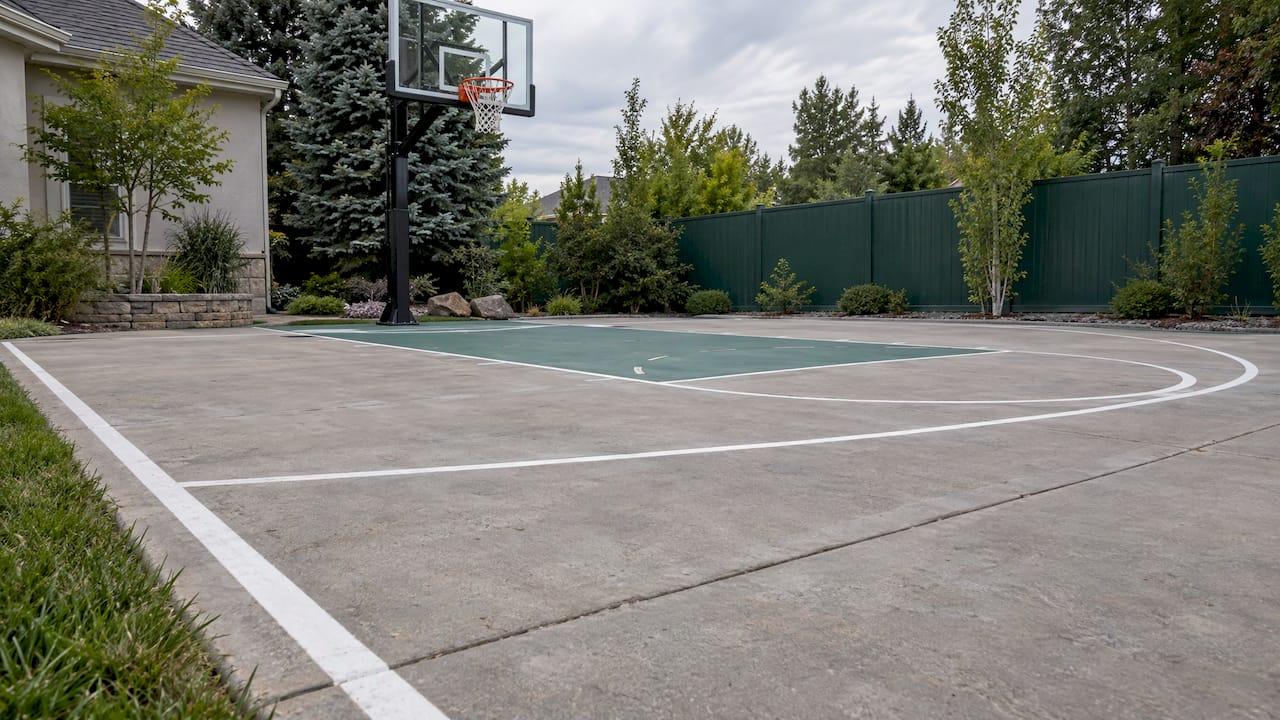
A good backyard basketball court layout starts with the hoop, not the yard. Put the hoop at one end, measure the free-throw line 15 feet out, size the key and arc you actually want, then add run-off space on every side. Most families end up with a half court between 30 x 30 and 35 x 40 feet, plus a buffer. The fastest way to know whether that fits is to draw it to scale on your own property before anyone digs, and that is what we built our basketball court estimator for.
This guide gives you the dimensions, the line-by-line layout, the clearances that people forget, and the site checks that decide where the slab can go.
TL;DR
- A 30 x 30 foot half court is the common backyard size: enough for 3-on-3 and three-point shots, but not a full high school arc.
- A full NBA or college half court is 47 x 50 feet. Full courts are 94 x 50 feet, which almost no yard can hold.
- Add at least 3 feet of clear space around the court, and 10 feet where you can, with the most room behind the baseline.
- Choose the flattest, best-draining spot, plan a slight slope for runoff, and call 811 before any digging.
- Map the court and its buffer on a satellite view of your lot first, so you know the footprint before you ask for quotes.
Table of Contents
- Choose the court size before the lines
- Lay out the court, line by line
- Allow for run-off space, the part people forget
- Check the site before you fix the layout
- Fitting a small or irregular yard
- What the layout does to the price
- Map the court on your own lot
- FAQ
- Sources
Choose the court size before the lines
Every line on the court follows from one decision: how much of a regulation half court you are going to build. Regulation is the starting point, not the requirement. College and NBA courts run 94 feet long by 50 feet wide, and a half court needs 50 feet of width and 47 feet of length. If that is too big, you scale down to the space you have.
These are the sizes homeowners usually plan around. Treat them as planning examples, not standards:
| Court type | Typical size | What it supports |
|---|---|---|
| Shooting pad | 20 x 20 to 20 x 25 ft | Free throws, close shots, one-on-one |
| Compact half court | 30 x 30 ft | Key, free-throw line, trimmed arc, 3-on-3 |
| Recreational half court | 30 x 50 ft or 35 x 40 ft | Full key, wider arc, wing space |
| High school half court | 42 x 50 ft | Regulation high school key and arc |
| NBA/NCAA half court | 47 x 50 ft | Regulation half-court play |
| Full court | 94 x 50 ft | Five-on-five; needs a very large lot |
The ranges above come from court builders’ planning guides, and they agree closely. For a deeper look at each size, see our guide to full, half and backyard basketball court dimensions.
Is 30 x 30 feet big enough?
For most families, yes. A 30 x 30 half court has room for 3-on-3 play and three-point shooting, and it covers shooting practice, free throws and small games. It will not host a full five-on-five game.
The catch is the arc. The high school three-point line sits 19 feet 9 inches from the center of the basket, so on a 30-foot-wide pad only the top of the arc fits. If you want the whole arc, plan on roughly 40 feet of width, which in practice means 30 x 50 feet, or a 42-foot-wide, 37-foot-deep layout that clears the arc with room on both wings.

Lay out the court, line by line
The order matters. Everything is measured from the hoop, so fix the hoop first.
- Set the baseline and hoop position. The baseline is the end line under the basket. In-ground systems usually put the pole at or just outside the baseline, with the backboard overhanging the court by about 4 feet. Pre-sized kits are typically designed around that 4-foot overhang. Decide this before you draw anything, because it moves every other measurement. If you use a height-adjustable system, leave at least 16 inches behind the anchor for the adjustment mechanism.
- Find the centerline. Mark a line running straight out from the center of the backboard. The key, the free-throw line and the top of the arc all center on it.
- Mark the free-throw line. It sits 15 feet from the face of the backboard, not 15 feet from the center of the rim. Mixing those two is the most common layout error.
- Mark the key (lane). The college and high school key is 12 feet wide, while the NBA key is 16 feet wide. Measure 6 feet to each side of the centerline for the 12-foot version. Measured from the baseline, the college and high school key runs 19 feet to the free-throw line, including the 4-foot overhang.
- Mark the three-point line. The high school arc is 19 feet 9 inches from the center of the rim, the college arc is 20 feet 9 inches, and the NBA arc is 23 feet 9 inches at the top, per a published court-dimensions guide. Pick one set of numbers and stay with it. Do not mix NBA and school dimensions on the same court.
- Set the sidelines and half-court line. These follow whatever width and length your yard allows. The rim height is 10 feet at every level.
To keep the key square, hang a plumb line from each corner of the backboard and measure from those points. Use a long tape and stakes with string, and check the diagonals: if both diagonals of the key rectangle match, it is square.
If space is tight, shrink the width first
When the yard cannot hold the full court, protect the free-throw distance. Standing the correct 15 feet from the hoop matters more for how the court feels than having the full 50 feet of width. Trim the sidelines and the arc, not the free-throw line.
Allow for run-off space, the part people forget

A 30 x 30 foot court is a 900 square foot playing area. The yard it needs is bigger. One builder’s guide puts the footprint of a 30 x 30 court at about 36 x 38 feet, or 1,368 square feet, once you add run-off and the space behind the hoop for the footing and the backboard overhang.
For the buffer itself, leave at least 3 feet of unobstructed space around the court, and 10 feet is preferred. Here is how to apply that:
- Baseline: the most important side. Players run through after layups, so give this end the largest buffer. Eight to 10 feet is ideal.
- Sidelines: 3 feet is the casual minimum. Competitive, fast play wants more.
- Behind the three-point line: about 5 feet of shooting room is the minimum for a true half-court feel. One builder calculates that an NBA arc plus that space plus the backboard overhang means a slab roughly 33 feet deep at minimum.
- Hard edges: do not build right up to a brick wall, a fence or a pool. If the court must sit near one, plan a fence or netting on that side.
A worked example: you have a 40 x 45 foot flat area. A 30 x 30 court with a 4-foot overhang and 3 feet of side run-off needs about 36 feet across and 34 to 38 feet deep. It fits, with a few feet to spare for landscaping. Add a larger baseline buffer and you may be down to a trimmed 30 x 28 slab. You only find that out by drawing the buffer, not just the court.
Check the site before you fix the layout
The best-looking layout fails if the ground will not cooperate. Check these in order.
Slope and drainage
Choose the flattest, firmest spot to keep site work down. A court should still shed water: allow a 2% slope so rain runs off the slab. Perfectly level construction can leave standing water, so the slope direction should be planned with the surrounding ground and drainage route in mind. If your best spot is uneven, grading and base work will be a real part of the cost; our guide to the sport court base, slab, gravel, slope and drainage explains what that scope looks like.
Sun direction
Orient the long axis roughly north to south so players are not shooting straight into the low morning or evening sun. Western exposure is the harder one in the afternoon, and a west-facing backyard can mean strong glare late in the day, so put the hoop where the setting sun is at the player’s side rather than in their eyes.
Utilities, trees and setbacks
- Utilities: call 811 before you dig. In the United States, the free 811 service has buried lines marked before excavation, which matters because an in-ground hoop needs a hole 36 to 48 inches deep.
- Trees: keep the court a safe distance from large trees so roots do not lift the slab later.
- Setbacks and easements: property-line setbacks vary by town. One builder’s guide lists typical side setbacks of 5 to 10 feet and rear setbacks of 10 to 25 feet, with front yards often restricted and easements usually barring slabs. Confirm the rules for your lot with your city or county planning office before you finalize the layout.
Fitting a small or irregular yard
If the yard is narrow, sloped or has an odd shape, scale the project to the space instead of forcing a regulation layout with no safety margin. A smaller court works when the hoop has proper overhang, the surface is level and players have room to move naturally.
Options that help in awkward lots:
- A shooting pad of about 20 x 20 or 20 x 25 feet, with the hoop at one end.
- A corner court that uses the diagonal of the yard, with the hoop angled into the corner.
- A rotated layout. Turning the court a few degrees can clear a tree or a drain line without losing the key.
- A trimmed arc. Keep the key and free-throw line correct and let the three-point line run partly off the slab, or skip it.
Try two or three versions on the map before you commit. Moving a line on a screen costs nothing; moving a slab costs thousands.
What the layout does to the price
Size drives cost directly. HomeGuide’s 2023 figures put a 30 x 30 half court at $3,600 to $14,400, including an asphalt or concrete base, a painted surface and one hoop, with installed surface costs of $4 to $16 per square foot. The spread comes from the base, the surface type, the hoop system and your local labor market. Trimming 5 feet off a dimension or skipping a grading job changes the total more than most upgrades do. For a full breakdown, read how much an outdoor basketball court costs.
Map the court on your own lot
Paper dimensions only go so far. The question that matters is whether a 47 x 50 or 30 x 30 court, plus its buffer, fits where you want it, clear of the house, trees, fence line and setback.
On Property Improvement Estimator you draw the court directly on satellite imagery of your property, adjust its size and position, and see a planning estimate based on your dimensions and local cost data. No account is required. When you are ready, you can send the drawing, measurements and photos to contractors as a quote request, so they bid on the same scope. Start with the basketball court calculator or the sport court estimate calculator, and read how to map a 47’ x 50’ half court to your yard.

If you want a local figure for your own lot rather than a national range, our local project report is the next step.
How we approach a backyard court layout
Most layout problems we see in planning start with a drawing that shows the court and nothing else. The court fits on paper, then the buffer runs into a fence, the slab needs more grading than expected, or the arc falls off the edge of the pad.
That is why we put the court, its run-off space and the real property on the same map. When you draw the exact location of the hoop, key and slab on aerial imagery, you see the trade-offs yourself: a few feet of width against a safer baseline, a rotated court against a tree.
It also changes the quote. A contractor who receives dimensions, a drawing, options and photos is pricing your actual project, not guessing at a generic one. Better-matched requests are better for you and for the contractor.
Draw first, then ask for prices.
Christian
FAQ
What is the best size for a backyard basketball court?
For most families it is a 30 x 30 foot half court, which supports shooting drills and 3-on-3 games. If you have the room, 35 x 40 feet gives a fuller key and more wing space, and 47 x 50 feet is the regulation NBA or college half court. Add run-off space around whichever size you pick.
How far is the free-throw line from the hoop?
The free-throw line is 15 feet from the face of the backboard, not from the center of the rim. The key is 12 feet wide for high school and college, and 16 feet wide for the NBA. Rim height is 10 feet at every level.
How much space do I need around the court?
Plan at least 3 feet of clear space around the court and up to 10 feet where you can, with the biggest buffer behind the baseline. A 30 x 30 court usually needs a yard footprint closer to 36 x 38 feet once overhang and run-off are included.
Which direction should the court face?
Orient the long axis roughly north to south so the low morning and evening sun is not directly in the shooter’s eyes. Then check the actual sun path on your lot, since trees and buildings change it.
Sources
- A Guide for How to Build a Backyard Basketball Court, Family Handyman
- Outdoor Basketball Court Costs for Backyard, HomeGuide
- Backyard Basketball Court: Sizes, Hoops, Surfaces and Ideas
- Backyard Basketball Court Guide: Half Court Sizes
- Basketball Half Court Dimensions (Drawings)
- Court Dimensions for Residential to Professional Courts
- 10 Things to Consider Before Building a Backyard Basketball Court
- Half Court Basketball Dimensions (and How to Lay One Out)
- Backyard Basketball Court Sizes and Yard Space Needed
- Backyard Basketball Court Dimensions, Drainage and Setbacks
- How to Plan Backyard Basketball Court Space