Homeowners: Turn Asphalt Sealcoating Cost Into Your Driveway Price
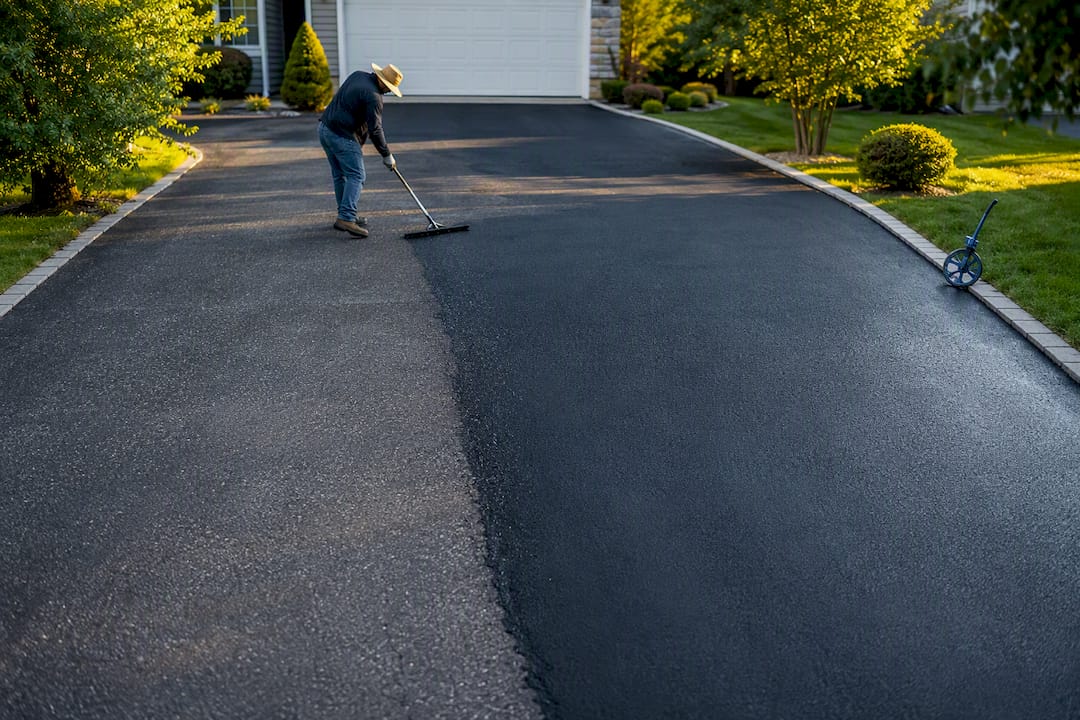
Professional sealcoating runs roughly $0.15 to $0.30 per square foot in 2026, which puts a standard two-car driveway at about $275 to $875 depending on size, condition, and sealer type. DIY material costs land closer to $0.08 to $0.15 per square foot, but only makes sense if your surface is already in good shape. For a number tied to your actual driveway, run the measurements through an asphalt sealcoating calculator before you call a contractor.
TL;DR:
- Professional sealcoating costs typically range from $0.15 to $0.30 per square foot, meaning a two-car driveway can cost between $275 and $875 depending on size and condition.
- Costs increase significantly if crack repair, oil stains, or surface damage are present, and applying multiple coats can raise the price by approximately 40% to 60%.
- Minimum charges and regional labor rates heavily influence the final quote, with small jobs often costing more per square foot than larger projects.
- A detailed, itemized quote should include cleaning, crack filling, priming, coats, and mobilization to avoid hidden costs.
- Using site-specific measurements and local price data can help homeowners obtain more accurate estimates and prevent overspending or subpar work.
Table of Contents
- National Asphalt Sealcoating Cost Ranges and Real Examples
- How Sealcoating Price Per Square Foot Is Actually Calculated
- What Should Be Included in a Sealcoating Quote
- What Drives Your Total Sealcoating Cost Up or Down
- Sealant Types, How Long They Last, and Health Considerations
- DIY vs. Hiring a Professional: What Actually Saves Money
- How to Get an Accurate Sealcoating Estimate
- When to Book Sealcoating for the Best Price and Cure
- How a Site-Specific Estimator Sharpens Your Sealcoating Budget
- The One Thing Most Homeowners Skip When Budgeting for Sealcoating
- Get a Site-Specific Sealcoating Estimate Before You Call a Contractor
- Sources
National Asphalt Sealcoating Cost Ranges and Real Examples
That $275 to $875 national average covers a lot of ground, and the swing usually comes down to three things: driveway size, how much crack repair the surface needs before sealing, and whether the contractor applies one coat or two. A cracked, oil-stained driveway that hasn’t been sealed in eight years will cost more than a clean surface that’s been maintained every two to three years, even if both driveways measure the same square footage.
Here’s how the math plays out at different sizes, using a professional rate of $0.17 to $0.45 per square foot depending on the market and contractor:
- Small pad or single-car apron driveways have a lower sealcoating cost.
- Compact driveways fall in a moderate cost range.
- Typical two-car driveways are priced in a mid-range bracket.
- Larger or complex driveways generally incur higher costs depending on layout and size.
DIY material costs generally remain lower compared to professional services, with material expenses varying by driveway size and preparation requirements, before accounting for the time and equipment rental involved. That’s a real savings on paper, but it only holds up if the surface doesn’t need patching first. A driveway with alligator cracking or a soft, sunken corner isn’t a sealcoating job at all. It’s a repair job that happens to get sealed afterward, and that changes the budget entirely.
Smaller sealcoating jobs frequently have a higher per-square-foot cost due to fixed mobilization and setup charges being distributed over a smaller area. It’s the same reason a 5,000 square foot parking lot can price out lower per square foot than a modest residential driveway, even though the total invoice is much bigger.
How Sealcoating Price Per Square Foot Is Actually Calculated
Sealcoating price per square foot isn’t just “sealer cost divided by area.” A legitimate quote bundles in materials, labor, mobilization, and often crack filling or minor patching, all rolled into one number. That’s why two contractors quoting the same driveway can land $150 apart. One is pricing raw material and a quick spray-down. The other is pricing a full prep and application process that actually lasts.
A few mechanics worth understanding before you accept a bid:
- Minimum charges distort small jobs. Most contractors set a floor, often between $150 and $250, because a truck roll and setup cost the same whether they’re sealing 200 square feet or 800.
- Economies of scale kick in past a certain size. Once a job clears roughly 1,000 to 1,500 square feet, the per-square-foot rate usually drops, since fixed costs like mobilization get spread thinner.
- Extra coats multiply the material line, not the labor line. A second coat typically adds 40% to 60% of the original material cost rather than doubling the whole quote.
Try running the numbers yourself with three sample scenarios:
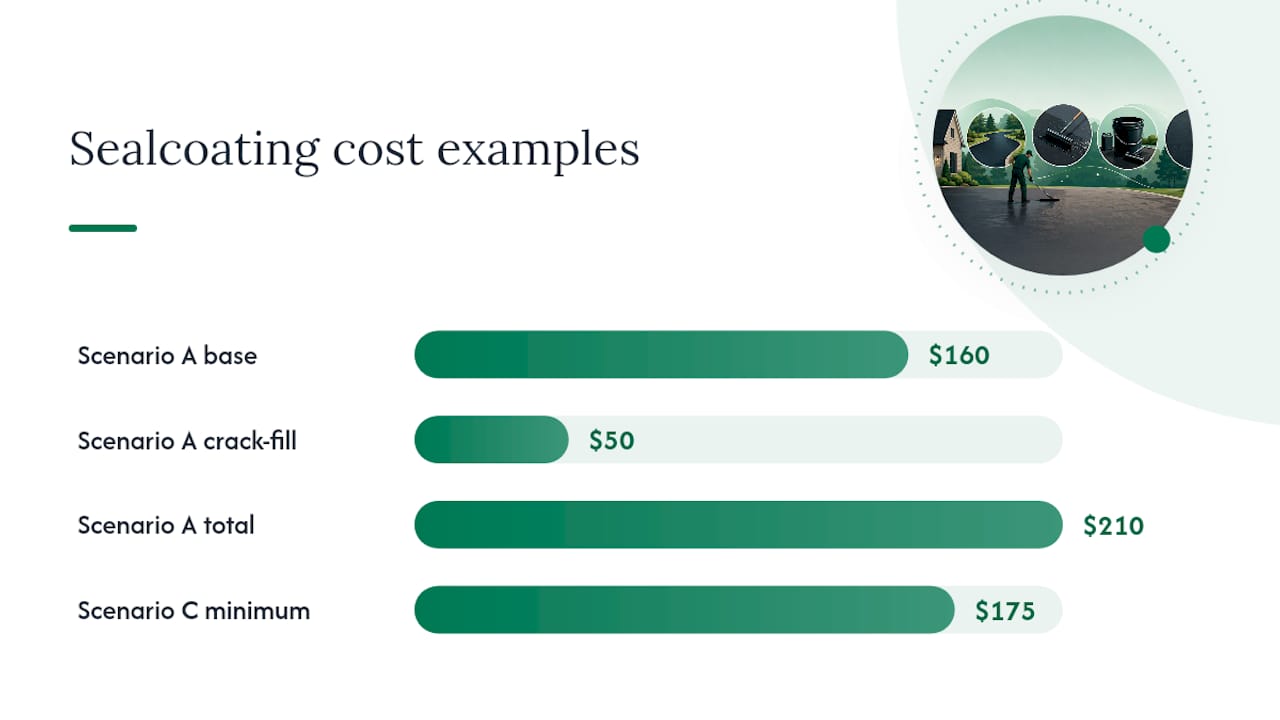
Scenario A: 800 sq ft driveway, single coat, $0.20/sq ft = $160 in base sealcoating, plus a flat $50 crack-fill charge for two moderate cracks = $210 total.
Scenario C: 400 sq ft pad, single coat, quoted at the contractor’s $175 minimum rather than the $0.25/sq ft rate that would technically compute to $100. The minimum wins here, so $175 is the real number.
Pro Tip: Ask every contractor to quote a rate per square foot AND confirm whether a minimum applies to your job size. If they only give you a flat number with no breakdown, ask them to show their math. A contractor who can’t or won’t do this is usually pricing off a gut estimate, not your actual driveway.
What Should Be Included in a Sealcoating Quote
A legitimate quote breaks into five components that together explain most of the price difference between bids: material, labor, equipment or mobilization, crack filling, and cleanup. If a quote skips straight to one number with no line items, you have no way to compare it against a competing bid, and no way to know what you’re actually paying for.
Here’s what a complete, itemized quote should spell out:
- Surface cleaning, including removing debris, oil stains, and vegetation from cracks before anything gets applied.
- Crack filling, priced either per linear foot or as a flat add, typically $0.50 to $3 per linear foot depending on crack width.
- Oil spot priming, a separate step that treats petroleum stains so the sealer actually bonds to them.
- Patch repair for potholes or crumbling edges, priced separately from sealcoating itself.
- Number of coats, since a single coat and a double coat are different jobs at different prices.
- Edge and trim work around garage doors, walkways, and landscaping borders.
- Mobilization or service fee, especially on smaller jobs.
- Warranty or expected lifespan, which tells you what the contractor is standing behind.
Skipping prep is the most common way contractors underprice a job. A quote that comes in noticeably below market rate often means the cleaning step got shortened, oil spots weren’t primed, or the sealer was thinned to stretch coverage. Thorough cleaning and correct priming are what determine how long a sealcoat actually lasts, so a cheap quote that skips them isn’t really cheaper. It’s a job you’ll pay for again in two years instead of four or five.
Add-on costs to expect on top of the base rate: crack filling generally runs $75 to $250 for a typical driveway with light to moderate cracking, pothole patching runs $100 to $300 per repair depending on depth, and oil-spot priming usually adds $50 to $150 to the total.
What Drives Your Total Sealcoating Cost Up or Down
Surface condition is the single biggest cost driver. A driveway with hairline cracks and no oil staining costs far less to prep than one with alligator cracking, standing water damage, or years of oil buildup. Contractors often charge more per square foot on neglected surfaces simply because the prep work eats more labor hours before the sealer ever touches the ground.
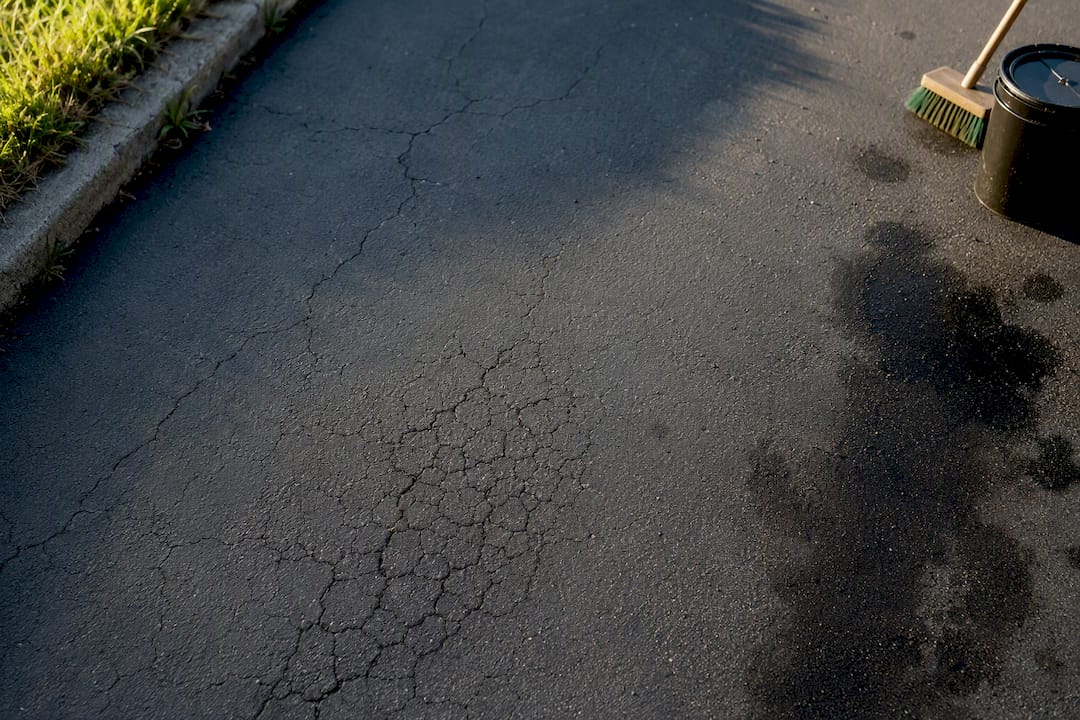
Sealer type and coat count come next. A single coat of standard emulsion sealer is the baseline; a second coat, a polymer-modified sealer, or an eco-formulated product all add cost, sometimes 30% to 60% over the base rate. Access and layout complexity matter too. A flat, open driveway is quick to seal. A driveway with a steep grade, tight turns, landscaping borders to protect, or a shared access point with a neighbor takes longer and costs more in labor.
Regional labor rates shift pricing as much as anything else. Contractors in higher cost-of-living markets typically charge more per hour, and that shows up directly in the per-square-foot rate. You can get a sense of how labor stacks against material costs using an asphalt labor cost calculator, which is useful if you’re trying to figure out whether a quote is padded on labor or padded on material.
Project size and scheduling round out the list:
- Minimum charges apply disproportionately to small jobs, inflating the effective per-square-foot rate.
- Peak season demand (late spring through early fall in most climates) pushes prices up as contractors book solid.
- Off-season or shoulder-season booking can shave 10% to 20% off a quote simply because crews have open calendar slots.
- Rush jobs squeezed into a packed schedule often carry a premium, sometimes 15% or more.
Sealant Types, How Long They Last, and Health Considerations
Asphalt emulsion sealer is the most common residential choice, typically lasting 2 to 3 years and costing the least per square foot. Coal tar sealer historically offered similar or slightly longer durability at a comparable price, but it comes with a real health caveat. Latex and acrylic sealers cost more upfront, often 20% to 40% above emulsion, but tend to hold color and resist UV fading better, stretching lifespan closer to 3 to 4 years. Polymer-modified sealers sit at the premium end, built for higher traffic and often rated for 4 to 5 years between applications.
The health consideration matters more than most cost guides mention. Coal-tar sealants contain polycyclic aromatic hydrocarbons (PAHs) linked to cancer risk, and that risk profile has pushed a number of U.S. jurisdictions to act. The District of Columbia, for instance, bans high-PAH coal-tar pavement sealants outright, and other local governments have passed similar restrictions.
Before you choose a coal-tar product, check whether your city or county restricts it. A ban that applies to your address can turn what looked like the cheapest option into a nonstarter, and you won’t find that out from a contractor’s price sheet.
DIY vs. Hiring a Professional: What Actually Saves Money
DIY sealcoating can genuinely save money on a driveway that’s already in reasonable shape. Material-only costs of $0.08 to $0.15 per square foot mean a 1,000 square foot driveway might run $80 to $150 in supplies, against $170 to $450 for a comparable professional job. The gap looks appealing until you account for what DIY actually demands.
- A rented or purchased squeegee and sprayer setup, plus protective gear and cleanup supplies.
- A full weekend, realistically, once you factor in cleaning, crack filling, drying time between steps, and the sealer’s cure window.
- A real risk of uneven application, puddling, or tracking sealer into the garage or onto grass if you rush it.
- No coverage if the surface turns out to need structural repair once you start, since sealcoating is a surface treatment, not a fix for deep potholes or full-depth failures.
Pro Tip: If your driveway has any pothole deeper than an inch or cracks wider than a quarter inch, get a professional opinion before you buy sealer. Sealing over a structural problem doesn’t fix it. It just hides it until it gets worse and more expensive.
The honest rule of thumb: DIY makes sense for small, well-maintained driveways under about 800 square feet with only hairline cracking. Anything larger, anything with real damage, or anything you plan to sell a house behind soon is worth handing to a pro.
How to Get an Accurate Sealcoating Estimate
- Measure your driveway yourself first, so you have a baseline square footage to check every contractor’s math against.
- Photograph problem areas like cracks, oil stains, and low spots, and note them when you request quotes.
- Ask for a line-item breakdown, not a single flat number, covering cleaning, crack fill, priming, coats, and mobilization separately.
- Confirm the number of coats in writing, since “sealcoating” without a coat count could mean one thin pass or two full ones.
- Verify insurance and ask for two or three local references, especially for larger jobs where a bad application is expensive to redo.
- Watch for quotes far below the going rate, since pricing that undercuts $0.17 to $0.25 per square foot often signals skipped prep or a diluted sealer.
Vague, flat-rate quotes without measured areas or local labor context tend to produce more surprise change orders down the line than quotes built from actual site data. Running your dimensions through an asphalt estimate calculator before contacting anyone gives you a number to negotiate from instead of one to react to.
When to Book Sealcoating for the Best Price and Cure
Sealer needs a dry surface, air temperature above roughly 50°F, and a 24 to 48 hour dry window without rain to cure properly. That narrows the realistic window to late spring through early fall in most climates. Booking in the early season shoulder period, before the rush hits in June and July, often gets you a better rate and a more flexible schedule. Wait until peak summer and you’re competing with every other homeowner on the block for the same crews. If rain pushes your job back, don’t let a contractor rush the reschedule. A sealer applied on a damp surface or right before a storm rolls in usually fails early, and you’ll be paying for a redo.
How a Site-Specific Estimator Sharpens Your Sealcoating Budget
Generic per-square-foot ranges get you in the ballpark. They don’t account for your driveway’s exact shape, your local material costs, or your regional labor rates. Property Improvement Estimator’s asphalt sealcoating calculator lets you draw your actual driveway on a satellite map, factoring in your measured area and local cost data instead of a national average.
That matters because a scoped, measured project reduces the guesswork contractors face when bidding. Instead of eyeballing your driveway from a photo, they get real dimensions and a documented layout. It’s also worth checking an asphalt material cost calculator if you want to see how sealcoating stacks against your driveway’s broader material lifecycle.
The One Thing Most Homeowners Skip When Budgeting for Sealcoating
Most people budgeting for sealcoating focus on finding the lowest price per square foot. That’s backwards. The number that actually protects your wallet is the cost per year of protection, not the cost per job. A $450 job that lasts five years beats a $275 job that fails in eighteen months, every time.
If you take one action from this article, measure your driveway and request three line-item quotes, not three flat numbers. The gap between the cheapest and most thorough bid tells you more about what you’re actually buying than any single price ever will. In my experience reviewing pricing breakdowns, the contractors who itemize crack fill and priming separately are almost always the ones who did the prep work right.
— Christian
Get a Site-Specific Sealcoating Estimate Before You Call a Contractor
An online platform can turn the ranges in this article into a real number for your actual driveway, using measured dimensions and local cost data instead of a national average that might not fit your market.
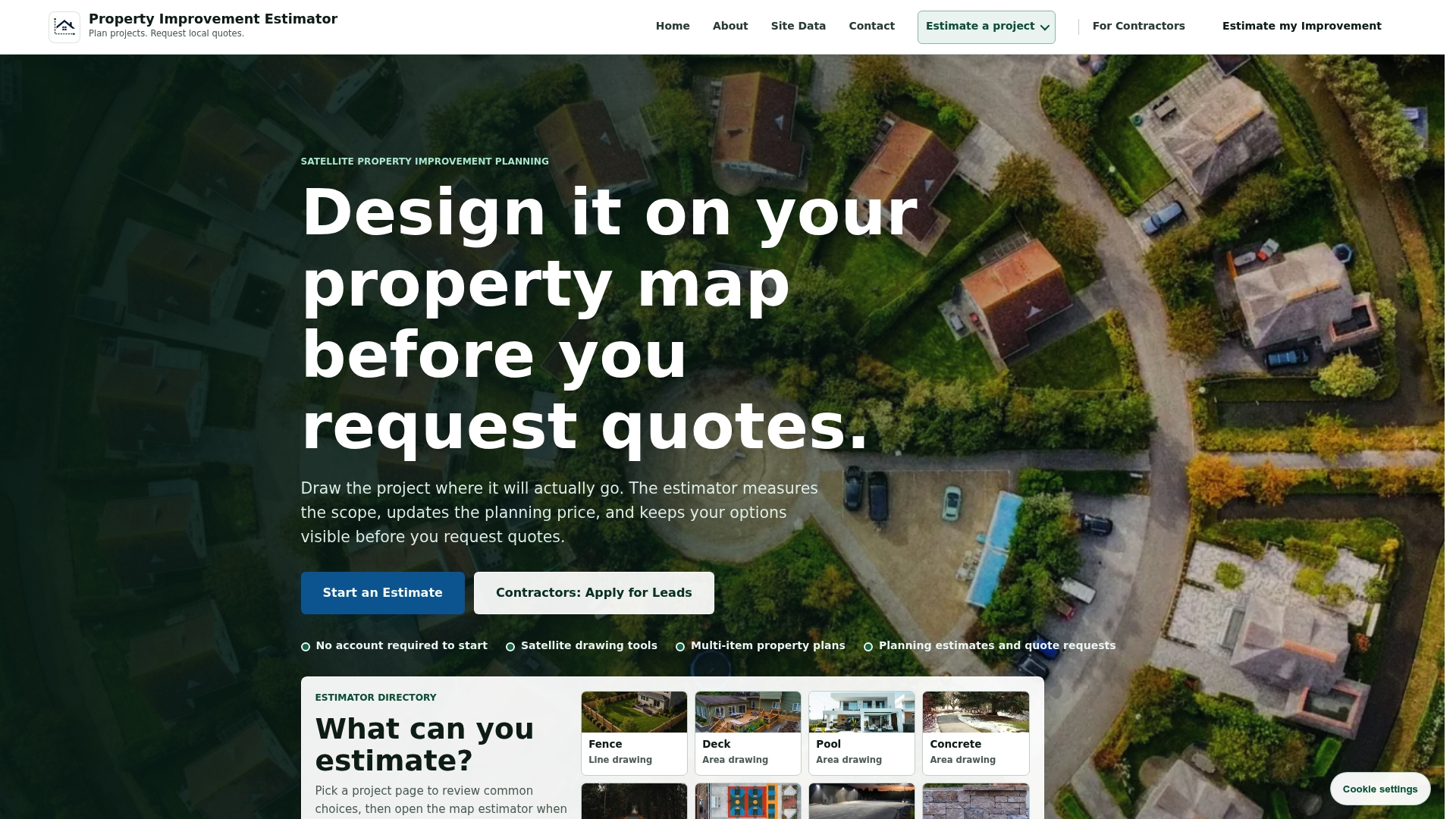
By drawing your driveway on a satellite map and marking cracked or damaged sections, a scoped estimate can be built that accounts for your specific square footage and regional pricing. This scoped project can then be sent to contractors as a detailed packet with measurements and notes attached, enabling bids based on your driveway rather than an estimate from a survey. Fewer surprise change orders, faster responses, and quotes you can actually compare side by side. Start your free sealcoating estimate and see what your driveway actually costs to seal this season.
Sources
- 2026 Asphalt Driveway Sealcoating Cost | Prices & Factors
- Sealcoat Costs: What You Pay to Seal a Driveway in the U.S. 2026 – CurrentCost
- Cancer
- Coal-tar and high PAH pavement sealant ban — DC Department of Energy & Environment