Asphalt Driveway Thickness for Homeowners: 2.5–3 in Over 6 in Base
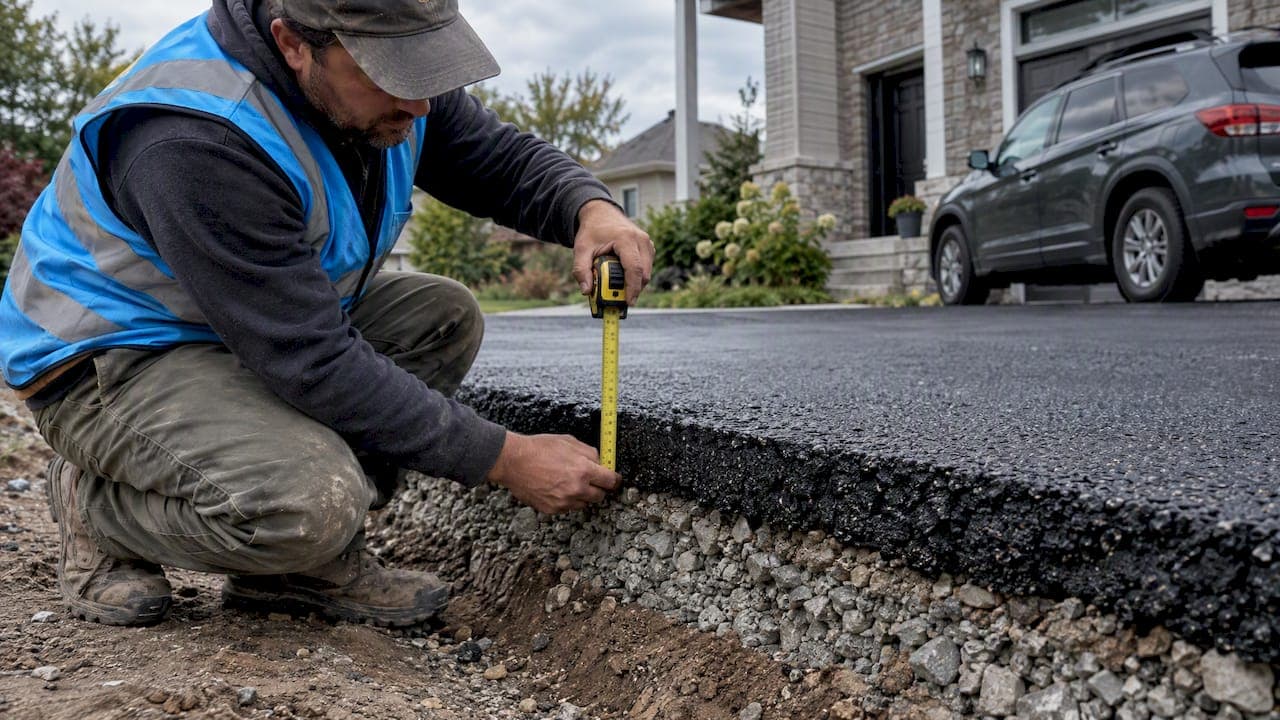
A typical residential driveway needs 2.5 to 3 inches of compacted asphalt over about 6 inches of compacted aggregate base; heavier use, like RVs or frequent truck traffic, calls for 3 to 4 inches of asphalt over an 8 to 10 inch base, or a full-depth design. Commercial drives and parking areas usually need 3 to 4 inches or more of surface course on a properly engineered base. The single biggest factor in how long any of these last isn’t the mat thickness itself: it’s the base and how well it’s compacted.
TL;DR:
- Heavily loaded driveways, such as those used for RVs or frequent trucks, require at least 3 to 4 inches of asphalt over an 8 to 10 inch base for durability.
- Proper base preparation, including proof-rolling and fixing soft spots, is critical to prevent early failure regardless of asphalt thickness.
- A base depth of 6 to 8 inches suffices for light residential use but should be increased to 8 to 10 inches for heavier loads or frequent heavy vehicles.
- Minimum lift thickness should be at least three times the maximum aggregate size to ensure proper compaction and interlocking.
- Accurate material estimation and scope definition are essential; using site-specific tools to draw driveway footprints and specify thickness improves bidding accuracy.
Table of Contents
- Recommended asphalt thickness by vehicle loading and use
- Base and subgrade thickness: the part that matters most
- Lift thickness, compaction rules, and aggregate size
- How to calculate asphalt volume and tons needed
- Signs your driveway needs more thickness or base repair
- What to ask contractors about thickness and construction checks
- Planning your project with site-specific tools
- A conservative approach to thickness decisions
- Turn these numbers into a contractor-ready quote
- FAQ
- Sources
Recommended asphalt thickness by vehicle loading and use
The right thickness depends on what rolls over the driveway, not on a single universal number. For passenger cars, family SUVs, and light trucks, a standard residential driveway commonly uses 2.5 to 3 inches of compacted asphalt over 6 to 8 inches of compacted aggregate base. That range handles daily parking and occasional deliveries without issue.

Heavier residential situations change the math. Driveways that regularly carry RVs, boat trailers, or delivery trucks need more structure because repeated heavy axle loads concentrate stress on a smaller footprint than a typical sedan. For these cases, plan on 3 to 4 inches of compacted asphalt over an 8 to 10 inch base, matching the heavier residential guidance from the Asphalt Institute.
Commercial and parking lot applications raise the stakes further. A 3 to 4 inch surface course alone rarely holds up under repeated commercial traffic unless it sits on a base engineered for that load, with attention to subgrade strength, drainage, and traffic volume. Overlays (adding asphalt over an existing, structurally sound surface) are a different animal from full-depth construction, where asphalt runs all the way to the subgrade; overlays only work when the base beneath is still solid.
- Light residential (cars, SUVs): 2.5 to 3 inches compacted asphalt over 6 to 8 inches base.
- Heavy residential (RVs, trailers, frequent trucks): 3 to 4 inches compacted asphalt over 8 to 10 inches base.
- Commercial or parking areas: 3 to 4+ inches surface course on an engineered base designed for traffic volume.
Full-depth asphalt, where the pavement itself replaces the aggregate base, is worth considering when soil conditions are poor or long-term durability matters more than upfront cost. Full-depth asphalt driveways built to 4 inches may be adequate, but 5 to 6 inches of full-depth asphalt delivers stronger performance across a wider range of climates and loads, and contractors typically place that thickness in two compacted lifts rather than one.
Base and subgrade thickness: the part that matters most
Asphalt is only as good as what’s underneath it. A base that’s too thin, poorly compacted, or sitting on wet soil will cause problems no amount of extra surface thickness can fix.
- Standard base depth: Residential driveways commonly use 6 to 8 inches of compacted aggregate base for light use, moving to 8 to 10 inches when the driveway sees RVs, trailers, or frequent heavy vehicles, per the Asphalt Institute’s residential guidance.
- The 1:3 rule of thumb: A well-compacted base reduces how much asphalt you need. A common field rule holds that 1 inch of asphalt can substitute for roughly 3 inches of aggregate base, which is why contractors sometimes trade base depth for mat thickness depending on site conditions and budget.
- Proof-rolling before paving: Before any asphalt goes down, the compacted base should be proof-rolled, meaning a loaded tandem-axle truck or heavy roller drives over the surface so the crew can watch for deflection, pumping, or soft spots, a standard step in base preparation for new asphalt pavements.
- Fixing soft spots: Locations that flex or pump under the proof-roller need correction before paving, whether that’s undercutting and replacing the material, adding a geotextile fabric layer, or chemically stabilizing the soil; skipping this step is one of the most common causes of early driveway failure.
- Drainage and edge support: Water trapped under or beside the pavement weakens the base over time, so grading the subgrade to shed water and providing edge support (shoulders, curbing, or compacted fill) protects the investment in both base and surface.
A driveway with a strong, well-drained 8 inch base and a 2.5 inch mat will often outlast one with a thin, poorly compacted base and a 4 inch mat. Thickness numbers matter, but only on top of a base that was built correctly.
Lift thickness, compaction rules, and aggregate size

Paving crews don’t just pour asphalt to a target depth and walk away: how thick each layer (or “lift”) is placed affects how well it compacts, and that depends on the size of the aggregate in the mix.
The general rule is that minimum compacted lift thickness should be at least three times the nominal maximum aggregate size (NMAS), since thinner lifts don’t give the larger stones room to settle and interlock during rolling. Design catalogs commonly adopt a minimum compacted lift of 2.5 inches and a lift-to-NMAS ratio of about 3.0 to support proper compaction. In practice, a mix with a half-inch NMAS needs a compacted lift of roughly 1.5 to 2 inches.
- Loose asphalt compacts down as rollers pass over it, and dense-graded mixes commonly see about 25% rolldown between loose and compacted thickness, so a contractor spreading material has to account for that shrinkage to hit the specified final depth.
- Static steel-wheeled rollers typically limit compacted lifts to about 3 inches, while pneumatic or vibratory rollers can handle thicker single lifts depending on project practice.
- Lifts placed too thin tear or shove under the roller instead of compacting cleanly, leaving low density and early cracking or raveling.
Pro Tip: When a contractor’s quote lists a “3-inch mat,” ask whether that’s one lift or two, since a single 3-inch lift pushes the upper limit for standard static rollers and may compact unevenly.
How to calculate asphalt volume and tons needed
Estimating material quantity is straightforward once you have the footprint and target compacted thickness. The math runs in three steps.
First, convert thickness from inches to feet by dividing by 12, then multiply by the driveway’s square footage to get cubic feet. Second, multiply cubic feet by the asphalt’s in-place unit weight to get pounds, then divide by 2,000 to convert to tons. For planning purposes, use an in-place unit weight of about 148 pounds per cubic foot, which sits within the typical 142 to 148 PCF range for compacted asphalt.
Here’s a worked example for a 20 by 20 foot driveway at 3 inches compacted:
| Step | Calculation | Result |
|---|---|---|
| Area | 20 ft × 20 ft | 20 feet by 20 feet |
| Thickness in feet | 3 in ÷ 12 | 0.25 feet |
| Volume | 400 sq ft × 0.25 ft | 100 cubic feet |
| Weight | 100 cu ft × 148 PCF | 14,800 pounds |
| Tons | 14,800 pounds divided by 2,000 | 7.4 tons |
That 7.4-ton figure follows directly from Asphalt Institute planning guidance on unit weight and gives you a number to compare against a contractor’s tonnage estimate.
- Always build in a 5 to 10% ordering margin for waste, rolldown, and joint overlap.
- Running your own numbers through an asphalt cost calculator before getting quotes helps you spot a tonnage estimate that looks too low for the area and thickness you specified.
Signs your driveway needs more thickness or base repair
Some failures are cosmetic; others point to a structural problem that a sealcoat won’t fix. Knowing the difference saves money.
- Alligator cracking, a web of interconnected cracks resembling reptile skin, signals structural failure from an undersized mat, weak subgrade, or both, and commonly traces back to insufficient pavement thickness or poor compaction.
- Rutting, visible depressions along wheel paths, points to inadequate thickness, incomplete compaction, or a base that’s deforming under repeated load.
- Edge failures and potholes often start at the pavement’s unsupported border and work inward; patching addresses the surface, but recurring edge failure usually means the shoulder or base support needs rebuilding.
- Reflective cracking, where cracks from an old surface reappear through a new overlay, shows the underlying problem was never actually fixed, just covered.
Patching makes sense for isolated, surface-level damage. When alligator cracking or rutting covers a large section, the only durable fix is undercutting the area and rebuilding the base and mat to the recommended thickness, since an overlay on a structurally failed section just delays the same failure.
What to ask contractors about thickness and construction checks
Getting the thickness you want starts with specifying it precisely in writing, not assuming the contractor’s standard job matches your needs.
- Specify compacted thickness and lift structure explicitly, for example: “3 inches compacted asphalt in two lifts: 1.5 inches plus 1.5 inches after compaction,” so there’s no ambiguity about loose versus compacted depth.
- Require proof-rolling with written acceptance criteria, including what happens if soft spots turn up (undercut, stabilize, or add geotextile) before paving begins.
- Ask about mix design and equipment: the mix’s NMAS, which roller type will compact it, the rolldown factor assumed, and how the crew will verify compacted thickness, whether by core sample or nuclear density gauge.
- Include a correction clause for any area that comes in thinner than specified, and ask for photos or measurement reports before releasing final payment.
Pro Tip: A one-page written spec with these four points attached to your quote request does more to prevent disputes than any verbal assurance from a sales rep.
Planning your project with site-specific tools
Converting these thickness targets into material tons and real cost ranges, specific to your driveway’s dimensions, is where guidance meets your actual project. Drawing your driveway’s exact footprint on a map and entering a target compacted thickness through our Asphalt Estimator generates tonnage and locally adjusted cost ranges instead of generic per-square-foot averages.
Site-specific measurements matter because a quote based on your driveway’s real shape, access, and local material costs gives contractors a scope they can bid accurately, rather than guessing at dimensions from a phone call. Tools include asphalt estimate calculators, overlay and sealcoating calculators, and a map handoff that passes your drawn footprint directly to contractors requesting your quote.
A conservative approach to thickness decisions
If I had to boil this down to one habit: spend your attention on base preparation and proof-rolling before you obsess over whether the mat should be 3 inches or 3.5. A strong, well-drained base with a modest mat consistently outperforms a thick mat over a weak one. For RVs, trailers, or anything with frequent heavy axle loads, I’d round up to the higher end of the heavy-residential range rather than the lower end. It costs less now than a rebuild later.
— Christian
Turn these numbers into a contractor-ready quote
Knowing the right thickness range is only half the job. Translating it into tons, local costs, and a scope contractors can actually bid on is where most homeowners get stuck with vague, inconsistent quotes. A map-based planning tool helps close that gap: draw your driveway footprint on satellite imagery, choose your target compacted thickness, and get tonnage and locally adjusted cost ranges in return, no account required.

That same drawn footprint and thickness spec becomes the scope package contractors see when you request quotes, which means they’re bidding on your actual driveway instead of a rough phone estimate.
- Draw your driveway footprint and get a tonnage and cost range from our Asphalt Estimator.
- Generate a contractor-ready local project report to attach to your quote requests.
Start your plan today using our asphalt estimate calculator and see your material and cost numbers before you call a single contractor.
FAQ
How much does it cost per square foot to install a 20x20 asphalt driveway?
Cost per square foot varies by region, base condition, and thickness specified, so there’s no single national figure to quote reliably. Running your driveway’s exact dimensions and target thickness through an asphalt material cost calculator gives you a locally adjusted range instead of a generic average.
What do you put down before asphalt?
Before asphalt goes down, crews prepare and compact an aggregate base, commonly 6 to 8 inches for residential driveways, per Asphalt Institute guidance, and proof-roll it to catch soft spots. Any weak areas found during proof-rolling get corrected, through undercutting, geotextile fabric, or stabilization, before paving begins.
Is 3.5 inches thick enough for a driveway?
For light residential use like cars and SUVs, 3.5 inches of compacted asphalt exceeds the typical 2.5 to 3 inch recommendation and is more than adequate over a properly compacted base. For RVs, trailers, or frequent heavy vehicles, 3.5 inches sits within the recommended 3 to 4 inch heavy-residential range, provided the base underneath is 8 to 10 inches and well compacted.
What is the unit weight of asphalt?
Compacted asphalt typically weighs 142 to 148 pounds per cubic foot (PCF) in place, with 148 PCF commonly used for planning calculations. That figure is what converts a driveway’s volume in cubic feet into the tons of material a paving crew needs to order.
Sources
- Engineering Frequently Asked Questions | Asphalt Institute Technical Questions
- Flexible pavement design catalog for non-state DOT roadways (NAPA) - SR-231 (03-2025)
- Driveways — Illinois Asphalt Pavement Association
- Layer thickness and placement guidance — Asphalt Pavement Handbook (section 7.5)
Recommended
- Asphalt Material Cost Calculator | Asphalt Depth, Base, Overlay, Sealcoating, and Local Factors
- Asphalt Labor Cost Calculator | Paving, Base Prep, Overlay, Sealcoating, Access, and Local Wages
- Asphalt Permit Cost Calculator | Driveways, Parking, Drainage, Right-of-Way, and Local Review
- Asphalt Sealcoating Calculator | Surface Coating Cost and Local Factors